
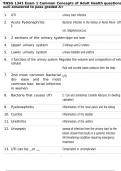
RNSG 1341 Exam 1 Common Concepts of Adult Health questions
well answered to pass graded A+
1. UTI urinary tract infection
2. Acute Pyelonephritis Bacterial infection in the Kidney or Renal Pelvis- (UTI
E.
coli, Staphylococcus.
3. 2 sections of the urinary system Upper and lower
4. Upper urinary system 2 kidneys and 2 ureters
5. Lower urinary system urinary bladder and urethra
6. 2 functions of the urinary system Regulate the volume and composition of extr
cellular
fluid and excrete waste products form the body
7. 2nd most common bacterial UTI
dis- ease and the most
common bac- terial infection
in women
8. Bacteria that causes UTI E. Coli and sometimes Candida Albicans (in dwelling
catheter)
9. Pyelonephritis inflammation of the renal pelvis and the kidney
10. Cystitis inflammation of the bladder
11. Urethritis inflammation of the urethra
12. Urosepsis spread of infection from the urinary tract to the
blood- stream that results in a systemic infection-
life threatening condition requiring emergency
treatment
13. UTI can be or Complicated or uncomplicated
1/
93
,RNSG 1341 Exam 1 Common Concepts of Adult Health questions
well answered to pass graded A+
14. Complicated UTI
2/
93
,RNSG 1341 Exam 1 Common Concepts of Adult Health questions
well answered to pass graded A+
present when underlying factors such as catheterization
or obstruction predispose to ascending bacterial
infec- tion
15. Uncomplicated UTI Occurs in otherwise normal urinary
tract Usually involves only the
bladder
16. UTI etiology and Urethra is normally sterile
pathophysiolo- gy Many bacteria originate from the perineum
Most infections are gram negative from the GI
tract Commonly attected by ascending
instrumentation (ie catheter)
Sexual issues without cleaning (more common in
women)
17. UTI natural defenses Normal voiding, complete bladder emptying, ureter
com-
petence, urethras plasticity, acidic pH, high urea conce
tration, glycoproteins that interfere with bacterial
growth.
18. Most common HAI UTI
19. UTI clinical manifestations Painful urination, abdominal pain, back pain, fever, se
sis, dysuria high frequency urinating, urgency,
suprapu- bic discomfort/pressure, blood in urine,
cloudy urine, fatigue or anorexia, Older adults-
cognitive impairment
20. UTI diagnostic studies 1. dipstick urinalysis to identify presence of *nitrites
(in-
dicating bacteriuria), WBCS, & leukocyte esterase*
(indi- cating pyuria)
3/
93
, RNSG 1341 Exam 1 Common Concepts of Adult Health questions
well answered to pass graded A+
2.urine culture indicated in complicated or HAI
UTIs, persistent bacteriuria, or frequently recurring
UTIs with clean catch technique
4/
93
well answered to pass graded A+
1. UTI urinary tract infection
2. Acute Pyelonephritis Bacterial infection in the Kidney or Renal Pelvis- (UTI
E.
coli, Staphylococcus.
3. 2 sections of the urinary system Upper and lower
4. Upper urinary system 2 kidneys and 2 ureters
5. Lower urinary system urinary bladder and urethra
6. 2 functions of the urinary system Regulate the volume and composition of extr
cellular
fluid and excrete waste products form the body
7. 2nd most common bacterial UTI
dis- ease and the most
common bac- terial infection
in women
8. Bacteria that causes UTI E. Coli and sometimes Candida Albicans (in dwelling
catheter)
9. Pyelonephritis inflammation of the renal pelvis and the kidney
10. Cystitis inflammation of the bladder
11. Urethritis inflammation of the urethra
12. Urosepsis spread of infection from the urinary tract to the
blood- stream that results in a systemic infection-
life threatening condition requiring emergency
treatment
13. UTI can be or Complicated or uncomplicated
1/
93
,RNSG 1341 Exam 1 Common Concepts of Adult Health questions
well answered to pass graded A+
14. Complicated UTI
2/
93
,RNSG 1341 Exam 1 Common Concepts of Adult Health questions
well answered to pass graded A+
present when underlying factors such as catheterization
or obstruction predispose to ascending bacterial
infec- tion
15. Uncomplicated UTI Occurs in otherwise normal urinary
tract Usually involves only the
bladder
16. UTI etiology and Urethra is normally sterile
pathophysiolo- gy Many bacteria originate from the perineum
Most infections are gram negative from the GI
tract Commonly attected by ascending
instrumentation (ie catheter)
Sexual issues without cleaning (more common in
women)
17. UTI natural defenses Normal voiding, complete bladder emptying, ureter
com-
petence, urethras plasticity, acidic pH, high urea conce
tration, glycoproteins that interfere with bacterial
growth.
18. Most common HAI UTI
19. UTI clinical manifestations Painful urination, abdominal pain, back pain, fever, se
sis, dysuria high frequency urinating, urgency,
suprapu- bic discomfort/pressure, blood in urine,
cloudy urine, fatigue or anorexia, Older adults-
cognitive impairment
20. UTI diagnostic studies 1. dipstick urinalysis to identify presence of *nitrites
(in-
dicating bacteriuria), WBCS, & leukocyte esterase*
(indi- cating pyuria)
3/
93
, RNSG 1341 Exam 1 Common Concepts of Adult Health questions
well answered to pass graded A+
2.urine culture indicated in complicated or HAI
UTIs, persistent bacteriuria, or frequently recurring
UTIs with clean catch technique
4/
93


