

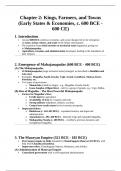
Chapter 2: Kings, Farmers, and Towns
(Early States & Economies, c. 600 BCE -
600 CE)
1. Introduction
Around 600 BCE, political, economic, and social changes led to the emergence
of states, urban centers, and trade in the Indian subcontinent.
The transition from tribal societies to territorial states happened, giving rise
to Mahajanapadas.
Agriculture, taxation, and administration developed, leading to the foundation of
later empires.
2. Emergence of Mahajanapadas (600 BCE - 400 BCE)
(A) The Mahajanapadas
16 Mahajanapadas (large territorial states) emerged, as described in Buddhist and
Jain texts.
Examples: Magadha, Kashi, Kosala, Vajji, Avanti, Gandhara, Matsya, Kuru,
Panchala, etc.
Two types of governance:
o Monarchies (ruled by kings) – e.g., Magadha, Kosala, Kashi.
o Gana-Sanghas (Oligarchies) – rule by a group of people, e.g., Vajji, Mallas.
(B) Rise of Magadha – The Most Powerful Mahajanapada
Factors for Magadha’s Rise:
o Fertile land for agriculture.
o Availability of iron for weapons and tools.
o Strong military (elephants, infantry, cavalry).
o Control over trade routes led to economic prosperity.
Important Rulers:
o Bimbisara (c. 544–492 BCE) – expanded territory and improved
administration.
o Ajatashatru (c. 492–460 BCE) – defeated Vajji and expanded Magadha.
o Mahapadma Nanda (c. 400 BCE) – overthrew previous dynasties and
strengthened Magadha.
3. The Mauryan Empire (321 BCE - 185 BCE)
First largest empire in India founded by Chandragupta Maurya (321 BCE), with
help from Chanakya (Kautilya).
Important rulers: Chandragupta Maurya, Bindusara, and Ashoka.
(A) Administration of Mauryan Empire
Centralized government with a well-organized administration.
(Early States & Economies, c. 600 BCE -
600 CE)
1. Introduction
Around 600 BCE, political, economic, and social changes led to the emergence
of states, urban centers, and trade in the Indian subcontinent.
The transition from tribal societies to territorial states happened, giving rise
to Mahajanapadas.
Agriculture, taxation, and administration developed, leading to the foundation of
later empires.
2. Emergence of Mahajanapadas (600 BCE - 400 BCE)
(A) The Mahajanapadas
16 Mahajanapadas (large territorial states) emerged, as described in Buddhist and
Jain texts.
Examples: Magadha, Kashi, Kosala, Vajji, Avanti, Gandhara, Matsya, Kuru,
Panchala, etc.
Two types of governance:
o Monarchies (ruled by kings) – e.g., Magadha, Kosala, Kashi.
o Gana-Sanghas (Oligarchies) – rule by a group of people, e.g., Vajji, Mallas.
(B) Rise of Magadha – The Most Powerful Mahajanapada
Factors for Magadha’s Rise:
o Fertile land for agriculture.
o Availability of iron for weapons and tools.
o Strong military (elephants, infantry, cavalry).
o Control over trade routes led to economic prosperity.
Important Rulers:
o Bimbisara (c. 544–492 BCE) – expanded territory and improved
administration.
o Ajatashatru (c. 492–460 BCE) – defeated Vajji and expanded Magadha.
o Mahapadma Nanda (c. 400 BCE) – overthrew previous dynasties and
strengthened Magadha.
3. The Mauryan Empire (321 BCE - 185 BCE)
First largest empire in India founded by Chandragupta Maurya (321 BCE), with
help from Chanakya (Kautilya).
Important rulers: Chandragupta Maurya, Bindusara, and Ashoka.
(A) Administration of Mauryan Empire
Centralized government with a well-organized administration.


