MDC II Exam I (:
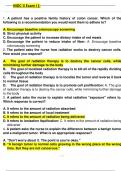
1. A patient has a positive family history of colon cancer. Which of the
following is a recommendation you would want them to adhere to?
A. Encourage baseline colonoscopy screening
B. Strict physical activity
C. Encourage the patient to increase dietary intake of red meats
D. Encourage the patient to reduce intake of fiber: A. Encourage baseline
colonoscopy screening
2. The patient asks the nurse how radiation works to destroy cancer cells.
How would you respond?
A. The goal of radiation therapy is to destroy the cancer cells, while
minimizing further damage to the body
B. The goal of localized radiation therapy is to kill all of the rapidly dividing
cells throughout the body
C. The goal of radiation therapy is to localize the tumor and reverse it back
to normal tissue
D. The goal of radiation therapy is to promote cell proliferation: A. The goal
of radiation therapy is to destroy the cancer cells, while minimizing further damage
to the body
3. A patient asks the nurse to explain what radiation "exposure" refers to.
Which response is correct?
A. It refers to the amount of radiation absorbed
B. It refers to the amount of local treatment
C. It refers to the amount of radiation being delivered
D. It refers to ionization liquification: C. It refers to the amount of radiation being
delivered
4. A patient asks the nurse to explain the difference between a benign tumor
and a malignant tumor. What is an appropriate response?
A. "Don't worry about it. The point is you're okay."
B. "A benign tumor is normal cells growing in the wrong place at the wrong
time. But they are not cancerous."
, MDC II Exam I (:
C. "A benign tumor will kill you, whereas a malignant tumor cannot."
D. "A benign tumor has not undergone apoptosis, whereas a malignant tumor
has.": B. "A benign tumor is normal cells growing in the wrong place at the wrong
time. But they are not cancerous."
5. A patient is undergoing chemotherapy and is receiving education about the
reduction of infection risk. Which action reduces the risk of
infection?
A. Live vaccine
B. Hand hygiene
C. Weight bearing exercises
D. Monitor for bruising: B. Hand hygiene
6. A patient would like to know what it means that her breast cancer has
metastasized.
A. irreversible damage has caused tumor growth
B. a tumor has sent chemical signals to develop its own vasculature
C. cancer cells have moved from their primary site
D. repeated exposure lead to mutation: C. Cancer cells have moved from their
primary site
7. The patient who has undergone which procedure is at most
risk for hypocalcemia?
A. Thyroidectomy
B. Adrenalectomy
C. Pancreactectomy
D. Gastectomy: A. Thyroidectomy
8. What serum laboratory value does the nurse expect to see with a patient
who is hypokalemic?
A. Calcium less than 8.0 mEq/L
B. Potassium less than 5.0 mEq/L
C. Calcium less than 11.0 mEq/L
D. Potassium less than 3.5 mEq/L: D. Potassium less than 3.5 mEq/L
1. A patient has a positive family history of colon cancer. Which of the
following is a recommendation you would want them to adhere to?
A. Encourage baseline colonoscopy screening
B. Strict physical activity
C. Encourage the patient to increase dietary intake of red meats
D. Encourage the patient to reduce intake of fiber: A. Encourage baseline
colonoscopy screening
2. The patient asks the nurse how radiation works to destroy cancer cells.
How would you respond?
A. The goal of radiation therapy is to destroy the cancer cells, while
minimizing further damage to the body
B. The goal of localized radiation therapy is to kill all of the rapidly dividing
cells throughout the body
C. The goal of radiation therapy is to localize the tumor and reverse it back
to normal tissue
D. The goal of radiation therapy is to promote cell proliferation: A. The goal
of radiation therapy is to destroy the cancer cells, while minimizing further damage
to the body
3. A patient asks the nurse to explain what radiation "exposure" refers to.
Which response is correct?
A. It refers to the amount of radiation absorbed
B. It refers to the amount of local treatment
C. It refers to the amount of radiation being delivered
D. It refers to ionization liquification: C. It refers to the amount of radiation being
delivered
4. A patient asks the nurse to explain the difference between a benign tumor
and a malignant tumor. What is an appropriate response?
A. "Don't worry about it. The point is you're okay."
B. "A benign tumor is normal cells growing in the wrong place at the wrong
time. But they are not cancerous."
, MDC II Exam I (:
C. "A benign tumor will kill you, whereas a malignant tumor cannot."
D. "A benign tumor has not undergone apoptosis, whereas a malignant tumor
has.": B. "A benign tumor is normal cells growing in the wrong place at the wrong
time. But they are not cancerous."
5. A patient is undergoing chemotherapy and is receiving education about the
reduction of infection risk. Which action reduces the risk of
infection?
A. Live vaccine
B. Hand hygiene
C. Weight bearing exercises
D. Monitor for bruising: B. Hand hygiene
6. A patient would like to know what it means that her breast cancer has
metastasized.
A. irreversible damage has caused tumor growth
B. a tumor has sent chemical signals to develop its own vasculature
C. cancer cells have moved from their primary site
D. repeated exposure lead to mutation: C. Cancer cells have moved from their
primary site
7. The patient who has undergone which procedure is at most
risk for hypocalcemia?
A. Thyroidectomy
B. Adrenalectomy
C. Pancreactectomy
D. Gastectomy: A. Thyroidectomy
8. What serum laboratory value does the nurse expect to see with a patient
who is hypokalemic?
A. Calcium less than 8.0 mEq/L
B. Potassium less than 5.0 mEq/L
C. Calcium less than 11.0 mEq/L
D. Potassium less than 3.5 mEq/L: D. Potassium less than 3.5 mEq/L