
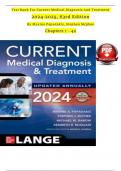
Test Bank For Current Medical Diagnosis And Treatment
2024-2025, 63rd Edition
By Maxine Papadakis, Stephen Mcphee
Chapters 1 - 42
,Chapter 1. Disease Prevention & Health Promotion
1. Which of the following behaviors indicates the highest potential for spreading infections
among clients? The nurse:
1) disinfects dirty hands with antibacterial soap.
2) allows alcohol-based rub to dry for 10 seconds.
3) washes hands only after leaving each room.
4) uses cold water for medical asepsis.
2. What is the most frequent cause of the spread of infection among institutionalized
patients?
1) Airborne microbes from other patients
2) Contact with contaminated equipment
3) Hands of healthcare workers
4) Exposure from family members
3. Which of the following nursing activities is of highest priority for maintaining medical
asepsis?
1) Washing hands
2) Donning gloves
3) Applying sterile drapes
4) Wearing a gown
4. A patient infected with a virus but who does not have any outward sign of the disease is
considered a:
1) pathogen.
2) fomite.
3) vector.
4) carrier.
5. A patient is admitted to the hospital with tuberculosis. Which precautions must the nurse
institute when caring for this patient?
1) Droplet transmission
2) Airborne transmission
3) Direct contact
4) Indirect contact
, 6. A patient becomes infected with oral candidiasis (thrush) while receiving intravenous
antibiotics to treat a systemic infection. Which type of infection has the patient developed?
1) Endogenous nosocomial
2) Exogenous nosocomial
3) Latent
4) Primary
7.The nurse assists a surgeon with central venous catheter insertion. Which action is
necessary to help maintain sterile technique?
1) Closing the patients door to limit room traffic while preparing the sterile field
2) Using clean procedure gloves to handle sterile equipment
3) Placing the nonsterile syringes containing flush solution on the sterile field
4) Remaining 6 inches away from the sterile field during the procedure
8.A patient admitted to the hospital with pneumonia has been receiving antibiotics for 2
days. His condition has stabilized, and his temperature has returned to normal. Which stage of
infection is the patient most likely experiencing?
1) Incubation
2) Prodromal
3) Decline
4) Convalescence
5) 8.
9. A patient develops localized heat and erythema over an area on the lower leg. These
findings are indicative of which secondary defense against infection?
1) Phagocytosis
2) Complement cascade
3) Inflammation
4) Immunity
10. The patient suddenly develops hives, shortness of breath, and wheezing after receiving
an antibiotic. Which antibody is primarily responsible for this patients response?
1) IgA
2) IgE
3) IgG
4) IgM
11. What type of immunity is provided by intravenous (IV) administration of
immunoglobulin G?
1) Cell-mediated
2) Passive
3) Humoral
4) Active
, 12. A epatient easks ethe enurse ewhy ethere eis eno evaccine eavailable efor ethe ecommon ecold.
eWhich eresponse eby ethe enurse eis ecorrect?
1) The evirus emutates etoo erapidly eto edevelop ea evaccine.
2) Vaccines eare edeveloped eonly efor every eserious eillnesses.
3) Researchers eare efocusing eefforts eon ean eHIV evaccine.
4) The evirus efor ethe ecommon ecold ehas enot ebeen eidentified.
1 e. eA epatient ewho ehas ea etemperature eof e101F e(38.3C) emost elikely erequires:
1) acetaminophen e(Tylenol).
2) increased efluids.
3) bedrest.
4) tepid ebath.
14. eWhy eis ea elotion ewithout epetroleum epreferred eover ea epetroleum-based eproduct eas
ea eskin eprotectant? eIt:
1) Prevents emicroorganisms efrom eadhering eto ethe eskin.
2) Facilitates ethe eabsorption eof elatex eproteins ethrough ethe eskin.
3) Decreases ethe erisk eof elatex eallergies.
4) Prevents ethe eskin efrom edrying eand echaffing.
15. eFor ewhich erange eof etime emust ea enurse ewash eher ehands ebefore eworking ein ethe
eoperating eroom?
1) 1 eto e2 eminutes
2) 2 eto e4 eminutes
3) 2 eto e6 eminutes
4) 6 eto e10 eminutes
16. eHow eshould ethe enurse edispose eof ethe ebreakfast etray eof ea epatient ewho erequires
eairborne eisolation?
1) Place ethe etray ein ea especially emarked etrash ecan einside ethe epatients eroom.
Place ethe etray ein ea especial eisolation ebag eheld eby ea esecond ehealthcare eworker eat ethe
2) patients edoor.
Return ethe etray ewith ea enote eto edietary eservices eso eit ecan ebe ecleaned eand ereused efor ethe
3) next emeal.
Carry ethe etray eto ean eisolation etrash ereceptacle elocated ein ethe edirty eutility eroom eand
4) dispose eof eit ethere.
1 e. eHow emuch eliquid esoap eshould ethe enurse euse efor eeffective ehand ewashing? eAt eleast:
1) 2 emL
2) 3 emL
3) 6 emL
4) 7 emL
2024-2025, 63rd Edition
By Maxine Papadakis, Stephen Mcphee
Chapters 1 - 42
,Chapter 1. Disease Prevention & Health Promotion
1. Which of the following behaviors indicates the highest potential for spreading infections
among clients? The nurse:
1) disinfects dirty hands with antibacterial soap.
2) allows alcohol-based rub to dry for 10 seconds.
3) washes hands only after leaving each room.
4) uses cold water for medical asepsis.
2. What is the most frequent cause of the spread of infection among institutionalized
patients?
1) Airborne microbes from other patients
2) Contact with contaminated equipment
3) Hands of healthcare workers
4) Exposure from family members
3. Which of the following nursing activities is of highest priority for maintaining medical
asepsis?
1) Washing hands
2) Donning gloves
3) Applying sterile drapes
4) Wearing a gown
4. A patient infected with a virus but who does not have any outward sign of the disease is
considered a:
1) pathogen.
2) fomite.
3) vector.
4) carrier.
5. A patient is admitted to the hospital with tuberculosis. Which precautions must the nurse
institute when caring for this patient?
1) Droplet transmission
2) Airborne transmission
3) Direct contact
4) Indirect contact
, 6. A patient becomes infected with oral candidiasis (thrush) while receiving intravenous
antibiotics to treat a systemic infection. Which type of infection has the patient developed?
1) Endogenous nosocomial
2) Exogenous nosocomial
3) Latent
4) Primary
7.The nurse assists a surgeon with central venous catheter insertion. Which action is
necessary to help maintain sterile technique?
1) Closing the patients door to limit room traffic while preparing the sterile field
2) Using clean procedure gloves to handle sterile equipment
3) Placing the nonsterile syringes containing flush solution on the sterile field
4) Remaining 6 inches away from the sterile field during the procedure
8.A patient admitted to the hospital with pneumonia has been receiving antibiotics for 2
days. His condition has stabilized, and his temperature has returned to normal. Which stage of
infection is the patient most likely experiencing?
1) Incubation
2) Prodromal
3) Decline
4) Convalescence
5) 8.
9. A patient develops localized heat and erythema over an area on the lower leg. These
findings are indicative of which secondary defense against infection?
1) Phagocytosis
2) Complement cascade
3) Inflammation
4) Immunity
10. The patient suddenly develops hives, shortness of breath, and wheezing after receiving
an antibiotic. Which antibody is primarily responsible for this patients response?
1) IgA
2) IgE
3) IgG
4) IgM
11. What type of immunity is provided by intravenous (IV) administration of
immunoglobulin G?
1) Cell-mediated
2) Passive
3) Humoral
4) Active
, 12. A epatient easks ethe enurse ewhy ethere eis eno evaccine eavailable efor ethe ecommon ecold.
eWhich eresponse eby ethe enurse eis ecorrect?
1) The evirus emutates etoo erapidly eto edevelop ea evaccine.
2) Vaccines eare edeveloped eonly efor every eserious eillnesses.
3) Researchers eare efocusing eefforts eon ean eHIV evaccine.
4) The evirus efor ethe ecommon ecold ehas enot ebeen eidentified.
1 e. eA epatient ewho ehas ea etemperature eof e101F e(38.3C) emost elikely erequires:
1) acetaminophen e(Tylenol).
2) increased efluids.
3) bedrest.
4) tepid ebath.
14. eWhy eis ea elotion ewithout epetroleum epreferred eover ea epetroleum-based eproduct eas
ea eskin eprotectant? eIt:
1) Prevents emicroorganisms efrom eadhering eto ethe eskin.
2) Facilitates ethe eabsorption eof elatex eproteins ethrough ethe eskin.
3) Decreases ethe erisk eof elatex eallergies.
4) Prevents ethe eskin efrom edrying eand echaffing.
15. eFor ewhich erange eof etime emust ea enurse ewash eher ehands ebefore eworking ein ethe
eoperating eroom?
1) 1 eto e2 eminutes
2) 2 eto e4 eminutes
3) 2 eto e6 eminutes
4) 6 eto e10 eminutes
16. eHow eshould ethe enurse edispose eof ethe ebreakfast etray eof ea epatient ewho erequires
eairborne eisolation?
1) Place ethe etray ein ea especially emarked etrash ecan einside ethe epatients eroom.
Place ethe etray ein ea especial eisolation ebag eheld eby ea esecond ehealthcare eworker eat ethe
2) patients edoor.
Return ethe etray ewith ea enote eto edietary eservices eso eit ecan ebe ecleaned eand ereused efor ethe
3) next emeal.
Carry ethe etray eto ean eisolation etrash ereceptacle elocated ein ethe edirty eutility eroom eand
4) dispose eof eit ethere.
1 e. eHow emuch eliquid esoap eshould ethe enurse euse efor eeffective ehand ewashing? eAt eleast:
1) 2 emL
2) 3 emL
3) 6 emL
4) 7 emL


