
Tumor Development
Before mitosis begins, the cell is in interphase, during which DNA is replicated,
and the cell prepares for division. In prophase the chromatin condenses into
chromosomes and the nuclear membrane breaks down. Mitotic spindle fibres
begin to form. During metaphase the chromosomes line up at the equator of the
cell. In anaphase the sister chromatids are pulled apart by their spindle fibres,
moving towards opposite poles of the cell. Telophase follows, with chromosomes
decondensing, the nuclear membrane reforming and mitotic spindle fibres break
down. Cytokinesis follows.
Cancers demonstrate how important it is that cell division is precisely controlled, as cs cancers arise due to
uncontrolled mitosis.
A change within a gene is called a mutation. If the mutated gene is one that causes cancer it is referred to as
an oncogene.
Gene mutations:
Gene mutations are common. Substitution/ Deletion/ Insertion
Most do not cause cancer.
They result in early cell death or the immune system destroying the cell.
Oncogenes:
They don’t result in early cell death, or in the cell being destroyed by the body's immune system. Oncogenes
usually result in uncontrolled cell division, and cells undergoing apoptosis (cell death) when they should. This
means that the harmful mutation can be passed on to many generations of cells.
What gene mutations are likely to lead to the formation of cancer?
Genes involved in regulating cell growth are more likely to cause tumor growth when mutated, compared to
other genes. Proto-oncogenes are normal genes that play a crucial role in regulating cell growth and division.
When proto-oncogenes are mutated or overactive they become oncogenes.
Carcinogens: any agents that may cause cancer. They include radiation, such as UV or X-rays or agents such
as tar in tobacco smoke.
Maglincay:
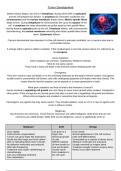
Not all tumors are cancerous. Those that are cancerous are called malignant, while those that are non
cancerous are called benign. While both can be dangerous, cancer is significantly more so.
Malignant Both Benign
Grow rapidly. Can grow to a Grow slowly.
Cells become unspecialised. larger size. Normal appearance to the cell nucleus.
Tumors can grow finger like projections. Abnormal growth Cells well differentiated.
Nuclei are often large and much darker - of cells. Surrounded by a capsule of dense tissue.
DNA is replicating faster than it should. Different degree Adhesion molecules are produced.
No adhesion molecules are produced. of harm based on Usually removed by surgery alone.
Often life threatening. size and location. Treatment usually involves surgery alone.
Treatment may require radiotherapy or Usually result Rarely occur after treatment.
chemotherapy. from mutations in
Can recur following treatment. the cell cycle.
Can metastasize.
Before mitosis begins, the cell is in interphase, during which DNA is replicated,
and the cell prepares for division. In prophase the chromatin condenses into
chromosomes and the nuclear membrane breaks down. Mitotic spindle fibres
begin to form. During metaphase the chromosomes line up at the equator of the
cell. In anaphase the sister chromatids are pulled apart by their spindle fibres,
moving towards opposite poles of the cell. Telophase follows, with chromosomes
decondensing, the nuclear membrane reforming and mitotic spindle fibres break
down. Cytokinesis follows.
Cancers demonstrate how important it is that cell division is precisely controlled, as cs cancers arise due to
uncontrolled mitosis.
A change within a gene is called a mutation. If the mutated gene is one that causes cancer it is referred to as
an oncogene.
Gene mutations:
Gene mutations are common. Substitution/ Deletion/ Insertion
Most do not cause cancer.
They result in early cell death or the immune system destroying the cell.
Oncogenes:
They don’t result in early cell death, or in the cell being destroyed by the body's immune system. Oncogenes
usually result in uncontrolled cell division, and cells undergoing apoptosis (cell death) when they should. This
means that the harmful mutation can be passed on to many generations of cells.
What gene mutations are likely to lead to the formation of cancer?
Genes involved in regulating cell growth are more likely to cause tumor growth when mutated, compared to
other genes. Proto-oncogenes are normal genes that play a crucial role in regulating cell growth and division.
When proto-oncogenes are mutated or overactive they become oncogenes.
Carcinogens: any agents that may cause cancer. They include radiation, such as UV or X-rays or agents such
as tar in tobacco smoke.
Maglincay:
Not all tumors are cancerous. Those that are cancerous are called malignant, while those that are non
cancerous are called benign. While both can be dangerous, cancer is significantly more so.
Malignant Both Benign
Grow rapidly. Can grow to a Grow slowly.
Cells become unspecialised. larger size. Normal appearance to the cell nucleus.
Tumors can grow finger like projections. Abnormal growth Cells well differentiated.
Nuclei are often large and much darker - of cells. Surrounded by a capsule of dense tissue.
DNA is replicating faster than it should. Different degree Adhesion molecules are produced.
No adhesion molecules are produced. of harm based on Usually removed by surgery alone.
Often life threatening. size and location. Treatment usually involves surgery alone.
Treatment may require radiotherapy or Usually result Rarely occur after treatment.
chemotherapy. from mutations in
Can recur following treatment. the cell cycle.
Can metastasize.


