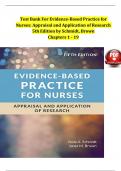
Test Bank For Evidence-Based Practice for
Nurses: Appraisal and Application of Research
5th Edition by Schmidt, Brown
Chapters 1 - 19
,Test Bank For Evidence-Based Practice for Nurses: Appraisal and Application of
Research 5th Edition by Schmidt, Brown
Table of Contents:
Chapter 1 What Is Evidence-Based Practice?
Chapter 2 Using Evidence Through Collaboration To Promote Excellence In Nursing Practice
Chapter 3 Identifying Research Questions
Chapter 4 Finding Sources Of Evidence
Chapter 5 Linking Theory, Research, And Practice
Chapter 6 Key Principles Of Quantitative Designs
Chapter 7 Quantitative Designs: Using Numbers To Provide Evidence
Chapter 8 Epidemiologic Designs: Using Data To Understand Populations
Chapter 9 Qualitative Designs: Using Words To Provide Evidence
Chapter 10 Collecting Evidence
Chapter 11 Using Samples To Provide Evidence
Chapter 12 Other Sources Of Evidence
Chapter 13 What Do The Quantitative Data Mean?
Chapter 14 What Do The Qualitative Data Mean?
Chapter 15 Weighing In On The Evidence
Chapter 16 Transitioning Evidence To Practice
Chapter 17 Developing Oneself As An Innovator
Chapter 18 Evaluating Outcomes Of Innovations
Chapter 19 Sharing The Insights With Others
,CHAPTER 1: WHAT IS EVIDENCE BASED PRACTICE?
Test Bank Evidence-Based Practice for Nurses: Appraisal and Application of Research 5th
Edition Schmidt, Brown
Multiple Choice
Definition of research (p. 14)
1. Which pof pthe pfollowing pis pthe pbest pdefinition pof presearch?
a. Critically pthinking pabout pproblems pthat poccur pin phealth pcare pto pdetermine
ppossiblepsolutions.
b. Information pthat pis pbased pon ppersonal pexperience por ptradition.
c. Planned pand psystematic pactivity pthat pleads pto pnew pknowledge
pand/or pthepdiscovery pof psolutions pto pproblems por pquestions.
d. Trying pa pvariety pof papproaches pto pa pclinical pproblem pand psettling pon pthe
papproachpthat pis peffective pmore poften pthan pnot.
Definition pof presearch putilization p(p. p4)
2. Which pof pthe pfollowing pis pthe pbest pdefinition pof presearch putilization?
a. Applying presearch pfindings pfrom pindividual pstudies pto ppractice.
b. Analyzing pmultiple presearch pstudies pto psynthesize pfindings.
c. Appreciating pthe pimportance pof pclinical pdecision pmaking.
d. Using pprevious ppersonal pexperience pto pbuild pconfidence.
Definition pof pEBP p(pp. p4-5)
3. Which pof pthe pfollowing pis pthe pbest pdefinition pof pevidence-based ppractice p(EBP)?
a. Application pof presearch pfindings pbased pon pscientific ptheories pin pa pclinical psetting.
b. Research pstudies pthat pcorrespond pto pnationally pestablished ppriorities pfor
phealthcare,pconducted pby pexperts pin ptheir pfields.
c. Use pof ptheory-derived, presearch-based pinformation pin pmaking pdecisions
paboutphealth pcare pdelivery, pwith pconsideration pof pindividual pneeds pand
ppreferences pand pthe pclinical pexpertise pof pthe pprovider.
d. Using pthe pindividual phealth pcare pprovider’s pperception pof ptruth pwithout
pconsciouspattention por preasoning.
Difference pbetween presearch putilization pand pEBP p(pp. p4-5)
4. Which pof pthe pfollowing pbest pdescribes pthe pdifference pbetween presearch
putilization pandpEBP?
a. Research putilization pis pa pprocess pof pevaluating pmultiple pstudies pfor
pthe pmostpgeneralizable pfindings; pEBP pis puse pof pthe pmost precent pstudy
pon pa ptopic.
, b. Research putilization pinvolves pchanging ppractice pbased pon pfindings pof pa
psinglepresearch pstudy; pEBP pis pthe psyntheses pof pfindings pfrom pmultiple
pstudies pto pincorporate pwith ppractitioner pskills pand pclient ppreference
pto pdetermine pbest pcare.
c. Research putilization pis pthe papplication pof presearch pfindings pto phealth pcare
ppractice;pEBP pis pconsidered pin pselecting pmedication poptions.
d. Research putilization pis preview pof presearch ppublications; pEBP pis
pusing pthe phealthcare pprovider’s pperception pof pwhat pcare pwould pbe
pbest pin pindividualpsituations.
Evidence pfrom pother pdisciplines p(p. p6)
5. In pwhat pway pcan pevidence pfrom pdisciplines pother pthan pnursing pbe phelpful?
a. Theory pbased pnon-nursing pevidence pcan pprovide pa pbasis pon pwhich
pto pbuildpnew pevidence.
b. Non-nursing pevidence psupports pthe puse pof pnursing pknowledge pobtained
pby ptrialpand perror.
c. Clinical pdecision pmaking pcan pbe pbased pon pfindings pfrom psingle pnon-
nursingpresearch pstudies.
d. All pevidence pis pequally pimportant pto pthe ppractice pof pnursing.
Identification pof psources pof pevidence p(p. p6)
6. You pare pa pnew pnurse pworking pat pXYZ phospital. pYour ppreceptor ptells pyou pto
pdangle pMs. pJones’ plegs pon pthe pside pof pthe pbed pbefore pyou pattempt pto passist pher pto
pa pchair. pYou pask pyourppreceptor pwhy pthis pis pdone pand pshNeUaRnSsIw
NeGrTsB
, p “.CTOhM
is pis
pwhat pwe phave palways pdone, pso pgo pdo pit.” pThis pis pan pexample pof pwhich ptype pof
pevidence?
a. Trial pand perror
b. Intuition
c. Borrowed pevidence
d. Tradition
Identification pof psources pof pevidence p(p. p6)
7. You pare pa pnew pnurse pworking pat pXYZ phospital. pYour ppreceptor ptells pyou pto
pdangle pMs. pJones’ plegs pon pthe pside pof pthe pbed pbefore pyou pattempt pto passist pher
pto pa pchair. pYou pask pyourppreceptor pwhy pthis pis pdone pand pshe panswers, p“Because pI
psaid pso.” pThis pis pan pexample pof pwhich ptype pof pevidence?
a. Intuition
b. Tradition
c. Authority
d. Borrowed pevidence
Identification pof psources pof pevidence p(p. p6)
8. Trial pand perror pis pnot pa ppreferred papproach pfor pdelivering pnursing pcare pbecause
a. it pis pnot pbased pon psystematic pscientific papproaches.
b. it pis pnot pa psanctioned pmethod pby pthe pAmerican pNurses pAssociation.
c. it pis pbased ponly pon pintuition pand ptherefore pnot pscientifically pbased.
d. patient poutcomes pare palways pbased ponly pon plevel p1 pevidence.
Nurses: Appraisal and Application of Research
5th Edition by Schmidt, Brown
Chapters 1 - 19
,Test Bank For Evidence-Based Practice for Nurses: Appraisal and Application of
Research 5th Edition by Schmidt, Brown
Table of Contents:
Chapter 1 What Is Evidence-Based Practice?
Chapter 2 Using Evidence Through Collaboration To Promote Excellence In Nursing Practice
Chapter 3 Identifying Research Questions
Chapter 4 Finding Sources Of Evidence
Chapter 5 Linking Theory, Research, And Practice
Chapter 6 Key Principles Of Quantitative Designs
Chapter 7 Quantitative Designs: Using Numbers To Provide Evidence
Chapter 8 Epidemiologic Designs: Using Data To Understand Populations
Chapter 9 Qualitative Designs: Using Words To Provide Evidence
Chapter 10 Collecting Evidence
Chapter 11 Using Samples To Provide Evidence
Chapter 12 Other Sources Of Evidence
Chapter 13 What Do The Quantitative Data Mean?
Chapter 14 What Do The Qualitative Data Mean?
Chapter 15 Weighing In On The Evidence
Chapter 16 Transitioning Evidence To Practice
Chapter 17 Developing Oneself As An Innovator
Chapter 18 Evaluating Outcomes Of Innovations
Chapter 19 Sharing The Insights With Others
,CHAPTER 1: WHAT IS EVIDENCE BASED PRACTICE?
Test Bank Evidence-Based Practice for Nurses: Appraisal and Application of Research 5th
Edition Schmidt, Brown
Multiple Choice
Definition of research (p. 14)
1. Which pof pthe pfollowing pis pthe pbest pdefinition pof presearch?
a. Critically pthinking pabout pproblems pthat poccur pin phealth pcare pto pdetermine
ppossiblepsolutions.
b. Information pthat pis pbased pon ppersonal pexperience por ptradition.
c. Planned pand psystematic pactivity pthat pleads pto pnew pknowledge
pand/or pthepdiscovery pof psolutions pto pproblems por pquestions.
d. Trying pa pvariety pof papproaches pto pa pclinical pproblem pand psettling pon pthe
papproachpthat pis peffective pmore poften pthan pnot.
Definition pof presearch putilization p(p. p4)
2. Which pof pthe pfollowing pis pthe pbest pdefinition pof presearch putilization?
a. Applying presearch pfindings pfrom pindividual pstudies pto ppractice.
b. Analyzing pmultiple presearch pstudies pto psynthesize pfindings.
c. Appreciating pthe pimportance pof pclinical pdecision pmaking.
d. Using pprevious ppersonal pexperience pto pbuild pconfidence.
Definition pof pEBP p(pp. p4-5)
3. Which pof pthe pfollowing pis pthe pbest pdefinition pof pevidence-based ppractice p(EBP)?
a. Application pof presearch pfindings pbased pon pscientific ptheories pin pa pclinical psetting.
b. Research pstudies pthat pcorrespond pto pnationally pestablished ppriorities pfor
phealthcare,pconducted pby pexperts pin ptheir pfields.
c. Use pof ptheory-derived, presearch-based pinformation pin pmaking pdecisions
paboutphealth pcare pdelivery, pwith pconsideration pof pindividual pneeds pand
ppreferences pand pthe pclinical pexpertise pof pthe pprovider.
d. Using pthe pindividual phealth pcare pprovider’s pperception pof ptruth pwithout
pconsciouspattention por preasoning.
Difference pbetween presearch putilization pand pEBP p(pp. p4-5)
4. Which pof pthe pfollowing pbest pdescribes pthe pdifference pbetween presearch
putilization pandpEBP?
a. Research putilization pis pa pprocess pof pevaluating pmultiple pstudies pfor
pthe pmostpgeneralizable pfindings; pEBP pis puse pof pthe pmost precent pstudy
pon pa ptopic.
, b. Research putilization pinvolves pchanging ppractice pbased pon pfindings pof pa
psinglepresearch pstudy; pEBP pis pthe psyntheses pof pfindings pfrom pmultiple
pstudies pto pincorporate pwith ppractitioner pskills pand pclient ppreference
pto pdetermine pbest pcare.
c. Research putilization pis pthe papplication pof presearch pfindings pto phealth pcare
ppractice;pEBP pis pconsidered pin pselecting pmedication poptions.
d. Research putilization pis preview pof presearch ppublications; pEBP pis
pusing pthe phealthcare pprovider’s pperception pof pwhat pcare pwould pbe
pbest pin pindividualpsituations.
Evidence pfrom pother pdisciplines p(p. p6)
5. In pwhat pway pcan pevidence pfrom pdisciplines pother pthan pnursing pbe phelpful?
a. Theory pbased pnon-nursing pevidence pcan pprovide pa pbasis pon pwhich
pto pbuildpnew pevidence.
b. Non-nursing pevidence psupports pthe puse pof pnursing pknowledge pobtained
pby ptrialpand perror.
c. Clinical pdecision pmaking pcan pbe pbased pon pfindings pfrom psingle pnon-
nursingpresearch pstudies.
d. All pevidence pis pequally pimportant pto pthe ppractice pof pnursing.
Identification pof psources pof pevidence p(p. p6)
6. You pare pa pnew pnurse pworking pat pXYZ phospital. pYour ppreceptor ptells pyou pto
pdangle pMs. pJones’ plegs pon pthe pside pof pthe pbed pbefore pyou pattempt pto passist pher pto
pa pchair. pYou pask pyourppreceptor pwhy pthis pis pdone pand pshNeUaRnSsIw
NeGrTsB
, p “.CTOhM
is pis
pwhat pwe phave palways pdone, pso pgo pdo pit.” pThis pis pan pexample pof pwhich ptype pof
pevidence?
a. Trial pand perror
b. Intuition
c. Borrowed pevidence
d. Tradition
Identification pof psources pof pevidence p(p. p6)
7. You pare pa pnew pnurse pworking pat pXYZ phospital. pYour ppreceptor ptells pyou pto
pdangle pMs. pJones’ plegs pon pthe pside pof pthe pbed pbefore pyou pattempt pto passist pher
pto pa pchair. pYou pask pyourppreceptor pwhy pthis pis pdone pand pshe panswers, p“Because pI
psaid pso.” pThis pis pan pexample pof pwhich ptype pof pevidence?
a. Intuition
b. Tradition
c. Authority
d. Borrowed pevidence
Identification pof psources pof pevidence p(p. p6)
8. Trial pand perror pis pnot pa ppreferred papproach pfor pdelivering pnursing pcare pbecause
a. it pis pnot pbased pon psystematic pscientific papproaches.
b. it pis pnot pa psanctioned pmethod pby pthe pAmerican pNurses pAssociation.
c. it pis pbased ponly pon pintuition pand ptherefore pnot pscientifically pbased.
d. patient poutcomes pare palways pbased ponly pon plevel p1 pevidence.