

Written by students who passed Immediately available after payment Read online or as PDF Wrong document? Swap it for free 4.6 TrustPilot
logo-home
Document preview thumbnail
Preview 3 out of 20 pages
Exam (elaborations)

ECO 391 Exam 2 | Questions with 100% Correct Answers

Document preview thumbnail
Preview 3 out of 20 pages

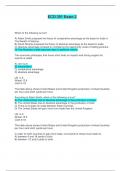
ECO 391 Exam 2 | Questions with 100% Correct Answers Which of the following is true? A) Adam Smith proposed the theory of comparative advantage as the basis for trade in The Wealth of Nations. B) David Ricardo proposed the theory of absolute advantage as the basis for trade. C) Absolute advantage is based on comparing the opportunity costs of trading partners. D) The Ricardian model assumes labor is perfectly mobile. The economic philosophy that favors strict limits on imports and strong support for exports is called A) zero sum. B) mercantilism. C) comparative advantage. D) absolute advantage. US. U.K Wheat 12 6 Cloth 6 18 The table above shows United States and United Kingdom production of wheat (bushels per hour) and cloth (yards per hour). According to Adam Smith, which of the following is true? A) The United States has an absolute advantage in the production of wheat. B) The United States has an absolute advantage in the production of cloth. C) There is no basis for trade between these countries. D) The United States will gain more from trade than the United Kingdom. US. U.K Wheat 12 6 Cloth 6 18 The table above shows United States and United Kingdom production of wheat (bushels per hour) and cloth (yards per hour). In order for both countries to gain from trade, one bushel of wheat must trade for A) between 6 and 18 yards of cloth. B) between 1/2 and 2 yards of cloth. C) between 1/3 and 3 yards of cloth. D) between 1/2 and 1/3 yards of cloth. A country will gain relatively more from trade when A) trade is regulated. B) the world price is close to the country's opportunity cost of the good. C) the world price is below the country's opportunity cost of the good. D) the world price is much greater than the country's opportunity cost for the good. Mercantilists perceived trade as a zero sum game. True/False True Adam Smith created the theory of comparative advantage. True/False False What type of policies did Adam Smith attack in his book, An Inquiry into the Nature and Causes of the Wealth of Nations? Mercantilism What did Adam Smith perceive was primarily responsible for improving standard of living? Increased specialization in production What is productivity? The amount of output from a unit of an input In the simple trade model, what is assumed about labor? It is perfectly mobile between the two industries within a nation. Which economist introduced the simple trade model and the concept of trade based on comparative advantage? David Ricardo Why did Adam Smith criticize the trade barriers imposed by the mercantilists? Smith was highly critical of trade barriers because they decrease specialization, technological progress, and wealth creation. He also recognized that imports enable a country to obtain goods that it cannot make or cannot make as cheaply, while exports are made for someone else and are useful only if they lead to imports. Suppose Mexico can produce 5 autos or 10 corn. Suppose the United States can produce 4 autos or 20 corn. If opportunity costs are constant for both countries, then A) the United States has a comparative advantage in corn production. B) Mexico has a comparative advantage in corn production. C) the United States cannot gain from trade with Mexico. D) the United States has a comparative advantage in auto production. Suppose Mexico can produce 5 autos or 10 corn. Suppose the United States can produce 4 autos or 20 corn. If opportunity costs are constant for both countries, which of the following would NOT be a potential terms of trade? A) 1 auto for 3 corn B) 1 auto for 4 corn C) 1 corn for 1/3 of an auto D) 1 corn for 1 auto Suppose Paraguay can produce 12 wheat or 3 corn. Suppose Bolivia can produce 4 wheat or 2 corn. Suppose opportunity costs are constant. Given these production possibilities, A) Paraguay has a comparative advantage in wheat. B) Paraguay has a comparative advantage in corn. C) Paraguay has a comparative advantage in both goods. D) Paraguay has an absolute advantage in neither good. Suppose that Paraguay can produce 12 wheat or 3 corn and Bolivia can produce 4 wheat or 2 corn. Suppose that opportunity costs are constant. Which of the following is a potentially agreeable trade arrangement for Paraguay and Bolivia? A) Paraguay trades one corn to Bolivia for three units of wheat. B) Bolivia trades one corn to Paraguay for three units of wheat. C) Bolivia trades one corn to Paraguay for one wheat. D) Paraguay trades one wheat to Bolivia for two corn. Suppose that Canada can produce 15 timber or 3 film and Mexico can produce 9 timber or 3 film. Suppose that opportunity costs are constant. Which of the following is FALSE? A) Canada has an absolute advantage in timber production. B) Mexico has a comparative advantage in film production. C) The opportunity costs for producing timber are lower in Canada than in Mexico. D) Canada and Mexico would find trade mutually advantageous at a ratio of one unit of film to six units of timber. Suppose that Canada can produce 15 units of timber or 3 units of grain. Suppose that Mexico can produce 6 units of timber or 2 units of grain. Which of the following is CORRECT? A) Mexico has a comparative advantage in grain production. B) Mexico has an absolute advantage in timber production. C) Canada has a comparative advantage in grain production. D) The countries would find trade mutually beneficial at a trading ratio of 1 grain for 2 timber. Suppose that Sandy can produce 10 economic reports or make 2 sales calls. Suppose Tim can produce 2 economic reports or make 1 sales call. Which of the following is CORRECT? A) The opportunity cost for Sandy of producing one economics report is 1/5 of a sales call. B) The opportunity cost for Sandy of producing one sales call is 10 economics reports. C) The opportunity cost for Tim of producing one sales call is 1/2 of an economics report. D) The opportunity cost for Tim of producing one economics report is 2 sales calls. Given that Sandy can produce 10 economics reports or make 2 sales calls and Tim can produce 2 economics reports or make 1 sales call, we can conclude that A) Sandy should specialize in economics reports, and Tim should specialize in sales calls. B) Sandy should produce both economics reports and sales calls since she cannot possibly gain from trade with Tim. C) Tim should specialize in producing economics reports, and Sandy should specialize in producing sales calls. D) Tim should produce both economics reports and sales calls. Given that Sandy can produce 10 economics reports or 2 sales calls and Tim can produce 2 economics reports or 1 sales call, which of the following is FALSE? A) Sandy has a comparative advantage in sales calls. B) Tim has a comparative advantage in sales calls. C) Sandy has a comparative advantage in economics reports. D) Sandy has an absolute advantage in both economics reports and sales calls. Given that Sandy can produce 10 economics reports or 2 sales calls and Tim can produce 2 economics reports or 1 sales call, which of the following would NOT be a mutually agreeable terms of trade for Sandy and Tim? A) 1 economics report for 1 sales call B) 1 sales call for 3 economics reports C) 1 sales call for 4 economics reports D) 1 economics report for 1/4 of a sales call For a country in autarky, the opportunity cost of the good on the horizontal axis is the same as A) the relative price of the good on the vertical axis. B) the relative price of the good on the horizontal axis. C) the opportunity cost of the good on the vertical axis. D) the nominal price of the good on the horizontal axis. With trade, the slope of the Consumption Possibilities Curve (CPC) is equal to A) the world price of the good on the horizontal axis. B) the world price of the good on the vertical axis. C) the opportunity cost of the good on the horizontal axis. D) the opportunity cost of the good on the vertical axis. Assume that both the United States and Germany produce beef and computers. The U.S. can produce 200 computers or 1,000 pounds of beef per day. Germany can produce 500 computers or 250 pounds of beef per day. What is the opportunity cost of beef and computer chips in each country? In which good does each country have a comparative advantage? What is the range for mutually beneficial trade in computers? In the U.S., the opportunity cost of computers is 5 pounds of beef. The opportunity cost of a pound of beef is 1/5 computer. In Germany, the opportunity cost of a computer is 1/2 pound of beef. The opportunity cost of a pound of beef is 2 computers. Since 1/5 is less than 1/2, the U.S. has a comparative advantage in beef, and likewise, Germany has a comparative advantage in computers. For both nations to benefit, a computer must trade for between 1/5 and 1/2 pounds of beef. Assume that both the United States and Germany produce beef and computers. The U.S. can produce 200 computers or 1,000 pounds of beef per day. Germany can produce 500 computers or 250 pounds of beef per day. Graph the PPCs for each country, putting computers on the horizontal axis. Then identify the slopes of the PPCs. What does the slope represent? Graphs should show: Germany: horizontal intercept = 500, vertical intercept = 250, slope = -1/2. U.S.: horizontal intercept = 200, vertical intercept = 1,000, slope = -1/5 The slope of the line represents the opportunity cost of the good on the horizontal axis (computers). Absolute and Comparative Productivity Advantage Contrasted The United States' comparative advantage over Japan in the production of rock-n-roll music implies that (for a similar quality of music) the A) opportunity cost of production is less in Japan. B) absolute cost of production is less in the United States. C) absolute cost of production is less in Japan. D) opportunity cost of production is less in the United States. If one nation is able to produce a good at a lower opportunity cost than another, it has A) an absolute advantage in that good. B) a comparative advantage in that good. C) a productivity advantage in that good. D) a technological advantage in that good. The basis for free trade is the concept of A) absolute advantage. B) differences in natural resources and climate. C) differences in nominal wages. D) comparative advantage. In our simple trade model, having a comparative advantage in a product implies that a country will specialize completely in the product A) with the highest opportunity cost. B) with the lowest opportunity cost. C) where total output is lower per worker-hour. D) where total output is greater per worker-hour. A country possesses a comparative advantage in the production of a product if A) the opportunity cost, in terms of the amount of other products that it gives up to produce this product, is lower than it is for its trading partners. B) it possesses an absolute advantage in the production of this good compared to its trading partners. C) it is able to produce less of this good per worker than its trading partners. D) it can produce more of this good per hour than its trading partners. The gains from trade rely on overall productivity (absolute advantage). True/False False A nation must have an absolute advantage in order to have a comparative advantage in producing a good or service. True/False False Explain how a country with no absolute advantage can gain from trade. Even if a country cannot produce absolutely more of a good, it can still have a comparative advantage. This means that it is relatively better at producing a given good. Thus if it specializes in producing the good that it produces at a relatively lower cost and trades for goods that it can only produce at a relatively higher cost, it will gain from trade. If a nation has no absolute advantage, then it A) cannot gain from trade. B) still gains from trade. C) can only gain from trade if it raises its productivity levels. D) can only gain from trade if it produces outside its production possibilities curve. Which of the following statements is FALSE? A) Comparative advantage is the principle upon which trade patterns are based. B) Opportunity cost measures the real cost to a country of producing a certain product. C) The gains from trade are the result of differences in opportunity cost and comparative advantage. D) A country that possesses an absolute advantage will always have a comparative advantage. If a country has lower overall productivity levels than its trading partners, then it will A) be unable to export. B) have a trade deficit. C) not be able to obtain gains from trade. D) have a lower standard of living than its trading partners. If two countries agree to specialize and trade based on comparative advantage, which of the following is most likely to be true? A) Both of the countries will consume outside their respective production possibilities curves. B) One of the countries will end up receiving all of the gains from trade. C) One of the countries will both consume and produce on its production possibilities curve. D) Only one of the countries will produce on and consume outside its production possibilities curve. If the world price for a good is above a nation's pre-trade equilibrium price, then the nation A) will export the good. B) will import the good. C) will neither export nor import the good. D) cannot gain from trade. E) Both C and D. When did the Republic of Korea change its economic policies? The 1960's What results has the Republic of Korea experienced from its change in policies? It has successfully industrialized. Its index of openness is many times greater and incomes have grown almost 6 percent per year over the period. Given the Republic of Korea's experience, what can we conclude about comparative advantage? It can change over time. More skill and more capital can be developed as income rises, changing productivity. If a nation is more productive than a trading partner, can it still gain from trade with that partner? Use the concepts of absolute and comparative advantage to explain. The gains from trade do not rely on overall productivity (absolute advantage) but on differences in relative prices (comparative advantage). In producing a good or service, as long as a trading partner gives up fewer units of an alternate product, we can gain from trade with them. Certain kinds of tropical fruits are impossible to grow outdoors in the United States. Suppose, however, that in order to create jobs in Wyoming, the U.S. government offered extensive subsidies to firms to produce bananas. With the subsidies, firms could build greenhouses and offer the fruit at world prices. A) The United States now has a comparative advantage in bananas. B) The United States has a comparative advantage, but is not competitive. C) The United States is competitive, but does not have a comparative advantage. D) The United States has a comparative advantage and is competitive. Competition between the United States and Mexico is A) equivalent to the competition between two giant corporations. B) a struggle over which country will get the best jobs. C) unfair if wages in Mexico are lower than in the United States. D) not a meaningful way to analyze trade. A country that creates competitive advantage where there are not comparative advantages misallocates its resources and has lower national well-being. True/False True Explain why government actions that make industries more competitive do not create comparative advantage. Because governments spend resources in order to make industries more competitive, price of goods in these industries no longer reflects the true costs of production (on which comparative advantage is based. Economic restructuring that takes place as a result of opening to trade with other countries A) contradicts the idea of gains from trade. B) causes some trading activity to be zero sum. C) worsens the nation's allocation of resources. D) improves the nation's allocation of resources. All of the following are true EXCEPT A) trade between two nations reduces their opportunity costs. B) trade makes nations dependent on each other. C) trade between nations will not benefit all citizens. D) the principle of comparative advantage does not apply to countries with limited resources. When economists talk about the gains from trade they mean that A) no one ever gets hurt by trade. B) the benefits of trade outweigh the losses. C) business firms benefit from trade but not necessarily individuals. D) trade increases government revenue through taxes on imports. E) economic restructuring is usually quick and painless. Based on the theory of comparative advantage, nations maximize their well-being when they A) create more jobs. B) allocate resources more efficiently. C) increase trade surpluses. D) increase exports. The nation as a whole is better off from trade as long as the gains from the winners exceed the losses from the losers. True/False True All individuals and firms in a country must gain from trade in order for it to be beneficial to the nation. True/False False Comparative advantage can change over time. True/False True A country is likely to be better off in the long run if it pursues self-sufficiency. True/False False Free trade may be good for a nation, but not for everyone in the nation. Explain why free trade is controversial and the list the justifications that proponents of trade adjustment assistance offer in support of those policies. The nation as a whole is better off as long as the gains from the winners exceed the losses from the losers. Restructuring means that some industries are dying and workers and producers have to find other opportunities. This may be difficult for not only those directly involved in the industry, but also for the surrounding communities. Adjustment assistance states that since the nation as a whole benefits from trade, there are newly added resources that can be used for compensation. Second, there is a potential ethical obligation to assist those hurt by economic change. Third, compensation reduces the incentives for those hurt by trade to fight against free trade policies. Describe some of the key controversies regarding global cotton trade between high cost and low cost cotton producers. Low cost cotton producers produce less cotton in total, but rely more on cotton exports for income. Their low incomes put them on the edge of survival and the fact that they make less in total to export makes cotton export revenues critical. High cost cotton producers depend much less on their cotton exports and have much higher incomes. High cost cotton producers are assisted through direct and indirect payments from their governments, tariffs on cotton imports, farm support programs including subsidized loans, insurance, marketing and promotion assistance, and revenue guarantees. These programs keep cotton production where it is less efficient and have the potential to harm living standards in developing nations and keep them from fully exploiting their comparative advantage in cotton. A production possibilities curve that is bowed out represents the case of A) constant costs. B) increasing costs. C) decreasing costs. D) external costs. A production possibilities curve that is a straight line represents the case of A) constant costs. B) increasing costs. C) constant opportunity costs but increasing real costs. D) constant opportunity costs but decreasing real costs. The straight-line production possibilities curve

Content preview

ECO 391 Exam 2


Which of the following is true?

A) Adam Smith proposed the theory of comparative advantage as the basis for trade in
The Wealth of Nations.
B) David Ricardo proposed the theory of absolute advantage as the basis for trade.
C) Absolute advantage is based on comparing the opportunity costs of trading partners.
D) The Ricardian model assumes labor is perfectly mobile.

The economic philosophy that favors strict limits on imports and strong support for
exports is called

A) zero sum.
B) mercantilism.
C) comparative advantage.
D) absolute advantage.

US. U.K
Wheat 12 6
Cloth 6 18

The table above shows United States and United Kingdom production of wheat (bushels
per hour) and cloth (yards per hour).

According to Adam Smith, which of the following is true?
A) The United States has an absolute advantage in the production of wheat.
B) The United States has an absolute advantage in the production of cloth.
C) There is no basis for trade between these countries.
D) The United States will gain more from trade than the United Kingdom.

US. U.K
Wheat 12 6
Cloth 6 18

The table above shows United States and United Kingdom production of wheat (bushels
per hour) and cloth (yards per hour).

In order for both countries to gain from trade, one bushel of wheat must trade for
A) between 6 and 18 yards of cloth.
B) between 1/2 and 2 yards of cloth.

,C) between 1/3 and 3 yards of cloth.
D) between 1/2 and 1/3 yards of cloth.

A country will gain relatively more from trade when

A) trade is regulated.
B) the world price is close to the country's opportunity cost of the good.
C) the world price is below the country's opportunity cost of the good.
D) the world price is much greater than the country's opportunity cost for the good.

Mercantilists perceived trade as a zero sum game.
True/False
True

Adam Smith created the theory of comparative advantage.
True/False
False

What type of policies did Adam Smith attack in his book, An Inquiry into the Nature and
Causes of the Wealth of Nations?
Mercantilism

What did Adam Smith perceive was primarily responsible for improving standard of
living?
Increased specialization in production

What is productivity?
The amount of output from a unit of an input

In the simple trade model, what is assumed about labor?
It is perfectly mobile between the two industries within a nation.

Which economist introduced the simple trade model and the concept of trade based on
comparative advantage?
David Ricardo

Why did Adam Smith criticize the trade barriers imposed by the mercantilists?
Smith was highly critical of trade barriers because they decrease specialization,
technological progress, and wealth creation. He also recognized that imports enable a
country to obtain goods that it cannot make or cannot make as cheaply, while exports
are made for someone else and are useful only if they lead to imports.

Suppose Mexico can produce 5 autos or 10 corn. Suppose the United States can
produce 4 autos or 20 corn. If opportunity costs are constant for both countries, then

, A) the United States has a comparative advantage in corn production.
B) Mexico has a comparative advantage in corn production.
C) the United States cannot gain from trade with Mexico.
D) the United States has a comparative advantage in auto production.

Suppose Mexico can produce 5 autos or 10 corn. Suppose the United States can
produce 4 autos or 20 corn. If opportunity costs are constant for both countries, which of
the following would NOT be a potential terms of trade?

A) 1 auto for 3 corn
B) 1 auto for 4 corn
C) 1 corn for 1/3 of an auto
D) 1 corn for 1 auto

Suppose Paraguay can produce 12 wheat or 3 corn. Suppose Bolivia can produce 4
wheat or 2 corn. Suppose opportunity costs are constant. Given these production
possibilities,

A) Paraguay has a comparative advantage in wheat.
B) Paraguay has a comparative advantage in corn.
C) Paraguay has a comparative advantage in both goods.
D) Paraguay has an absolute advantage in neither good.

Suppose that Paraguay can produce 12 wheat or 3 corn and Bolivia can produce 4
wheat or 2 corn. Suppose that opportunity costs are constant. Which of the following is
a potentially agreeable trade arrangement for Paraguay and Bolivia?

A) Paraguay trades one corn to Bolivia for three units of wheat.
B) Bolivia trades one corn to Paraguay for three units of wheat.
C) Bolivia trades one corn to Paraguay for one wheat.
D) Paraguay trades one wheat to Bolivia for two corn.

Suppose that Canada can produce 15 timber or 3 film and Mexico can produce 9 timber
or 3 film. Suppose that opportunity costs are constant. Which of the following is FALSE?

A) Canada has an absolute advantage in timber production.
B) Mexico has a comparative advantage in film production.
C) The opportunity costs for producing timber are lower in Canada than in Mexico.
D) Canada and Mexico would find trade mutually advantageous at a ratio of one unit of
film to six units of timber.

Suppose that Canada can produce 15 units of timber or 3 units of grain. Suppose that
Mexico can produce 6 units of timber or 2 units of grain. Which of the following is
CORRECT?

A) Mexico has a comparative advantage in grain production.

Document information

Uploaded on
February 12, 2025
Number of pages
20
Written in
2024/2025
Type
Exam (elaborations)
Contains
Questions & answers
$18.99

Wrong document? Swap it for free Within 14 days of purchase and before downloading, you can choose a different document. You can simply spend the amount again.
Written by students who passed
Immediately available after payment
Read online or as PDF

Seller avatar
Reputation scores are based on the amount of documents a seller has sold for a fee and the reviews they have received for those documents. There are three levels: Bronze, Silver and Gold. The better the reputation, the more your can rely on the quality of the sellers work.
Jumuja
3.9
(121)
Sold
589
Followers
417
Items
2856
Last sold
3 days ago


Why students choose Stuvia

Created by fellow students, verified by reviews

Quality you can trust: written by students who passed their tests and reviewed by others who've used these notes.

Didn't get what you expected? Choose another document

No worries! You can instantly pick a different document that better fits what you're looking for.

Pay as you like, start learning right away

No subscription, no commitments. Pay the way you're used to via credit card and download your PDF document instantly.

Student with book image

“Bought, downloaded, and aced it. It really can be that simple.”

Alisha Student

Working on your references?

Create accurate citations in APA, MLA and Harvard with our free citation generator.

Working on your references?

Frequently asked questions
