

Name: Score:
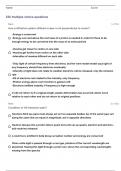
356 Multiple choice questions
Term 1 of 356
How is diffraction pattern different is laser is not perpendicular to screen?
-Energy is conserved
-Energy over and above the rest mass of a proton is needed in order for there to be
enough energy to be converted into the mass of an extra particle
-Maxima get closer to centre on one side
-Maxima get further from centre on the other side
-Intensities of maxima different on each side
-Only light of certain frequency frees electrons, but the wave model model says light of
any frequency should free electrons eventually
-Intensity of light does not relate to weather electrons will be released, only the emission
rate
-KE of electrons not related to the intensity, only frequency
-Photon energy above work function is gained a KE
-Electrons emitted instantly if frequency is high enough
It will not return to it's original length, plastic deformation has occurred; atoms move
relative to each other and do not return to original positions
Term 2 of 356
Conditions of N3 interaction pairs?
Newton's third law pairs must always act on two separate bodies; be of the same type; act
along the same line; be equal in magnitude; act in opposite directions
Neutron decays into a proton (down quark turns into an up quark), electron and electron-
anti-neutrino released
A neutrino is emitted in beta decay so lepton number and energy are conserved
When white light is passed through a cool gas, photons of the correct wavelength are
absorbed. Passing this light through a prism now shows the corresponding wavelengths
missing from the spectra
,Term 3 of 356
What is luminosity?
The energy absorbed by an object
The brightness perceived by an observer
The total energy emitted in all directions
The absolute power output at the source
Term 4 of 356
What are leptons? Name 6
Hot gases as electrons fall back to their original energy level and release a photon. If you
split the light from a hot gas in a prism/grating, you get bright lines on black background
This is the lowest frequency of stationary wave that can exist on the string, Wave length = 2L
Waves with the same wavelength/frequency and constant phase difference
Fundamental particles
Electrons + E.neutrino
Muons + M.neutrino
Tau + T.neutrino
And there respective anti-particles
Definition 5 of 356
hf = work function (hfo) + KE max
Work function equation
Compton scattering equation
Photoelectric effect equation
The lens equation?
,Definition 6 of 356
Protons (B=1)
Neutrons (B=1)
And there respective antiparticles
What are photons?
What are baryons?
What are equipotentials?
What is laminar flow?
Term 7 of 356
Equation linking angular speed and linear speed?
-Fix ruler in place
-Set square
-Repeat readings
Linear speed = radius x angular velocity
v=wr
More massive star = less time in main sequence, burns through hydrogen quicker
linear association between two variables
, Term 8 of 356
What happens in a converging lens when U = f?
When u = 0, the rays are absorbed by the lens
When u < f, the rays diverge
When U = f, the rays emerge parallel
When u > f, the rays converge at the focal point
Definition 9 of 356
A measure of how easily a material's surface can be scratched / indented
Define hardness
Define stability
Define strength
What is turbulent flow?
356 Multiple choice questions
Term 1 of 356
How is diffraction pattern different is laser is not perpendicular to screen?
-Energy is conserved
-Energy over and above the rest mass of a proton is needed in order for there to be
enough energy to be converted into the mass of an extra particle
-Maxima get closer to centre on one side
-Maxima get further from centre on the other side
-Intensities of maxima different on each side
-Only light of certain frequency frees electrons, but the wave model model says light of
any frequency should free electrons eventually
-Intensity of light does not relate to weather electrons will be released, only the emission
rate
-KE of electrons not related to the intensity, only frequency
-Photon energy above work function is gained a KE
-Electrons emitted instantly if frequency is high enough
It will not return to it's original length, plastic deformation has occurred; atoms move
relative to each other and do not return to original positions
Term 2 of 356
Conditions of N3 interaction pairs?
Newton's third law pairs must always act on two separate bodies; be of the same type; act
along the same line; be equal in magnitude; act in opposite directions
Neutron decays into a proton (down quark turns into an up quark), electron and electron-
anti-neutrino released
A neutrino is emitted in beta decay so lepton number and energy are conserved
When white light is passed through a cool gas, photons of the correct wavelength are
absorbed. Passing this light through a prism now shows the corresponding wavelengths
missing from the spectra
,Term 3 of 356
What is luminosity?
The energy absorbed by an object
The brightness perceived by an observer
The total energy emitted in all directions
The absolute power output at the source
Term 4 of 356
What are leptons? Name 6
Hot gases as electrons fall back to their original energy level and release a photon. If you
split the light from a hot gas in a prism/grating, you get bright lines on black background
This is the lowest frequency of stationary wave that can exist on the string, Wave length = 2L
Waves with the same wavelength/frequency and constant phase difference
Fundamental particles
Electrons + E.neutrino
Muons + M.neutrino
Tau + T.neutrino
And there respective anti-particles
Definition 5 of 356
hf = work function (hfo) + KE max
Work function equation
Compton scattering equation
Photoelectric effect equation
The lens equation?
,Definition 6 of 356
Protons (B=1)
Neutrons (B=1)
And there respective antiparticles
What are photons?
What are baryons?
What are equipotentials?
What is laminar flow?
Term 7 of 356
Equation linking angular speed and linear speed?
-Fix ruler in place
-Set square
-Repeat readings
Linear speed = radius x angular velocity
v=wr
More massive star = less time in main sequence, burns through hydrogen quicker
linear association between two variables
, Term 8 of 356
What happens in a converging lens when U = f?
When u = 0, the rays are absorbed by the lens
When u < f, the rays diverge
When U = f, the rays emerge parallel
When u > f, the rays converge at the focal point
Definition 9 of 356
A measure of how easily a material's surface can be scratched / indented
Define hardness
Define stability
Define strength
What is turbulent flow?


