CNL Exam
Study online at https://quizlet.com/_1d44hc
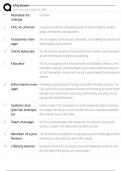
1. Mandate for Drill down
change
2. CNL as clinician A designer/coordinator/integrator/evaluator of care to individuals, families,
groups, communities, and populations.
3. Outcomes man- The CNL regularly synthesizes data, information, and knowledge to evaluate and
ager achieve optimal client outcomes.
4. Client advocate The CNL becomes competent at ensuring that clients, families, and communities
are well informed and included in care planning.
5. Educator The CNL used appropriate teaching principles and strategies as well as current
information, materials, and technologies to teach clients, health care profession-
als, and communities. Promote self-care and a maximal level of functioning and
wellness.
6. Information man- Knowledge regarding research findings and health information resources. The
ager CNL is proficient in using information systems and technology to improve health
care outcomes. Assist clients in accessing, understanding, evaluating, and ap-
plying health-related information.
7. Systems ana- Systems analyst: A CNL participates in a system review and conducts a microsys-
lyst/risk anticipa- tem analysis, identifying a clinical issue with a focus on a particular population.
tor Also to identify risks to client safety.
8. Team manager The CNL properly delegates and manages the nursing team resources and
served as a leader in the interdisciplinary health care team.
9. Member of a pro- The CNL remains accountable for the ongoing acquisition of knowledge and skills
fession related to his or her profession and to effect change.
10. Lifelong learner Recognizes the need for an actively pursues new knowledge and skills as one's
role and needs of the gesture care system evolves.
, CNL Exam
Study online at https://quizlet.com/_1d44hc
11. IOM suggests six 1. Safe
goals for improve- 2. Effective
ment: 3. Patient-centered
4. Timely
5. Efficient
6. Equitable
12. Effective lateral 1. Communication
integration re- 2. Collaboration
quires 3. Coordination
4. Evaluation
13. Collaboration Interdisciplinary process of problem solving that involves shared responsibility
for decision making as well as the execution of specific plans of care while
working toward a common goal.
14. RCA A structured method used to analyze serious adverse events. Focuses to identify
underlying system problems (not individual).
15. FMEA Conducted in an effort to help identify weak points in a process, to prevent
failures of a process/system and to reduce/prevent errors before it has a chance
to occur. "Near misses" are key opportunities.
16. Synergy model Responsibility and accountability for outcomes is a shared responsibility be-
tween the patient and the health care providers.
17. Hierarchy of evi- 1. Systematic review or meta analysis of randomized controlled trials (RCTs) and
dence evidence based clinical practice guidelines
2. One well designed RCT
3. Quasi-experimental study wo randomization
4. Well designed case-control and cohort studies
5. Systematic reviews of descriptive and/or qualitative studies
, CNL Exam
Study online at https://quizlet.com/_1d44hc
6. Single descriptive and/or qualitative studies
7. Expert opinion/expert committee reports.
18. 5 stages of Forming
group develop- Storming
ment, Tuckman's Norming
Model Performing
Adjourning/mourning
19. Hospital Quality CMS advances national quality initiatives
Initiative
20. National Data- Patient falls, pressure ulcers, skill mix, nursing hours per patient day, RN survey,
base for Nursing RN education and certification, peds pain assessment cycle, peds IV infiltration
Quality Indicators rate, restraints, nurse turnover, HAI (VAP, CLABSI, CAUTI)
21. National Quality Provides national leadership to establish national priorities and goals for ensur-
Forum ing that health care delivery is safe, effective, patient centered, timely, efficient,
and equitable.
22. 5 Ps Purpose
Patients
Professionals
Processes
Patterns
23. Run chart Tool to study variation and data over time
24. Gnatt chart Bar chart that illustrates a project schedule. Illustrates start/finish dates of the
terminal elements and summary elements of a project.
25. Fishbone diagram Cause/effect. Took to identify themes of clinical issues (equipment, personnel,
communication, etc). AKA ishikawa.
, CNL Exam
Study online at https://quizlet.com/_1d44hc
26. Human diversity Understanding the ways cultural, ethnic, socioeconomic, linguistic, religious, and
lifestyle variations are expressed.
27. Chaos theory Based on the principle that a system can maintain itself only if change is occurring
somewhere in the organization all the time. Chaos and change are seen as means
of survival.
28. Transformational Believes that leaders and followers motivate each other toward the end goal of
leadership developing followers into leaders.
29. Transactional Focused on operations and uses disciplinary power and incentives to motivate
leadership employees.
30. Operational defi- Clearly define what is to be collected and avoid confusion for those collecting the
nitions data. Also helps when interpreting data.
31. Process mapping Tool to provide the team with an objective view of the problem being investigat-
ed. This view will help everyone to determine the barriers to transfer. Once the
barriers are determined through process mapping, each barrier can be broken
down further to determine solutions.
32. Late majority Needs the most support and will often be resistant. They make up the largest
majority of the group. They maintain a high degree of skepticism and require
a large amount of information before adopting change. They will adopt change
only in the late stages. Laggards historically will not adopt change.
33. Experimental re- Quantitative. Experimental research is quantitative research, which is a formal,
search objective, rigorous, and systematic process for generating information about the
world. Experimental research is an objective, highly controlled investigation for
the purpose of predicting and controlling phenomena in nursing practice.
34. Concept map Tool to show how a main idea branched out to break down into specific topics.
35. Picture of the separate steps of a process in sequential order.
Study online at https://quizlet.com/_1d44hc
1. Mandate for Drill down
change
2. CNL as clinician A designer/coordinator/integrator/evaluator of care to individuals, families,
groups, communities, and populations.
3. Outcomes man- The CNL regularly synthesizes data, information, and knowledge to evaluate and
ager achieve optimal client outcomes.
4. Client advocate The CNL becomes competent at ensuring that clients, families, and communities
are well informed and included in care planning.
5. Educator The CNL used appropriate teaching principles and strategies as well as current
information, materials, and technologies to teach clients, health care profession-
als, and communities. Promote self-care and a maximal level of functioning and
wellness.
6. Information man- Knowledge regarding research findings and health information resources. The
ager CNL is proficient in using information systems and technology to improve health
care outcomes. Assist clients in accessing, understanding, evaluating, and ap-
plying health-related information.
7. Systems ana- Systems analyst: A CNL participates in a system review and conducts a microsys-
lyst/risk anticipa- tem analysis, identifying a clinical issue with a focus on a particular population.
tor Also to identify risks to client safety.
8. Team manager The CNL properly delegates and manages the nursing team resources and
served as a leader in the interdisciplinary health care team.
9. Member of a pro- The CNL remains accountable for the ongoing acquisition of knowledge and skills
fession related to his or her profession and to effect change.
10. Lifelong learner Recognizes the need for an actively pursues new knowledge and skills as one's
role and needs of the gesture care system evolves.
, CNL Exam
Study online at https://quizlet.com/_1d44hc
11. IOM suggests six 1. Safe
goals for improve- 2. Effective
ment: 3. Patient-centered
4. Timely
5. Efficient
6. Equitable
12. Effective lateral 1. Communication
integration re- 2. Collaboration
quires 3. Coordination
4. Evaluation
13. Collaboration Interdisciplinary process of problem solving that involves shared responsibility
for decision making as well as the execution of specific plans of care while
working toward a common goal.
14. RCA A structured method used to analyze serious adverse events. Focuses to identify
underlying system problems (not individual).
15. FMEA Conducted in an effort to help identify weak points in a process, to prevent
failures of a process/system and to reduce/prevent errors before it has a chance
to occur. "Near misses" are key opportunities.
16. Synergy model Responsibility and accountability for outcomes is a shared responsibility be-
tween the patient and the health care providers.
17. Hierarchy of evi- 1. Systematic review or meta analysis of randomized controlled trials (RCTs) and
dence evidence based clinical practice guidelines
2. One well designed RCT
3. Quasi-experimental study wo randomization
4. Well designed case-control and cohort studies
5. Systematic reviews of descriptive and/or qualitative studies
, CNL Exam
Study online at https://quizlet.com/_1d44hc
6. Single descriptive and/or qualitative studies
7. Expert opinion/expert committee reports.
18. 5 stages of Forming
group develop- Storming
ment, Tuckman's Norming
Model Performing
Adjourning/mourning
19. Hospital Quality CMS advances national quality initiatives
Initiative
20. National Data- Patient falls, pressure ulcers, skill mix, nursing hours per patient day, RN survey,
base for Nursing RN education and certification, peds pain assessment cycle, peds IV infiltration
Quality Indicators rate, restraints, nurse turnover, HAI (VAP, CLABSI, CAUTI)
21. National Quality Provides national leadership to establish national priorities and goals for ensur-
Forum ing that health care delivery is safe, effective, patient centered, timely, efficient,
and equitable.
22. 5 Ps Purpose
Patients
Professionals
Processes
Patterns
23. Run chart Tool to study variation and data over time
24. Gnatt chart Bar chart that illustrates a project schedule. Illustrates start/finish dates of the
terminal elements and summary elements of a project.
25. Fishbone diagram Cause/effect. Took to identify themes of clinical issues (equipment, personnel,
communication, etc). AKA ishikawa.
, CNL Exam
Study online at https://quizlet.com/_1d44hc
26. Human diversity Understanding the ways cultural, ethnic, socioeconomic, linguistic, religious, and
lifestyle variations are expressed.
27. Chaos theory Based on the principle that a system can maintain itself only if change is occurring
somewhere in the organization all the time. Chaos and change are seen as means
of survival.
28. Transformational Believes that leaders and followers motivate each other toward the end goal of
leadership developing followers into leaders.
29. Transactional Focused on operations and uses disciplinary power and incentives to motivate
leadership employees.
30. Operational defi- Clearly define what is to be collected and avoid confusion for those collecting the
nitions data. Also helps when interpreting data.
31. Process mapping Tool to provide the team with an objective view of the problem being investigat-
ed. This view will help everyone to determine the barriers to transfer. Once the
barriers are determined through process mapping, each barrier can be broken
down further to determine solutions.
32. Late majority Needs the most support and will often be resistant. They make up the largest
majority of the group. They maintain a high degree of skepticism and require
a large amount of information before adopting change. They will adopt change
only in the late stages. Laggards historically will not adopt change.
33. Experimental re- Quantitative. Experimental research is quantitative research, which is a formal,
search objective, rigorous, and systematic process for generating information about the
world. Experimental research is an objective, highly controlled investigation for
the purpose of predicting and controlling phenomena in nursing practice.
34. Concept map Tool to show how a main idea branched out to break down into specific topics.
35. Picture of the separate steps of a process in sequential order.