

NIMS IS-700.b Final Exam.pdf NIMS IS-700.b Final Exam.pdf NIMS IS-700.b Final Exam.pdf
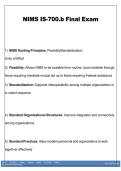
NIMS IS-700.b Final Exam
1) NIMS Guiding Principles: FlexibilityStandardization
Unity of Effort
2) Flexibility: Allows NIMS to be scalable from routine, local incidents through
those requiring interstate mutual aid up to those requiring Federal assistance
3) Standardization: Supports interoperability among multiple organizations in
in-cident response
4) Standard Organizational Structures: Improve integration and connectivity
among organizations
5) Standard Practices: Allow incident personnel and organizations to work
togeth-er effectively
NIMS IS-700.B FINAL EXAM NIMS IS-700.B FINAL
[AUTHOR NAME]
EXAM!!!!!!!!!!!!!!!!!!!!!!!!!!@
NIMS IS-700.b Final Exam.pdf NIMS IS-700.b Final Exam.pdf NIMS IS-700.b Final Exam.pdf
, NIMS IS-700.b Final Exam.pdf NIMS IS-700.b Final Exam.pdf NIMS IS-700.b Final Exam.pdf
6) Common Terminology: Enables effective communication
7) Unity of Effort: Enables organizations with jurisdictional authority or
functionalresponsibilities to support each other while allowing each participating
agency to maintain its own authority and accountability
8) 3 Major Components of NIMS: 1. Resource Management
2. Command and Coordination
3. Communications and Information Management
9. Resource Management: Standard mechanisms to systematics manage re-
sources, including personnel, equipment, supplies, teams, and facilities, both
before and during incidents in order to allow organizations to more effectively
shareresources when needed
10. Command and Communication: Describes leadership roles,
processes, andrecommended organizational structures for incident
NIMS IS-700.B FINAL EXAM NIMS IS-700.B FINAL
[AUTHOR NAME]
EXAM!!!!!!!!!!!!!!!!!!!!!!!!!!@
NIMS IS-700.b Final Exam.pdf NIMS IS-700.b Final Exam.pdf NIMS IS-700.b Final Exam.pdf
, NIMS IS-700.b Final Exam.pdf NIMS IS-700.b Final Exam.pdf NIMS IS-700.b Final Exam.pdf
management at the opera- tional and incident support levels and explains how
these structures interact to manage incidents effectively and efficiently
11. Communications and Information Management: Describes systems
and methods that help to ensure that incident personnel and other decision
makers have the means and information they need to make and communicate
decisions
12. 4 Key Activities of Resource Management Preparedness: 1.
Identifying andtyping resources
2. Qualifying, certifying, and credentialing personnel
3. Planning for resources
4. Acquiring, storing, and inventorying resources
NIMS IS-700.B FINAL EXAM NIMS IS-700.B FINAL
[AUTHOR NAME]
EXAM!!!!!!!!!!!!!!!!!!!!!!!!!!@
NIMS IS-700.b Final Exam.pdf NIMS IS-700.b Final Exam.pdf NIMS IS-700.b Final Exam.pdf
, NIMS IS-700.b Final Exam.pdf NIMS IS-700.b Final Exam.pdf NIMS IS-700.b Final Exam.pdf
13. Typing: Capability: The resources capability to perform its function in
one or more of the five mission areas: Prevention, Protection, Mitigation,
Response, andRecovery
14. Typing: Category: The function for a which a resource would be most
useful(firefighting, law enforcement, health and medical)
15. Typing: Kind: A broad characterization, such as personnel, equipment,
teams,and facilities
16. Typing: Type: A resources level of capability to perform its function
based on size, power, capacity (for equipment), or experience and qualifications;
Type 1 hasgreater capacity than Type 2, 3, or 4
17. Qualifying: Personnel meet the minimum established standards
(includingtraining, experience, physical and medical fitness) to fill specific
positions
18. Certification: Recognition from an AHJ or a third party that an
individual hascompleted qualification for a position
19. Credentialing: Documentation- typically an ID card or badge- that
identifiespersonnel and verifies their qualifications for a particular position
NIMS IS-700.B FINAL EXAM NIMS IS-700.B FINAL
[AUTHOR NAME]
EXAM!!!!!!!!!!!!!!!!!!!!!!!!!!@
NIMS IS-700.b Final Exam.pdf NIMS IS-700.b Final Exam.pdf NIMS IS-700.b Final Exam.pdf
NIMS IS-700.b Final Exam
1) NIMS Guiding Principles: FlexibilityStandardization
Unity of Effort
2) Flexibility: Allows NIMS to be scalable from routine, local incidents through
those requiring interstate mutual aid up to those requiring Federal assistance
3) Standardization: Supports interoperability among multiple organizations in
in-cident response
4) Standard Organizational Structures: Improve integration and connectivity
among organizations
5) Standard Practices: Allow incident personnel and organizations to work
togeth-er effectively
NIMS IS-700.B FINAL EXAM NIMS IS-700.B FINAL
[AUTHOR NAME]
EXAM!!!!!!!!!!!!!!!!!!!!!!!!!!@
NIMS IS-700.b Final Exam.pdf NIMS IS-700.b Final Exam.pdf NIMS IS-700.b Final Exam.pdf
, NIMS IS-700.b Final Exam.pdf NIMS IS-700.b Final Exam.pdf NIMS IS-700.b Final Exam.pdf
6) Common Terminology: Enables effective communication
7) Unity of Effort: Enables organizations with jurisdictional authority or
functionalresponsibilities to support each other while allowing each participating
agency to maintain its own authority and accountability
8) 3 Major Components of NIMS: 1. Resource Management
2. Command and Coordination
3. Communications and Information Management
9. Resource Management: Standard mechanisms to systematics manage re-
sources, including personnel, equipment, supplies, teams, and facilities, both
before and during incidents in order to allow organizations to more effectively
shareresources when needed
10. Command and Communication: Describes leadership roles,
processes, andrecommended organizational structures for incident
NIMS IS-700.B FINAL EXAM NIMS IS-700.B FINAL
[AUTHOR NAME]
EXAM!!!!!!!!!!!!!!!!!!!!!!!!!!@
NIMS IS-700.b Final Exam.pdf NIMS IS-700.b Final Exam.pdf NIMS IS-700.b Final Exam.pdf
, NIMS IS-700.b Final Exam.pdf NIMS IS-700.b Final Exam.pdf NIMS IS-700.b Final Exam.pdf
management at the opera- tional and incident support levels and explains how
these structures interact to manage incidents effectively and efficiently
11. Communications and Information Management: Describes systems
and methods that help to ensure that incident personnel and other decision
makers have the means and information they need to make and communicate
decisions
12. 4 Key Activities of Resource Management Preparedness: 1.
Identifying andtyping resources
2. Qualifying, certifying, and credentialing personnel
3. Planning for resources
4. Acquiring, storing, and inventorying resources
NIMS IS-700.B FINAL EXAM NIMS IS-700.B FINAL
[AUTHOR NAME]
EXAM!!!!!!!!!!!!!!!!!!!!!!!!!!@
NIMS IS-700.b Final Exam.pdf NIMS IS-700.b Final Exam.pdf NIMS IS-700.b Final Exam.pdf
, NIMS IS-700.b Final Exam.pdf NIMS IS-700.b Final Exam.pdf NIMS IS-700.b Final Exam.pdf
13. Typing: Capability: The resources capability to perform its function in
one or more of the five mission areas: Prevention, Protection, Mitigation,
Response, andRecovery
14. Typing: Category: The function for a which a resource would be most
useful(firefighting, law enforcement, health and medical)
15. Typing: Kind: A broad characterization, such as personnel, equipment,
teams,and facilities
16. Typing: Type: A resources level of capability to perform its function
based on size, power, capacity (for equipment), or experience and qualifications;
Type 1 hasgreater capacity than Type 2, 3, or 4
17. Qualifying: Personnel meet the minimum established standards
(includingtraining, experience, physical and medical fitness) to fill specific
positions
18. Certification: Recognition from an AHJ or a third party that an
individual hascompleted qualification for a position
19. Credentialing: Documentation- typically an ID card or badge- that
identifiespersonnel and verifies their qualifications for a particular position
NIMS IS-700.B FINAL EXAM NIMS IS-700.B FINAL
[AUTHOR NAME]
EXAM!!!!!!!!!!!!!!!!!!!!!!!!!!@
NIMS IS-700.b Final Exam.pdf NIMS IS-700.b Final Exam.pdf NIMS IS-700.b Final Exam.pdf


