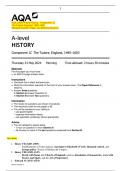
AQA_2024: A-level History - Component 2C
The Reformation in Europe: c.1500–1564
(Merged Question Paper and Marking Scheme)
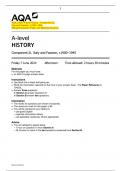
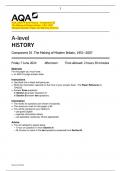
A-level
HISTORY
Component 2C The Reformation in Europe, c1500–1564
Friday 7 June 2024 Afternoon Time allowed: 2 hours 30 minutes
Materials
For this paper you must have:
an AQA 16-page answer book.
Instructions
Use black ink or black ball-point pen.
Write the information required on the front of your answer book. The Paper Reference is
7042/2C.
Answer three questions.
In Section A answer Question 01.
In Section B answer two questions.
Information
The marks for questions are shown in brackets.
The maximum mark for this paper is 80.
You will be marked on your ability to:
– use good English
– organise information clearly
– use specialist vocabulary where appropriate.
Advice
You are advised to spend about:
– 1 hour on Question 01 from Section A
– 45 minutes on each of the two questions answered from Section B.
IB/M/Jun24/G4003/E4
,A-Level History: Component 2C - The Reformation in Europe, c1500–1564
Exam Summary
This component focuses on the religious, political, and social changes brought about by the Reformation in
Europe, particularly between 1500 and 1564. Key themes include:
The Causes of the Reformation (c1500–1520s): The factors leading to the Reformation, including
the corruption of the Catholic Church, the sale of indulgences, and the rise of humanist ideas. Key
figures like Martin Luther, whose 95 Theses in 1517 challenged Church practices, especially the sale
of indulgences, igniting a widespread religious movement across Europe.
Lutheranism and the Spread of Reform (1517–1540s): The development of Lutheranism as a
separate religious movement, including Luther's theological ideas such as justification by faith alone
and the authority of Scripture. The spread of Lutheran ideas in Germany and other parts of Europe,
and the political and social support for these reforms from princes and cities who sought
independence from papal authority.
The Political and Religious Impact of the Reformation (1520s–1540s): The political ramifications
of the Reformation, including the rise of Protestantism in various regions (especially in Germany,
Scandinavia, and parts of Switzerland). The tensions between Catholic and Protestant rulers, the role
of the Holy Roman Emperor Charles V in attempting to suppress Protestantism, and the split between
Catholicism and the new Protestant denominations.
The English Reformation (1530s–1540s): The role of Henry VIII in the Reformation, particularly
the break from Rome and the establishment of the Church of England. This included the dissolution
of the monasteries, the Act of Supremacy (1534), and the formation of a distinct English religious
identity, though the theological direction of England remained uncertain until later reigns.
The Radical Reformation (1520s–1560s): The rise of more radical Protestant groups, including the
Anabaptists, who sought more significant reforms and often faced persecution from both Catholics
and more moderate Protestants. These groups' beliefs in adult baptism, the separation of church and
state, and rejection of traditional Catholic sacraments set them apart from mainstream Protestantism.
The Catholic Reformation and Counter-Reformation (1540s–1564): The Catholic Church's
response to the Protestant Reformation, including the efforts of figures like Ignatius of Loyola, who
founded the Society of Jesus (Jesuits) in 1534 to spread Catholic reform and education. The Council
of Trent (1545–1563) was convened to address Church corruption, reaffirm Catholic doctrine, and
counter Protestant challenges.
This exam evaluates the key religious, political, and social transformations that occurred during the
Reformation, focusing on the development of Protestantism, the Catholic Church’s response, and the impact
these movements had on European society and politics by 1564.
7042/2C
,
, 2
Section A
Answer Question 01.
Source A
From an official record by the Consistory of Geneva concerning Madame Perrin, 1546.
The Perrin family was powerful and strongly opposed to Calvin.
The wife of Monsieur Perrin appeared and was accused of having danced at Belle Rive
and at the house of Antoine Let. She denied it, although she admitted that she had seen
others dancing. She further acknowledged that she herself enjoyed dancing.
She accused the court of victimising her father, her brother and her brother-in-law and
said that furthermore there was a vendetta against her family. She was reprimanded for 5
this accusation. She said that she wished to help her father and added that he should
only be investigated in private and not in public. She was told that he would be treated in
the same way as anyone else in the city would be treated.
She was again asked to name those who had been dancing. She replied twice that she
would prefer to be corrected by the city magistrates and therefore face civil justice rather 10
than by the Consistory Court as she did not think this a matter for the Consistory.
Source B
From the published minutes of a public meeting in Geneva, ‘Records of Pastors who
Observed a Lecture by Jerome Bolsec’, 1551. Bolsec was a former Catholic priest.
Bolsec has been a doctor of medicine in Paris, but he has come to live in Geneva.
Although he initially supported Calvin, he has now become opposed to his theology.
Bolsec declared:
- that there was a wicked, new opinion, contrary to the Word of God and Holy Scripture,
that before the creation of the world, God had predestined those who were to be saved 5
and those who were to be damned, before he had seen who would be believers
- that he condemned the doctrine of God that we follow, saying that it portrayed God as a
tyrant
- that in saying God had predestined us to life or death, we made God into the author of
evil and injustice 10
- that we provided grounds for the wicked to criticise God, by saying that they could do
nothing about it if they were damned and that their actions were therefore no fault of
their own.
IB/M/Jun24/7042/2C
, 3
Source C
From a pamphlet, ‘Justifying the Fate of Michael Servetus’, by John Calvin, 1553. This
was published after Servetus, an opponent of Calvin, was burnt at the stake for heresy.
Whoever maintains that wrong occurs when heretics and blasphemers are punished, and
suggests that those involved in punishing the guilty become associated with their crimes
which makes them just as guilty as the original criminals, is mistaken. Let me be clear,
there is no wrong in such an act; heresy must be punished.
This is not a matter for men to oversee and decide for themselves. It is God who speaks 5
and it is clear what law He wishes to see maintained in the Church, even to the end of
the world.
It is God who demands of us such severity, to show us that due honour is paid to Him.
We are obliged to put service to Him above every other human consideration. The
consequence of this is that we spare not family nor the blood of anyone and forget all 10
humanity when the matter is one of His glory. Nothing else matters other than the glory
of God.
0 1 With reference to these sources and your understanding of the historical context,
assess the value of these three sources to an historian studying opposition to
Calvinism in the years 1546 to 1553.
[30 marks]
Turn over for Section B
IB/M/Jun24/7042/2C Turn over ►
, 4
Section B
Answer two questions.
0 2 ‘The secular influence of the Church was greater than its spiritual influence at the
beginning of the 16th century.’
Assess the validity of this view.
[25 marks]
0 3 ‘It was the Catholic authorities’ response, in the years 1517 to 1520, to
Luther’s 95 Theses which made him such a serious threat to the Church.’
Assess the validity of this view.
[25 marks]
0 4 To what extent was the survival of Lutheranism, in the years 1531 to 1536, due to the
strengths of its supporters?
[25 marks]
END OF QUESTIONS
Copyright information
For confidentiality purposes, all acknowledgements of third-party copyright material are published in a separate booklet. This booklet is published after
each live examination series and is available for free download from www.aqa.org.uk
Permission to reproduce all copyright material has been applied for. In some cases, efforts to contact copyright-holders may have been unsuccessful and
AQA will be happy to rectify any omissions of acknowledgements. If you have any queries please contact the Copyright Team.
Copyright © 2024 AQA and its licensors. All rights reserved.
IB/M/Jun24/7042/2C
The Reformation in Europe: c.1500–1564
(Merged Question Paper and Marking Scheme)
A-level
HISTORY
Component 2C The Reformation in Europe, c1500–1564
Friday 7 June 2024 Afternoon Time allowed: 2 hours 30 minutes
Materials
For this paper you must have:
an AQA 16-page answer book.
Instructions
Use black ink or black ball-point pen.
Write the information required on the front of your answer book. The Paper Reference is
7042/2C.
Answer three questions.
In Section A answer Question 01.
In Section B answer two questions.
Information
The marks for questions are shown in brackets.
The maximum mark for this paper is 80.
You will be marked on your ability to:
– use good English
– organise information clearly
– use specialist vocabulary where appropriate.
Advice
You are advised to spend about:
– 1 hour on Question 01 from Section A
– 45 minutes on each of the two questions answered from Section B.
IB/M/Jun24/G4003/E4
,A-Level History: Component 2C - The Reformation in Europe, c1500–1564
Exam Summary
This component focuses on the religious, political, and social changes brought about by the Reformation in
Europe, particularly between 1500 and 1564. Key themes include:
The Causes of the Reformation (c1500–1520s): The factors leading to the Reformation, including
the corruption of the Catholic Church, the sale of indulgences, and the rise of humanist ideas. Key
figures like Martin Luther, whose 95 Theses in 1517 challenged Church practices, especially the sale
of indulgences, igniting a widespread religious movement across Europe.
Lutheranism and the Spread of Reform (1517–1540s): The development of Lutheranism as a
separate religious movement, including Luther's theological ideas such as justification by faith alone
and the authority of Scripture. The spread of Lutheran ideas in Germany and other parts of Europe,
and the political and social support for these reforms from princes and cities who sought
independence from papal authority.
The Political and Religious Impact of the Reformation (1520s–1540s): The political ramifications
of the Reformation, including the rise of Protestantism in various regions (especially in Germany,
Scandinavia, and parts of Switzerland). The tensions between Catholic and Protestant rulers, the role
of the Holy Roman Emperor Charles V in attempting to suppress Protestantism, and the split between
Catholicism and the new Protestant denominations.
The English Reformation (1530s–1540s): The role of Henry VIII in the Reformation, particularly
the break from Rome and the establishment of the Church of England. This included the dissolution
of the monasteries, the Act of Supremacy (1534), and the formation of a distinct English religious
identity, though the theological direction of England remained uncertain until later reigns.
The Radical Reformation (1520s–1560s): The rise of more radical Protestant groups, including the
Anabaptists, who sought more significant reforms and often faced persecution from both Catholics
and more moderate Protestants. These groups' beliefs in adult baptism, the separation of church and
state, and rejection of traditional Catholic sacraments set them apart from mainstream Protestantism.
The Catholic Reformation and Counter-Reformation (1540s–1564): The Catholic Church's
response to the Protestant Reformation, including the efforts of figures like Ignatius of Loyola, who
founded the Society of Jesus (Jesuits) in 1534 to spread Catholic reform and education. The Council
of Trent (1545–1563) was convened to address Church corruption, reaffirm Catholic doctrine, and
counter Protestant challenges.
This exam evaluates the key religious, political, and social transformations that occurred during the
Reformation, focusing on the development of Protestantism, the Catholic Church’s response, and the impact
these movements had on European society and politics by 1564.
7042/2C
,
, 2
Section A
Answer Question 01.
Source A
From an official record by the Consistory of Geneva concerning Madame Perrin, 1546.
The Perrin family was powerful and strongly opposed to Calvin.
The wife of Monsieur Perrin appeared and was accused of having danced at Belle Rive
and at the house of Antoine Let. She denied it, although she admitted that she had seen
others dancing. She further acknowledged that she herself enjoyed dancing.
She accused the court of victimising her father, her brother and her brother-in-law and
said that furthermore there was a vendetta against her family. She was reprimanded for 5
this accusation. She said that she wished to help her father and added that he should
only be investigated in private and not in public. She was told that he would be treated in
the same way as anyone else in the city would be treated.
She was again asked to name those who had been dancing. She replied twice that she
would prefer to be corrected by the city magistrates and therefore face civil justice rather 10
than by the Consistory Court as she did not think this a matter for the Consistory.
Source B
From the published minutes of a public meeting in Geneva, ‘Records of Pastors who
Observed a Lecture by Jerome Bolsec’, 1551. Bolsec was a former Catholic priest.
Bolsec has been a doctor of medicine in Paris, but he has come to live in Geneva.
Although he initially supported Calvin, he has now become opposed to his theology.
Bolsec declared:
- that there was a wicked, new opinion, contrary to the Word of God and Holy Scripture,
that before the creation of the world, God had predestined those who were to be saved 5
and those who were to be damned, before he had seen who would be believers
- that he condemned the doctrine of God that we follow, saying that it portrayed God as a
tyrant
- that in saying God had predestined us to life or death, we made God into the author of
evil and injustice 10
- that we provided grounds for the wicked to criticise God, by saying that they could do
nothing about it if they were damned and that their actions were therefore no fault of
their own.
IB/M/Jun24/7042/2C
, 3
Source C
From a pamphlet, ‘Justifying the Fate of Michael Servetus’, by John Calvin, 1553. This
was published after Servetus, an opponent of Calvin, was burnt at the stake for heresy.
Whoever maintains that wrong occurs when heretics and blasphemers are punished, and
suggests that those involved in punishing the guilty become associated with their crimes
which makes them just as guilty as the original criminals, is mistaken. Let me be clear,
there is no wrong in such an act; heresy must be punished.
This is not a matter for men to oversee and decide for themselves. It is God who speaks 5
and it is clear what law He wishes to see maintained in the Church, even to the end of
the world.
It is God who demands of us such severity, to show us that due honour is paid to Him.
We are obliged to put service to Him above every other human consideration. The
consequence of this is that we spare not family nor the blood of anyone and forget all 10
humanity when the matter is one of His glory. Nothing else matters other than the glory
of God.
0 1 With reference to these sources and your understanding of the historical context,
assess the value of these three sources to an historian studying opposition to
Calvinism in the years 1546 to 1553.
[30 marks]
Turn over for Section B
IB/M/Jun24/7042/2C Turn over ►
, 4
Section B
Answer two questions.
0 2 ‘The secular influence of the Church was greater than its spiritual influence at the
beginning of the 16th century.’
Assess the validity of this view.
[25 marks]
0 3 ‘It was the Catholic authorities’ response, in the years 1517 to 1520, to
Luther’s 95 Theses which made him such a serious threat to the Church.’
Assess the validity of this view.
[25 marks]
0 4 To what extent was the survival of Lutheranism, in the years 1531 to 1536, due to the
strengths of its supporters?
[25 marks]
END OF QUESTIONS
Copyright information
For confidentiality purposes, all acknowledgements of third-party copyright material are published in a separate booklet. This booklet is published after
each live examination series and is available for free download from www.aqa.org.uk
Permission to reproduce all copyright material has been applied for. In some cases, efforts to contact copyright-holders may have been unsuccessful and
AQA will be happy to rectify any omissions of acknowledgements. If you have any queries please contact the Copyright Team.
Copyright © 2024 AQA and its licensors. All rights reserved.
IB/M/Jun24/7042/2C