
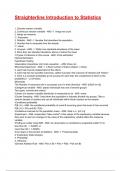
Straighterline Introduction to Statistics
1. Discrete random variable
2. Continuous random variable - ANS -1. things we count
2. things we measure
\1. Parameter
2. Statistic - ANS -1. Number that describes the population
2. Number that is computed from the sample
\1. Usual
2. Unusual - ANS -1. Within two standards deviations of the mean
2. More than two standard deviations above or below the mean
\3 Types of inference in this course - ANS -Point estimation
Interval Estimation
Hypothesis Testing
\Association (does/does not) imply causation. - ANS -Does not
\Binomial Experiment - ANS -1. a fixed number of trials (notation: n trials)
2. each trial must be independent of the others
3. each trial has two possible outcomes, called "success" (the outcome of interest) and "failure"
4. there is a constant probability (p) of success for each trial, the complement of which is the
probability (1 - p) of failure
\Binomials
The Number of outcomes with x successes out of n trials (formula) - ANS -[n!]/[x!*(n-x)!]
\Categorical variable - ANS -places individuals into one of several groups
Two types: nominal and ordinal
\Center of a random variable distribution is measured by its - ANS -mean
\Cluster Sampling - ANS -Used when the population is naturally divided into groups. Take a
random sample of clusters and use all individuals within those clusters as the sample.
\Conditional probability
P(B | A) - ANS -the conditional probability of event B occurring given that event A has occurred
P(B | A) = P(A and B) / P(A).
\Confidence intervals for the population mean - ANS -Xhat ± z∗⋅[σ/(√n)]
\Experiment - ANS -researchers "take control" of the values of the explanatory variable because
they want to see how changes in the value of the explanatory variable affect the response
variable
\Finding an outlier using IQR - ANS -An observation is considered a suspected outlier if it is:
less than Q1 - 1.5(IQR), or
more than Q3 + 1.5(IQR).
\Four steps in the process of statistics - ANS -1. Producing Data
2. Exploratory Data Analysis
3. Probability
4. Inference
\General Addition Rule - ANS -P(A or B) = P(A) + P(B) - P(A and B)
1. Discrete random variable
2. Continuous random variable - ANS -1. things we count
2. things we measure
\1. Parameter
2. Statistic - ANS -1. Number that describes the population
2. Number that is computed from the sample
\1. Usual
2. Unusual - ANS -1. Within two standards deviations of the mean
2. More than two standard deviations above or below the mean
\3 Types of inference in this course - ANS -Point estimation
Interval Estimation
Hypothesis Testing
\Association (does/does not) imply causation. - ANS -Does not
\Binomial Experiment - ANS -1. a fixed number of trials (notation: n trials)
2. each trial must be independent of the others
3. each trial has two possible outcomes, called "success" (the outcome of interest) and "failure"
4. there is a constant probability (p) of success for each trial, the complement of which is the
probability (1 - p) of failure
\Binomials
The Number of outcomes with x successes out of n trials (formula) - ANS -[n!]/[x!*(n-x)!]
\Categorical variable - ANS -places individuals into one of several groups
Two types: nominal and ordinal
\Center of a random variable distribution is measured by its - ANS -mean
\Cluster Sampling - ANS -Used when the population is naturally divided into groups. Take a
random sample of clusters and use all individuals within those clusters as the sample.
\Conditional probability
P(B | A) - ANS -the conditional probability of event B occurring given that event A has occurred
P(B | A) = P(A and B) / P(A).
\Confidence intervals for the population mean - ANS -Xhat ± z∗⋅[σ/(√n)]
\Experiment - ANS -researchers "take control" of the values of the explanatory variable because
they want to see how changes in the value of the explanatory variable affect the response
variable
\Finding an outlier using IQR - ANS -An observation is considered a suspected outlier if it is:
less than Q1 - 1.5(IQR), or
more than Q3 + 1.5(IQR).
\Four steps in the process of statistics - ANS -1. Producing Data
2. Exploratory Data Analysis
3. Probability
4. Inference
\General Addition Rule - ANS -P(A or B) = P(A) + P(B) - P(A and B)


