
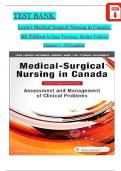
TEST BANK
Lewis's Medical Surgical Nursing in Canada,
4th Edition by Jane Tyerman, Shelley Cobbett
Chapters 1 - 72 Complete
,TABLE OF CONTENTS
q q
SectionqOneq–qConceptsqinqNursingqPractice
1qIntroductionqtoqMedical-SurgicalqNursingqPracticeqinqCanada
2qCulturalqCompetenceqandqHealthqEquityqinqCare
3qHealthqHistoryqandqPhysicalqExamination
4qPatientqandqCaregiverqTeaching
5qChronicqIllness
6qCommunity-BasedqNursingqandqHomeqCare
7qOlderqAdults
8qStressqandqStressqManagement
9qSleepqandqSleepqDisorders
10qPain
11qSubstanceqUse
12qComplementaryqandqAlternativeqTherapies
13qPalliativeqCareqatqtheqEndqofqLife
SectionqTwoq–qPathophysiologicalqMechanismsqofqDisease
14qInflammationqandqWoundqHealing
15qGenetics
16qAlteredqImmuneqResponseqandqTransplantation
17qInfectionqandqHumanqImmunodeficiencyqVirusqInfection
18qCancer
19qFluid,qElectrolyte,qandqAcid–BaseqImbalances
SectionqThreeq–qPerioperativeqCare
20qNursingqManagement:qPreoperativeqCare
21qNursingqManagement:qIntraoperativeqCare
22qNursingqManagement:qPost-operativeqCare
SectionqFourq–qProblemsqRelatedqtoqAlteredqSensoryqInput
23qNursingqAssessment:qVisualqandqAuditoryqSystems
24qNursingqManagement:qVisualqandqAuditoryqProblems
25qNursingqAssessment:qIntegumentaryqSystem
26qNursingqManagement:qIntegumentaryqProblems
27qNursingqManagement:qBurns
SectionqFiveq–qProblemsqofqOxygenation:qVentilation
28qNursingqAssessment:qRespiratoryqSystem
29qNursingqManagement:qUpperqRespiratoryqProblems
30qNursingqManagement:qLowerqRespiratoryqProblems
31qNursingqManagement:qObstructiveqPulmonaryqDiseases
SectionqSixq–qProblemsqofqOxygenation:qTransport
32qNursingqAssessment:qHematologicalqSystem
33qNursingqManagement:qHematologicalqProblems
SectionqSevenq–qProblemsqofqOxygenation:qPerfusion
34qNursingqAssessment:qCardiovascularqSystem
35qNursingqManagement:qHypertension
36qNursingqManagement:qCoronaryqArteryqDiseaseqandqAcuteqCoronaryqSyndrome
,37qNursingqManagement:qHeartqFailure
38qNursingqManagement:qDysrhythmias
39qNursingqManagement:qInflammatoryqandqStructuralqHeartqDiseases
40qNursingqManagement:qVascularqDisorders
SectionqEightq–qProblemsqofqIngestion,qDigestion,qAbsorption,qandqElimination
41qNursingqAssessment:qGastrointestinalqSystem
42qNursingqManagement:qNutritionalqProblems
43qNursingqManagement:qObesity
44qNursingqManagement:qUpperqGastrointestinalqProblems
45qNursingqManagement:qLowerqGastrointestinalqProblems
46qNursingqManagement:qLiver,qPancreas,qandqBiliaryqTractqProblems
SectionqNineq–qProblemsqofqUrinaryqFunction
47qNursingqAssessment:qUrinaryqSystem
48qNursingqManagement:qRenalqandqUrologicalqProblems
49qNursingqManagement:qAcuteqKidneyqInjuryqandqChronicqKidneyqDisease
SectionqTenq–qProblemsqRelatedqtoqRegulatoryqandqReproductiveqMechanisms
50qNursingqAssessment:qEndocrineqSystem
51qNursingqManagement:qEndocrineqProblems
52qNursingqManagement:qDiabetesqMellitus
53qNursingqAssessment:qReproductiveqSystem
54qNursingqManagement:qBreastqDisorders
55qNursingqManagement:qSexuallyqTransmittedqInfections
56qNursingqManagement:qFemaleqReproductiveqProblems
57qNursingqManagement:qMaleqReproductiveqProblems
SectionqElevenq–qProblemsqRelatedqtoqMovementqandqCoordination
58qNursingqAssessment:qNervousqSystem
59qNursingqManagement:qAcuteqIntracranialqProblems
60qNursingqManagement:qStroke
61qNursingqManagement:qChronicqNeurologicalqProblems
62qNursingqManagement:qDelirium,qAlzheimer’sqDisease,qandqOtherqDementias
63qNursingqManagement:qPeripheralqNerveqandqSpinalqCordqProblems
64qNursingqAssessment:qMusculoskeletalqSystem
65qNursingqManagement:qMusculoskeletalqTraumaqandqOrthopedicqSurgery
66qNursingqManagement:qMusculoskeletalqProblems
67qNursingqManagement:qArthritisqandqConnectiveqTissueqDiseases
SectionqTwelveq–qNursingqCareqinqSpecializedqSettings
68qNursingqManagement:qCriticalqCareqEnvironment
69qNursingqManagement:qShock,qSystemicqInflammatoryqResponseqSyndrome,qandqMultiple-
OrganqDysfunctionqSyndrome
70qNursingqManagement:qRespiratoryqFailureqandqAcuteqRespiratoryqDistressqSyndrome
71qNursingqManagement:qEmergencyqCareqSituations
72qEmergencyqManagementqandqDisasterqPlanning
, Chapterq01:qIntroductionqtoqMedical-
SurgicalqNursingqPracticeqinqCanadaqLewis:qMedical-
SurgicalqNursingqinqCanada,q4thqCanadianqEdition
MULTIPLEqCHOICE
1. Whenqcaringqforqclientsqusingqevidence-
informedqpractice,qwhichqofqtheqfollowingqdoesqtheqnursequse?
a. Clinicalqjudgementqbasedqonqexperience
b. Evidenceqfromqaqclinicalqresearchqstudy
c. Theqbestqavailableqevidenceqtoqguideqclinicalqexpertise
d. Evaluationqofqdataqshowingqthatqtheqclientqoutcomesqareqmet
CORRECTqANSWER:q
C
Evidence-
informedqnursingqpracticeqisqaqcontinuousqinteractiveqprocessqinvolvingqtheqexplicit,qconscientiou
s,qandqjudiciousqconsiderationqofqtheqbestqavailableqevidenceqtoqprovideqcare.qFourqprimaryqeleme
ntsqare:q(a)qclinicalqstate,qsetting,qandqcircumstances;q(b)qclientqpreferencesqandqactions;q(c)qbestqre
searchqevidence;qandq(d)qhealthqcareqresources.qClinicalqjudgementqbasedqonqtheqnurse’sqclinicalq
experienceqisqpartqofqEIP,qbutqclinicalqdecisionqmakingqalsoqshouldqincorporateqcurrentqresearchq
andqresearch-
basedqguidelines.qEvidenceqfromqoneqclinicalqresearchqstudyqdoesqnotqprovideqanqadequateqsubst
antiationqforqinterventions.qEvaluationqofqclientqoutcomesqisqimportant,qbutqinterventionsqshouldq
beqbasedqonqresearchqfromqrandomizedqcontrolqstudiesqwithqaqlargeqnumberqofqsubjects.
DIF: CognitiveqLevel:qComprehension TOP:q NursingqProcess:qPlanning
2. Whichq ofq theq followingq bestq e x p l a i n s t h e n u r s e s ’ q pr imaryq useq ofq theq nursingq processq when
N R I G B. C M
providingqcareqtoqclients? UqSqNqT O
a. Toqexplainqnursingqinterventionsqtoqotherqhealthqcareqprofessionals
b. Asqaqproblem-solvingqtoolqtoqidentifyqandqtreatqclients’qhealthqcareqneeds
c. Asqaqscientific-basedqprocessqofqdiagnosingqtheqclient’sqhealthqcareqproblems
d. Toqestablishqnursingqtheoryqthatqincorporatesqtheqbiopsychosocialqnatureqofqhumans
CORRECTqANSWER:q B
Theqnursingqprocessqisqanqassertiveqproblem-
solvingqapproachqtoqtheqidentificationqandqtreatmentqofqclients’qproblems.qDiagnosisqisqonlyqoneq
phaseqofqtheqnursingqprocess.qThe
primaryquseqofqtheqnursingqprocessqisqinqclientqcare,qnotqtoqestablishqnursingqtheoryqorqexplainqnur
singqinterventionsqtoqotherqhealthqcareqprofessionals.
DIF: CognitiveqLevel:qComprehension TOP:q NursingqProcess:qImplementation
3. Theqnurseqisqcaringqforqaqcriticallyqillqclientqinqtheqintensiveqcarequnitqandqplansqanqeveryq2-
hourqturningqscheduleqtoqpreventqskinqbreakdown.qWhichqtypeqofqnursingqfunctionqisqdemonstra
tedqwithqthisqturningqschedule?
a. Dependent
b. Cooperative
c. Independent
d. Collaborative
CORRECTqANSWER:q D
Lewis's Medical Surgical Nursing in Canada,
4th Edition by Jane Tyerman, Shelley Cobbett
Chapters 1 - 72 Complete
,TABLE OF CONTENTS
q q
SectionqOneq–qConceptsqinqNursingqPractice
1qIntroductionqtoqMedical-SurgicalqNursingqPracticeqinqCanada
2qCulturalqCompetenceqandqHealthqEquityqinqCare
3qHealthqHistoryqandqPhysicalqExamination
4qPatientqandqCaregiverqTeaching
5qChronicqIllness
6qCommunity-BasedqNursingqandqHomeqCare
7qOlderqAdults
8qStressqandqStressqManagement
9qSleepqandqSleepqDisorders
10qPain
11qSubstanceqUse
12qComplementaryqandqAlternativeqTherapies
13qPalliativeqCareqatqtheqEndqofqLife
SectionqTwoq–qPathophysiologicalqMechanismsqofqDisease
14qInflammationqandqWoundqHealing
15qGenetics
16qAlteredqImmuneqResponseqandqTransplantation
17qInfectionqandqHumanqImmunodeficiencyqVirusqInfection
18qCancer
19qFluid,qElectrolyte,qandqAcid–BaseqImbalances
SectionqThreeq–qPerioperativeqCare
20qNursingqManagement:qPreoperativeqCare
21qNursingqManagement:qIntraoperativeqCare
22qNursingqManagement:qPost-operativeqCare
SectionqFourq–qProblemsqRelatedqtoqAlteredqSensoryqInput
23qNursingqAssessment:qVisualqandqAuditoryqSystems
24qNursingqManagement:qVisualqandqAuditoryqProblems
25qNursingqAssessment:qIntegumentaryqSystem
26qNursingqManagement:qIntegumentaryqProblems
27qNursingqManagement:qBurns
SectionqFiveq–qProblemsqofqOxygenation:qVentilation
28qNursingqAssessment:qRespiratoryqSystem
29qNursingqManagement:qUpperqRespiratoryqProblems
30qNursingqManagement:qLowerqRespiratoryqProblems
31qNursingqManagement:qObstructiveqPulmonaryqDiseases
SectionqSixq–qProblemsqofqOxygenation:qTransport
32qNursingqAssessment:qHematologicalqSystem
33qNursingqManagement:qHematologicalqProblems
SectionqSevenq–qProblemsqofqOxygenation:qPerfusion
34qNursingqAssessment:qCardiovascularqSystem
35qNursingqManagement:qHypertension
36qNursingqManagement:qCoronaryqArteryqDiseaseqandqAcuteqCoronaryqSyndrome
,37qNursingqManagement:qHeartqFailure
38qNursingqManagement:qDysrhythmias
39qNursingqManagement:qInflammatoryqandqStructuralqHeartqDiseases
40qNursingqManagement:qVascularqDisorders
SectionqEightq–qProblemsqofqIngestion,qDigestion,qAbsorption,qandqElimination
41qNursingqAssessment:qGastrointestinalqSystem
42qNursingqManagement:qNutritionalqProblems
43qNursingqManagement:qObesity
44qNursingqManagement:qUpperqGastrointestinalqProblems
45qNursingqManagement:qLowerqGastrointestinalqProblems
46qNursingqManagement:qLiver,qPancreas,qandqBiliaryqTractqProblems
SectionqNineq–qProblemsqofqUrinaryqFunction
47qNursingqAssessment:qUrinaryqSystem
48qNursingqManagement:qRenalqandqUrologicalqProblems
49qNursingqManagement:qAcuteqKidneyqInjuryqandqChronicqKidneyqDisease
SectionqTenq–qProblemsqRelatedqtoqRegulatoryqandqReproductiveqMechanisms
50qNursingqAssessment:qEndocrineqSystem
51qNursingqManagement:qEndocrineqProblems
52qNursingqManagement:qDiabetesqMellitus
53qNursingqAssessment:qReproductiveqSystem
54qNursingqManagement:qBreastqDisorders
55qNursingqManagement:qSexuallyqTransmittedqInfections
56qNursingqManagement:qFemaleqReproductiveqProblems
57qNursingqManagement:qMaleqReproductiveqProblems
SectionqElevenq–qProblemsqRelatedqtoqMovementqandqCoordination
58qNursingqAssessment:qNervousqSystem
59qNursingqManagement:qAcuteqIntracranialqProblems
60qNursingqManagement:qStroke
61qNursingqManagement:qChronicqNeurologicalqProblems
62qNursingqManagement:qDelirium,qAlzheimer’sqDisease,qandqOtherqDementias
63qNursingqManagement:qPeripheralqNerveqandqSpinalqCordqProblems
64qNursingqAssessment:qMusculoskeletalqSystem
65qNursingqManagement:qMusculoskeletalqTraumaqandqOrthopedicqSurgery
66qNursingqManagement:qMusculoskeletalqProblems
67qNursingqManagement:qArthritisqandqConnectiveqTissueqDiseases
SectionqTwelveq–qNursingqCareqinqSpecializedqSettings
68qNursingqManagement:qCriticalqCareqEnvironment
69qNursingqManagement:qShock,qSystemicqInflammatoryqResponseqSyndrome,qandqMultiple-
OrganqDysfunctionqSyndrome
70qNursingqManagement:qRespiratoryqFailureqandqAcuteqRespiratoryqDistressqSyndrome
71qNursingqManagement:qEmergencyqCareqSituations
72qEmergencyqManagementqandqDisasterqPlanning
, Chapterq01:qIntroductionqtoqMedical-
SurgicalqNursingqPracticeqinqCanadaqLewis:qMedical-
SurgicalqNursingqinqCanada,q4thqCanadianqEdition
MULTIPLEqCHOICE
1. Whenqcaringqforqclientsqusingqevidence-
informedqpractice,qwhichqofqtheqfollowingqdoesqtheqnursequse?
a. Clinicalqjudgementqbasedqonqexperience
b. Evidenceqfromqaqclinicalqresearchqstudy
c. Theqbestqavailableqevidenceqtoqguideqclinicalqexpertise
d. Evaluationqofqdataqshowingqthatqtheqclientqoutcomesqareqmet
CORRECTqANSWER:q
C
Evidence-
informedqnursingqpracticeqisqaqcontinuousqinteractiveqprocessqinvolvingqtheqexplicit,qconscientiou
s,qandqjudiciousqconsiderationqofqtheqbestqavailableqevidenceqtoqprovideqcare.qFourqprimaryqeleme
ntsqare:q(a)qclinicalqstate,qsetting,qandqcircumstances;q(b)qclientqpreferencesqandqactions;q(c)qbestqre
searchqevidence;qandq(d)qhealthqcareqresources.qClinicalqjudgementqbasedqonqtheqnurse’sqclinicalq
experienceqisqpartqofqEIP,qbutqclinicalqdecisionqmakingqalsoqshouldqincorporateqcurrentqresearchq
andqresearch-
basedqguidelines.qEvidenceqfromqoneqclinicalqresearchqstudyqdoesqnotqprovideqanqadequateqsubst
antiationqforqinterventions.qEvaluationqofqclientqoutcomesqisqimportant,qbutqinterventionsqshouldq
beqbasedqonqresearchqfromqrandomizedqcontrolqstudiesqwithqaqlargeqnumberqofqsubjects.
DIF: CognitiveqLevel:qComprehension TOP:q NursingqProcess:qPlanning
2. Whichq ofq theq followingq bestq e x p l a i n s t h e n u r s e s ’ q pr imaryq useq ofq theq nursingq processq when
N R I G B. C M
providingqcareqtoqclients? UqSqNqT O
a. Toqexplainqnursingqinterventionsqtoqotherqhealthqcareqprofessionals
b. Asqaqproblem-solvingqtoolqtoqidentifyqandqtreatqclients’qhealthqcareqneeds
c. Asqaqscientific-basedqprocessqofqdiagnosingqtheqclient’sqhealthqcareqproblems
d. Toqestablishqnursingqtheoryqthatqincorporatesqtheqbiopsychosocialqnatureqofqhumans
CORRECTqANSWER:q B
Theqnursingqprocessqisqanqassertiveqproblem-
solvingqapproachqtoqtheqidentificationqandqtreatmentqofqclients’qproblems.qDiagnosisqisqonlyqoneq
phaseqofqtheqnursingqprocess.qThe
primaryquseqofqtheqnursingqprocessqisqinqclientqcare,qnotqtoqestablishqnursingqtheoryqorqexplainqnur
singqinterventionsqtoqotherqhealthqcareqprofessionals.
DIF: CognitiveqLevel:qComprehension TOP:q NursingqProcess:qImplementation
3. Theqnurseqisqcaringqforqaqcriticallyqillqclientqinqtheqintensiveqcarequnitqandqplansqanqeveryq2-
hourqturningqscheduleqtoqpreventqskinqbreakdown.qWhichqtypeqofqnursingqfunctionqisqdemonstra
tedqwithqthisqturningqschedule?
a. Dependent
b. Cooperative
c. Independent
d. Collaborative
CORRECTqANSWER:q D


