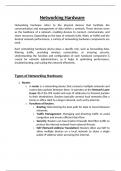
Networking Hardware
Networking hardware refers to the physical devices that facilitate the
communication and management of data within a network. These devices serve
as the backbone of a network, enabling devices to connect, communicate, and
share resources. Depending on the type of network (LAN, WAN, or MAN) and the
desired network performance, a variety of networking hardware components are
used.
Each networking hardware device plays a specific role, such as forwarding data,
filtering traffic, providing wireless connectivity, or ensuring security.
Understanding the function and configuration of each hardware component is
crucial for network administrators, as it helps in optimizing performance,
troubleshooting, and scaling the network effectively.
Types of Networking Hardware:
1. Router:
o A router is a networking device that connects multiple networks and
routes data packets between them. It operates at the Network Layer
(Layer 3) of the OSI model and uses IP addresses to forward packets
to their destinations. Routers typically connect local networks (like a
home or office LAN) to a larger network, such as the internet.
o Functions of Routers:
Routing: Determining the best path for data to travel between
networks.
Traffic Management: Managing and directing traffic to avoid
congestion and ensure efficient data flow.
Security: Routers can have built-in firewalls that filter traffic to
protect the internal network from external threats.
NAT (Network Address Translation): Routers often use NAT to
allow multiple devices on a local network to share a single
public IP address when accessing the internet.
, 2. Switch:
o A switch is a networking device that operates at the Data Link Layer
(Layer 2) of the OSI model. It connects devices within the same
network (usually within a LAN) and forwards data frames based on
their MAC addresses. Switches allow devices within a network to
communicate efficiently, reducing collisions and improving
bandwidth utilization.
o Functions of Switches:
Packet Switching: Forwarding data packets to the correct
destination within a local network.
Traffic Segmentation: Switches divide the network into smaller
segments, reducing network congestion and improving
performance.
Layer 3 Switches: These switches, also known as multilayer
switches, can perform routing functions in addition to
switching, allowing them to route traffic between different
subnets within the same network.
3. Hub:
o A hub is a simple networking device that operates at the Physical
Layer (Layer 1) of the OSI model. It connects multiple devices within
a LAN and broadcasts data packets to all devices on the network.
Unlike switches, hubs do not intelligently direct traffic, which means
they are less efficient and can lead to network congestion.
o Limitations of Hubs:
Collision Domain: Since a hub broadcasts data to all devices, it
creates a collision domain, leading to packet collisions and
data retransmissions.
Limited Bandwidth: All devices connected to a hub share the
same bandwidth, which can slow down the network as more
devices are added.
4. Bridge:
o A bridge is a networking device that connects two or more network
segments at the Data Link Layer (Layer 2). It is used to extend the
range of a network by joining multiple segments and filtering traffic
between them. Bridges examine the MAC addresses of devices on
both sides of the network and forward data only to the segment that
requires it.
Networking hardware refers to the physical devices that facilitate the
communication and management of data within a network. These devices serve
as the backbone of a network, enabling devices to connect, communicate, and
share resources. Depending on the type of network (LAN, WAN, or MAN) and the
desired network performance, a variety of networking hardware components are
used.
Each networking hardware device plays a specific role, such as forwarding data,
filtering traffic, providing wireless connectivity, or ensuring security.
Understanding the function and configuration of each hardware component is
crucial for network administrators, as it helps in optimizing performance,
troubleshooting, and scaling the network effectively.
Types of Networking Hardware:
1. Router:
o A router is a networking device that connects multiple networks and
routes data packets between them. It operates at the Network Layer
(Layer 3) of the OSI model and uses IP addresses to forward packets
to their destinations. Routers typically connect local networks (like a
home or office LAN) to a larger network, such as the internet.
o Functions of Routers:
Routing: Determining the best path for data to travel between
networks.
Traffic Management: Managing and directing traffic to avoid
congestion and ensure efficient data flow.
Security: Routers can have built-in firewalls that filter traffic to
protect the internal network from external threats.
NAT (Network Address Translation): Routers often use NAT to
allow multiple devices on a local network to share a single
public IP address when accessing the internet.
, 2. Switch:
o A switch is a networking device that operates at the Data Link Layer
(Layer 2) of the OSI model. It connects devices within the same
network (usually within a LAN) and forwards data frames based on
their MAC addresses. Switches allow devices within a network to
communicate efficiently, reducing collisions and improving
bandwidth utilization.
o Functions of Switches:
Packet Switching: Forwarding data packets to the correct
destination within a local network.
Traffic Segmentation: Switches divide the network into smaller
segments, reducing network congestion and improving
performance.
Layer 3 Switches: These switches, also known as multilayer
switches, can perform routing functions in addition to
switching, allowing them to route traffic between different
subnets within the same network.
3. Hub:
o A hub is a simple networking device that operates at the Physical
Layer (Layer 1) of the OSI model. It connects multiple devices within
a LAN and broadcasts data packets to all devices on the network.
Unlike switches, hubs do not intelligently direct traffic, which means
they are less efficient and can lead to network congestion.
o Limitations of Hubs:
Collision Domain: Since a hub broadcasts data to all devices, it
creates a collision domain, leading to packet collisions and
data retransmissions.
Limited Bandwidth: All devices connected to a hub share the
same bandwidth, which can slow down the network as more
devices are added.
4. Bridge:
o A bridge is a networking device that connects two or more network
segments at the Data Link Layer (Layer 2). It is used to extend the
range of a network by joining multiple segments and filtering traffic
between them. Bridges examine the MAC addresses of devices on
both sides of the network and forward data only to the segment that
requires it.