Networking Models
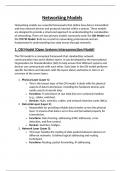
Networking models are essential frameworks that define how data is transmitted
and how network devices and protocols interact within a system. These models
are designed to provide a structured approach to understanding the complexities
of networking. There are two primary models commonly used: the OSI Model and
the TCP/IP Model. Both are crucial for networking professionals and are
fundamental in understanding how data moves through networks.
1. OSI Model (Open Systems Interconnection Model)
The OSI model is a conceptual framework that standardizes network
communication into seven distinct layers. It was developed by the International
Organization for Standardization (ISO) to help ensure that different systems and
devices can communicate with each other. Each layer in the OSI model performs
specific functions and interacts with the layers above and below it. Here is an
overview of the seven layers:
1. Physical Layer (Layer 1):
o This is the lowest layer of the OSI model. It deals with the physical
aspects of data transmission, including the hardware devices and
media used to transmit data.
o Functions: Transmission of raw data bits over a physical medium
(e.g., cables, switches).
o Devices: Hubs, switches, cables, and network interface cards (NICs).
2. Data Link Layer (Layer 2):
o Responsible for providing reliable data transfer across the physical
layer. It ensures that data is error-free and formatted properly for
transmission.
o Functions: Data framing, addressing (MAC addresses), error
detection, and flow control.
o Devices: Switches, bridges.
3. Network Layer (Layer 3):
o This layer handles the routing of data packets between devices on
different networks. It defines logical addressing and routing
techniques.
o Functions: Routing, packet forwarding, IP addressing.
Networking models are essential frameworks that define how data is transmitted
and how network devices and protocols interact within a system. These models
are designed to provide a structured approach to understanding the complexities
of networking. There are two primary models commonly used: the OSI Model and
the TCP/IP Model. Both are crucial for networking professionals and are
fundamental in understanding how data moves through networks.
1. OSI Model (Open Systems Interconnection Model)
The OSI model is a conceptual framework that standardizes network
communication into seven distinct layers. It was developed by the International
Organization for Standardization (ISO) to help ensure that different systems and
devices can communicate with each other. Each layer in the OSI model performs
specific functions and interacts with the layers above and below it. Here is an
overview of the seven layers:
1. Physical Layer (Layer 1):
o This is the lowest layer of the OSI model. It deals with the physical
aspects of data transmission, including the hardware devices and
media used to transmit data.
o Functions: Transmission of raw data bits over a physical medium
(e.g., cables, switches).
o Devices: Hubs, switches, cables, and network interface cards (NICs).
2. Data Link Layer (Layer 2):
o Responsible for providing reliable data transfer across the physical
layer. It ensures that data is error-free and formatted properly for
transmission.
o Functions: Data framing, addressing (MAC addresses), error
detection, and flow control.
o Devices: Switches, bridges.
3. Network Layer (Layer 3):
o This layer handles the routing of data packets between devices on
different networks. It defines logical addressing and routing
techniques.
o Functions: Routing, packet forwarding, IP addressing.