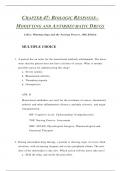
C HAPTER 47: B IOLOGIC R ESPONSE –
M ODIFYING AND A NTIRHEUMATIC D RUGS
Lilley: Pharmacology and the Nursing Process, 10th Edition
MULTIPLE CHOICE
1. A patient has an order for the monoclonal antibody adalimumab. The nurse
notes that the patient does not have a history of cancer. What is another
possible reason for administering this drug?
a. Severe anemia
b. Rheumatoid arthritis
c. Thrombocytopenia
d. Osteoporosis
ANS: B
Monoclonal antibodies are used for the treatment of cancer, rheumatoid
arthritis and other inflammatory diseases, multiple sclerosis, and organ
transplantation.
DIF: Cognitive Level: Understanding (Comprehension)
TOP: Nursing Process: Assessment
MSC: NC LEX: Physiological Integrit y: Pharmacological and
Parenteral Therapies
2. During interleukin drug therapy, a patient is showing signs of severe fluid
retention, with increasing dyspnea and severe peripheral edema. The next
dose of the interleukin is due now. Which action will the nurse take next?
a. Hold the drug, and notify the prescriber.
, b. Give the drug, and notify the prescriber.
c. Give the drug along with acetaminophen and diphenhydramine.
d. Monitor the patient for 2 hours, and then gi ve the drug if the
patient’s condition improves.
ANS: A
The fluid retention that may occur with interleukin therapy is
reversible; if therapy is stopped, the prescriber must be notified. The
other options are incorrect.
DIF: Cognitive Level: Appl ying (App lication)
TOP: Nursing Process: Implementation
MSC: NC LEX: Physiological Integrit y: Pharmacological and
Parenteral Therapies
3. The nurse is administering an interferon and will implement which
intervention?
a. Giving the medication with meals
b. Monitoring dail y weights
c. Limiting fluids while the patient is taking this medication
d. Rotating injection sites
ANS: D
Interferon is given parenterall y (not orally), and injection sites need to
be rotated. Fluids need to be increased during interferon therapy. The
other options are incorrect.
DIF: Cognitive Level: Appl ying (Application)
TOP: Nursing Process: Implementation
MSC: NC LEX: Physiological Integrit y: Pharmacological and
Parenteral Therapies
M ODIFYING AND A NTIRHEUMATIC D RUGS
Lilley: Pharmacology and the Nursing Process, 10th Edition
MULTIPLE CHOICE
1. A patient has an order for the monoclonal antibody adalimumab. The nurse
notes that the patient does not have a history of cancer. What is another
possible reason for administering this drug?
a. Severe anemia
b. Rheumatoid arthritis
c. Thrombocytopenia
d. Osteoporosis
ANS: B
Monoclonal antibodies are used for the treatment of cancer, rheumatoid
arthritis and other inflammatory diseases, multiple sclerosis, and organ
transplantation.
DIF: Cognitive Level: Understanding (Comprehension)
TOP: Nursing Process: Assessment
MSC: NC LEX: Physiological Integrit y: Pharmacological and
Parenteral Therapies
2. During interleukin drug therapy, a patient is showing signs of severe fluid
retention, with increasing dyspnea and severe peripheral edema. The next
dose of the interleukin is due now. Which action will the nurse take next?
a. Hold the drug, and notify the prescriber.
, b. Give the drug, and notify the prescriber.
c. Give the drug along with acetaminophen and diphenhydramine.
d. Monitor the patient for 2 hours, and then gi ve the drug if the
patient’s condition improves.
ANS: A
The fluid retention that may occur with interleukin therapy is
reversible; if therapy is stopped, the prescriber must be notified. The
other options are incorrect.
DIF: Cognitive Level: Appl ying (App lication)
TOP: Nursing Process: Implementation
MSC: NC LEX: Physiological Integrit y: Pharmacological and
Parenteral Therapies
3. The nurse is administering an interferon and will implement which
intervention?
a. Giving the medication with meals
b. Monitoring dail y weights
c. Limiting fluids while the patient is taking this medication
d. Rotating injection sites
ANS: D
Interferon is given parenterall y (not orally), and injection sites need to
be rotated. Fluids need to be increased during interferon therapy. The
other options are incorrect.
DIF: Cognitive Level: Appl ying (Application)
TOP: Nursing Process: Implementation
MSC: NC LEX: Physiological Integrit y: Pharmacological and
Parenteral Therapies