Social Studies for
Ava
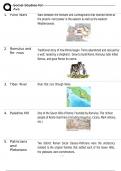
1. Punic Wars Wars between the Romans and Carthaginians that marked Rome as
the preemi- nent power in the eastern as well as the western
Mediterranean.
2. Romulus and Traditional story of how Rome began. Twins abandoned and rescued by
Re- mus
a wolf, raised by a shepherd . Grew to build Rome. Romulus later killed
Remus, and gave Rome its name.
3. Tiber River River that runs through Rome
4. Palatine Hill One of the Seven Hills of Rome; Founded by Romulus. The richest
people of Rome lived here (including Augustus, Cicero, Mark Antony,
etc.)
5. Patricians Two distinct Roman Social Classes--Patricians were the aristocracy
and
(related to the original families that settled each of the Seven Hills),
Plebeians
the plebeians were commoners.
, Social Studies for
Ava
6. Etruscans A people who inhabited early Italy--controlled the area around Rome
around the 7th century BC.
7. Tarquin the 7th Etruscan king, last king of Rome, a harsh tyrant driven from power in
509 B.C.
Proud (? - 495 BC) by the people & the Senate. The people & Senate then established a
Republic.
8. Roman 753-509 BCE--7 kings of Rome, beginning with Romulus in 753 BC, and
monar- chy
ending with Tarquin the Proud in 509 BC.
9. consul An elected oflcial who led the Roman Republic; two elected to serve for
one year; most powerful position in Rome, but there were limits. They
only served a year, and each could veto what the other proposed.
, Social Studies for
Ava
10. Roman Senate a council of wealthy and powerful Romans that advised the city's
leaders; originally a council to advise the King, then a legislative body;
Senators were selected for life terms; consuls rarely ignored or
contradicted the advice of the Senate.
11. Roman Roman oflcial who ruled the conquered land or province for Rome. The
gover- nors
governor would be in charge of the local Roman army and also be
responsible for collecting taxes. This is similar to the Assyria Empire
(where governors selected by the Assyri- an King would administer the
conquered lands) and to the Persian Empire (where the governors were
called "satraps" and the provinces were called "satrapies").
Example: Pontius Pilate in Judea, serving under Emperor Tiberius.
12. Plebeian
assem- bly
Assembly of only plebeians. Made laws and elected 10 people's tribunes.
Eventu- ally could veto laws passed by the Roman Senate.
Ava
1. Punic Wars Wars between the Romans and Carthaginians that marked Rome as
the preemi- nent power in the eastern as well as the western
Mediterranean.
2. Romulus and Traditional story of how Rome began. Twins abandoned and rescued by
Re- mus
a wolf, raised by a shepherd . Grew to build Rome. Romulus later killed
Remus, and gave Rome its name.
3. Tiber River River that runs through Rome
4. Palatine Hill One of the Seven Hills of Rome; Founded by Romulus. The richest
people of Rome lived here (including Augustus, Cicero, Mark Antony,
etc.)
5. Patricians Two distinct Roman Social Classes--Patricians were the aristocracy
and
(related to the original families that settled each of the Seven Hills),
Plebeians
the plebeians were commoners.
, Social Studies for
Ava
6. Etruscans A people who inhabited early Italy--controlled the area around Rome
around the 7th century BC.
7. Tarquin the 7th Etruscan king, last king of Rome, a harsh tyrant driven from power in
509 B.C.
Proud (? - 495 BC) by the people & the Senate. The people & Senate then established a
Republic.
8. Roman 753-509 BCE--7 kings of Rome, beginning with Romulus in 753 BC, and
monar- chy
ending with Tarquin the Proud in 509 BC.
9. consul An elected oflcial who led the Roman Republic; two elected to serve for
one year; most powerful position in Rome, but there were limits. They
only served a year, and each could veto what the other proposed.
, Social Studies for
Ava
10. Roman Senate a council of wealthy and powerful Romans that advised the city's
leaders; originally a council to advise the King, then a legislative body;
Senators were selected for life terms; consuls rarely ignored or
contradicted the advice of the Senate.
11. Roman Roman oflcial who ruled the conquered land or province for Rome. The
gover- nors
governor would be in charge of the local Roman army and also be
responsible for collecting taxes. This is similar to the Assyria Empire
(where governors selected by the Assyri- an King would administer the
conquered lands) and to the Persian Empire (where the governors were
called "satraps" and the provinces were called "satrapies").
Example: Pontius Pilate in Judea, serving under Emperor Tiberius.
12. Plebeian
assem- bly
Assembly of only plebeians. Made laws and elected 10 people's tribunes.
Eventu- ally could veto laws passed by the Roman Senate.