3/15/2026, 1:31:57 PMAccredited test
(Accredited test bank
bank strategic
Accredited
strategic management
test bank
management textstrategic
text
andand cases
management
cases 11th 11th edition
edition text questions
dess and
desscases
questions
11th edition
answers_removed.pdf
answers dess questions
All Chapters answers_removed.pdf
A+: 2026).
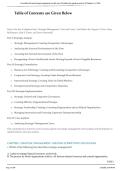
Table of Contents are Given Below
Here is the list of chapters from "Strategic Management: Text and Cases," 11th Edition by Gregory G. Dess, Gerry
McNamara, Alan B. Eisner, and Steve Sauerwald:
Part I: Strategic Analysis
1. Strategic Management: Creating Competitive Advantages
2. Analyzing the External Environment of the Firm
3. Assessing the Internal Environment of the Firm
4. Recognizing a Firm’s Intellectual Assets: Moving beyond a Firm’s Tangible Resources
Part II: Strategic Formulation
5. Business-Level Strategy: Creating and Sustaining Competitive Advantages
6. Corporate-Level Strategy: Creating Value through Diversification
7. International Strategy: Creating Value in Global Markets
8. Entrepreneurial Strategy and Competitive Dynamics
Part III: Strategic Implementation
9. Strategic Control and Corporate Governance
10. Creating Effective Organizational Designs
11. Strategic Leadership: Creating a Learning Organization and an Ethical Organization
12. Managing Innovation and Fostering Corporate Entrepreneurship
Part IV: Case Analysis
13. Analyzing Strategic Management Cases
This comprehensive structure covers various aspects of strategic management, from analysis and formulation to
implementation and case analysis.
CHAPTER 1: STRATEGIC MANAGEMENT: CREATING COMPETITIVE ADVANTAGES
1. Which of the following best describes strategic management?
A. A plan to manage financial resources exclusively.
B. The process by which organizations achieve a fit between internal resources and external opportunities.
PAGE 1
Page 1 of 130
Accredited test bank strategic management text
Accredited
and cases
test
11th
bank
edition
strategic
dess
3/15/2026
management
questions answers_removed.pdf 3/23/2026, 4:16:49 PM
text and cases 11th edition dess questions answers_removed.pdf
,3/15/2026, 1:31:57 PMAccredited test
(Accredited test bank
bank strategic
Accredited
strategic management
test bank
management textstrategic
text
andand cases
management
cases 11th 11th edition
edition text questions
dess and
desscases
questions
11th edition
answers_removed.pdf
answers dess questions
All Chapters answers_removed.pdf
A+: 2026).
C. A set of tactics used to manage day-to-day operations.
D. The exclusive responsibility of the finance department.
Correct Answer: B
Explanation: Strategic management involves the analysis, decisions, and actions an organization undertakes to
create and sustain competitive advantages by aligning the firm’s internal resources with external opportunities.
2. In Dess et al.’s framework, competitive advantage refers to:
A. Financial advantages enjoyed by firms operating in monopoly markets.
B. The ability to consistently outperform rivals in profitability or market share.
C. The size of a firm’s production capacity relative to that of its competitors.
D. A firm’s reputation for philanthropic activities.
Correct Answer: B
Explanation: Competitive advantage occurs when a firm’s strategies enable it to maintain superior
performance relative to competitors over time, such as higher profitability or market share.
3. The strategic management process typically includes:
A. Analysis, formulation, and implementation.
B. Hiring, training, and team-building.
C. Accounting, financing, and budgeting.
D. Sales forecasting, promotional planning, and brand awareness.
Correct Answer: A
Explanation: Strategic management involves analyzing the internal and external environment, formulating
strategies, and implementing them effectively to achieve organizational goals.
4. A key aspect of strategy formulation is:
A. Setting operational budgets.
B. Monitoring daily production schedules.
C. Developing a coherent plan for competitive positioning.
D. Task assignment for frontline employees.
Correct Answer: C
Explanation: Strategy formulation centers on determining how to position the firm against competitors and
how to allocate resources in a way that creates and sustains competitive advantage.
PAGE 2
Page 2 of 130
Accredited test bank strategic management text
Accredited
and cases
test
11th
bank
edition
strategic
dess
3/15/2026
management
questions answers_removed.pdf 3/23/2026, 4:16:49 PM
text and cases 11th edition dess questions answers_removed.pdf
,3/15/2026, 1:31:57 PMAccredited test
(Accredited test bank
bank strategic
Accredited
strategic management
test bank
management textstrategic
text
andand cases
management
cases 11th 11th edition
edition text questions
dess and
desscases
questions
11th edition
answers_removed.pdf
answers dess questions
All Chapters answers_removed.pdf
A+: 2026).
5. Strategic controls differ from financial controls primarily in that:
A. Strategic controls are concerned with short-term performance, while financial controls are for the long term.
B. Strategic controls are future-oriented and qualitative, whereas financial controls are largely quantitative.
C. Financial controls are more flexible than strategic controls.
D. Only strategic controls are used by top management.
Correct Answer: B
Explanation: Strategic controls focus on the content of strategic actions to ensure they align with long-term
goals (qualitative, forward-looking), while financial controls rely on short-term, quantitative performance
measures.
6. Stakeholders of a firm include:
A. Only the firm’s shareholders.
B. Shareholders, employees, suppliers, and customers, but not the local community.
C. Everyone who holds shares, plus the board of directors.
D. Individuals and groups who can affect or are affected by the organization’s actions.
Correct Answer: D
Explanation: Stakeholders encompass all parties—internal and external—who have a stake in the
organization’s performance, including shareholders, employees, customers, suppliers, governments, and
communities.
7. The hierarchy of organizational goals typically consists of:
A. Corporate, competitive, and functional strategies.
B. Vision, mission, and strategic objectives.
C. Leadership, motivation, and control.
D. Tactics, guidelines, and procedures.
Correct Answer: B
Explanation: Organizations often articulate a broad vision, which is then translated into a mission statement
and further detailed into specific strategic objectives.
8. A strong organizational vision should:
A. Provide detailed guidance for all managerial decisions.
B. Be broad, inspiring, and provide a long-term direction.
C. Focus solely on short-term profit maximization.
D. Be updated weekly to maintain relevance.
PAGE 3
Page 3 of 130
Accredited test bank strategic management text
Accredited
and cases
test
11th
bank
edition
strategic
dess
3/15/2026
management
questions answers_removed.pdf 3/23/2026, 4:16:49 PM
text and cases 11th edition dess questions answers_removed.pdf
, 3/15/2026, 1:31:57 PMAccredited test
(Accredited test bank
bank strategic
Accredited
strategic management
test bank
management textstrategic
text
andand cases
management
cases 11th 11th edition
edition text questions
dess and
desscases
questions
11th edition
answers_removed.pdf
answers dess questions
All Chapters answers_removed.pdf
A+: 2026).
Correct Answer: B
Explanation: A vision statement paints a broad, motivational picture of what an organization aspires to achieve
in the long run, inspiring stakeholders and guiding strategic decisions.
9. Mission statements are typically:
A. Vague descriptions of the industry.
B. Statements of the firm’s reason for being and its stakeholders.
C. Synonymous with firm slogans.
D. Legally binding documents for shareholders.
Correct Answer: B
Explanation: A mission statement describes the company’s purpose and the scope of its operations, clarifying
why it exists and which stakeholders it aims to serve.
10. Environmental scanning, in the context of strategic management, is:
A. Assessing financial reports for quarterly performance.
B. Searching and analyzing the external environment to spot trends and events.
C. Monitoring in-house compliance procedures.
D. Only relevant in government or public-sector organizations.
Correct Answer: B
Explanation: Environmental scanning involves monitoring the broader external environment to identify early
signals of changes, trends, and events that might affect a firm’s strategic position.
11. Which of the following is not a typical benefit of effective strategic management?
A. Enhanced coordination across different organizational levels.
B. Greater resistance to environmental changes.
C. More innovative thinking within the organization.
D. More efficient resource allocation.
Correct Answer: B
Explanation: Strategic management promotes adaptability, not resistance. Organizations aim to anticipate and
respond to changes rather than resist them.
12. Corporate-level strategy focuses on:
A. How each business unit competes in a particular industry.
B. Long-term financing mechanisms.
PAGE 4
Page 4 of 130
Accredited test bank strategic management text
Accredited
and cases
test
11th
bank
edition
strategic
dess
3/15/2026
management
questions answers_removed.pdf 3/23/2026, 4:16:49 PM
text and cases 11th edition dess questions answers_removed.pdf
(Accredited test bank
bank strategic
Accredited
strategic management
test bank
management textstrategic
text
andand cases
management
cases 11th 11th edition
edition text questions
dess and
desscases
questions
11th edition
answers_removed.pdf
answers dess questions
All Chapters answers_removed.pdf
A+: 2026).
Table of Contents are Given Below
Here is the list of chapters from "Strategic Management: Text and Cases," 11th Edition by Gregory G. Dess, Gerry
McNamara, Alan B. Eisner, and Steve Sauerwald:
Part I: Strategic Analysis
1. Strategic Management: Creating Competitive Advantages
2. Analyzing the External Environment of the Firm
3. Assessing the Internal Environment of the Firm
4. Recognizing a Firm’s Intellectual Assets: Moving beyond a Firm’s Tangible Resources
Part II: Strategic Formulation
5. Business-Level Strategy: Creating and Sustaining Competitive Advantages
6. Corporate-Level Strategy: Creating Value through Diversification
7. International Strategy: Creating Value in Global Markets
8. Entrepreneurial Strategy and Competitive Dynamics
Part III: Strategic Implementation
9. Strategic Control and Corporate Governance
10. Creating Effective Organizational Designs
11. Strategic Leadership: Creating a Learning Organization and an Ethical Organization
12. Managing Innovation and Fostering Corporate Entrepreneurship
Part IV: Case Analysis
13. Analyzing Strategic Management Cases
This comprehensive structure covers various aspects of strategic management, from analysis and formulation to
implementation and case analysis.
CHAPTER 1: STRATEGIC MANAGEMENT: CREATING COMPETITIVE ADVANTAGES
1. Which of the following best describes strategic management?
A. A plan to manage financial resources exclusively.
B. The process by which organizations achieve a fit between internal resources and external opportunities.
PAGE 1
Page 1 of 130
Accredited test bank strategic management text
Accredited
and cases
test
11th
bank
edition
strategic
dess
3/15/2026
management
questions answers_removed.pdf 3/23/2026, 4:16:49 PM
text and cases 11th edition dess questions answers_removed.pdf
,3/15/2026, 1:31:57 PMAccredited test
(Accredited test bank
bank strategic
Accredited
strategic management
test bank
management textstrategic
text
andand cases
management
cases 11th 11th edition
edition text questions
dess and
desscases
questions
11th edition
answers_removed.pdf
answers dess questions
All Chapters answers_removed.pdf
A+: 2026).
C. A set of tactics used to manage day-to-day operations.
D. The exclusive responsibility of the finance department.
Correct Answer: B
Explanation: Strategic management involves the analysis, decisions, and actions an organization undertakes to
create and sustain competitive advantages by aligning the firm’s internal resources with external opportunities.
2. In Dess et al.’s framework, competitive advantage refers to:
A. Financial advantages enjoyed by firms operating in monopoly markets.
B. The ability to consistently outperform rivals in profitability or market share.
C. The size of a firm’s production capacity relative to that of its competitors.
D. A firm’s reputation for philanthropic activities.
Correct Answer: B
Explanation: Competitive advantage occurs when a firm’s strategies enable it to maintain superior
performance relative to competitors over time, such as higher profitability or market share.
3. The strategic management process typically includes:
A. Analysis, formulation, and implementation.
B. Hiring, training, and team-building.
C. Accounting, financing, and budgeting.
D. Sales forecasting, promotional planning, and brand awareness.
Correct Answer: A
Explanation: Strategic management involves analyzing the internal and external environment, formulating
strategies, and implementing them effectively to achieve organizational goals.
4. A key aspect of strategy formulation is:
A. Setting operational budgets.
B. Monitoring daily production schedules.
C. Developing a coherent plan for competitive positioning.
D. Task assignment for frontline employees.
Correct Answer: C
Explanation: Strategy formulation centers on determining how to position the firm against competitors and
how to allocate resources in a way that creates and sustains competitive advantage.
PAGE 2
Page 2 of 130
Accredited test bank strategic management text
Accredited
and cases
test
11th
bank
edition
strategic
dess
3/15/2026
management
questions answers_removed.pdf 3/23/2026, 4:16:49 PM
text and cases 11th edition dess questions answers_removed.pdf
,3/15/2026, 1:31:57 PMAccredited test
(Accredited test bank
bank strategic
Accredited
strategic management
test bank
management textstrategic
text
andand cases
management
cases 11th 11th edition
edition text questions
dess and
desscases
questions
11th edition
answers_removed.pdf
answers dess questions
All Chapters answers_removed.pdf
A+: 2026).
5. Strategic controls differ from financial controls primarily in that:
A. Strategic controls are concerned with short-term performance, while financial controls are for the long term.
B. Strategic controls are future-oriented and qualitative, whereas financial controls are largely quantitative.
C. Financial controls are more flexible than strategic controls.
D. Only strategic controls are used by top management.
Correct Answer: B
Explanation: Strategic controls focus on the content of strategic actions to ensure they align with long-term
goals (qualitative, forward-looking), while financial controls rely on short-term, quantitative performance
measures.
6. Stakeholders of a firm include:
A. Only the firm’s shareholders.
B. Shareholders, employees, suppliers, and customers, but not the local community.
C. Everyone who holds shares, plus the board of directors.
D. Individuals and groups who can affect or are affected by the organization’s actions.
Correct Answer: D
Explanation: Stakeholders encompass all parties—internal and external—who have a stake in the
organization’s performance, including shareholders, employees, customers, suppliers, governments, and
communities.
7. The hierarchy of organizational goals typically consists of:
A. Corporate, competitive, and functional strategies.
B. Vision, mission, and strategic objectives.
C. Leadership, motivation, and control.
D. Tactics, guidelines, and procedures.
Correct Answer: B
Explanation: Organizations often articulate a broad vision, which is then translated into a mission statement
and further detailed into specific strategic objectives.
8. A strong organizational vision should:
A. Provide detailed guidance for all managerial decisions.
B. Be broad, inspiring, and provide a long-term direction.
C. Focus solely on short-term profit maximization.
D. Be updated weekly to maintain relevance.
PAGE 3
Page 3 of 130
Accredited test bank strategic management text
Accredited
and cases
test
11th
bank
edition
strategic
dess
3/15/2026
management
questions answers_removed.pdf 3/23/2026, 4:16:49 PM
text and cases 11th edition dess questions answers_removed.pdf
, 3/15/2026, 1:31:57 PMAccredited test
(Accredited test bank
bank strategic
Accredited
strategic management
test bank
management textstrategic
text
andand cases
management
cases 11th 11th edition
edition text questions
dess and
desscases
questions
11th edition
answers_removed.pdf
answers dess questions
All Chapters answers_removed.pdf
A+: 2026).
Correct Answer: B
Explanation: A vision statement paints a broad, motivational picture of what an organization aspires to achieve
in the long run, inspiring stakeholders and guiding strategic decisions.
9. Mission statements are typically:
A. Vague descriptions of the industry.
B. Statements of the firm’s reason for being and its stakeholders.
C. Synonymous with firm slogans.
D. Legally binding documents for shareholders.
Correct Answer: B
Explanation: A mission statement describes the company’s purpose and the scope of its operations, clarifying
why it exists and which stakeholders it aims to serve.
10. Environmental scanning, in the context of strategic management, is:
A. Assessing financial reports for quarterly performance.
B. Searching and analyzing the external environment to spot trends and events.
C. Monitoring in-house compliance procedures.
D. Only relevant in government or public-sector organizations.
Correct Answer: B
Explanation: Environmental scanning involves monitoring the broader external environment to identify early
signals of changes, trends, and events that might affect a firm’s strategic position.
11. Which of the following is not a typical benefit of effective strategic management?
A. Enhanced coordination across different organizational levels.
B. Greater resistance to environmental changes.
C. More innovative thinking within the organization.
D. More efficient resource allocation.
Correct Answer: B
Explanation: Strategic management promotes adaptability, not resistance. Organizations aim to anticipate and
respond to changes rather than resist them.
12. Corporate-level strategy focuses on:
A. How each business unit competes in a particular industry.
B. Long-term financing mechanisms.
PAGE 4
Page 4 of 130
Accredited test bank strategic management text
Accredited
and cases
test
11th
bank
edition
strategic
dess
3/15/2026
management
questions answers_removed.pdf 3/23/2026, 4:16:49 PM
text and cases 11th edition dess questions answers_removed.pdf