NR 565 Pharmacology Week 1
Study online at https://quizlet.com/_9mhepn
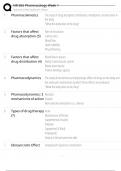
1. Pharmacokinetics The study of drug absorption, distribution, metabolism, and excretion in
the body
"What the body does to the drug"
2. Factors that affect Rate of dissolution
drug absorption (5) Surface area
Blood flow
Lipid solubility
PH partitioning
3. Factors that affect Blood flow to tissues
drug distribution (4) Ability to exit vascular system
Blood-brain barrier
Protein-binding capacity
4. Pharmacodynamics The study of biochemical and physiologic effects of drugs on the body and
the molecular mechanisms by which those effects are produced
"What the body does to the drug"
5. Phamacodynamics: 3 Receptor
mechanisms of action Enzyme
Non-selective interactions (i.e. chemo)
6. Types of drug therapy Acute
(7) Maintenance (HTN/bc)
Supplemental (insulin)
Palliative
Supportive (IV fluid)
Prophylactic
Empirical (broad-spectrum abx)
7. Idiosyncratic Effect Unexpected response to medication
, NR 565 Pharmacology Week 1
Study online at https://quizlet.com/_9mhepn
8. Tolerance Declining response to a drug
9. Dependence Physiological/psychological need for a drug; needs drug for normal func-
tion
10. Addiction Compulsive use of a drug despite negative/dangerous effects
11. Drug interactions: When 2 drugs compete for metabolizing enzymes
drug-drug
12. Drug interactions: Grapefruit juice or leafy greens
food-drug
13. Drug interactions: ad- 1+1 = 2; both provide intended effect
ditive
14. Drug interactions: an- 1+1 = <2; less than desired effect of one or both drugs
tagonistic
15. Drug interactions: 1+1 = >2; sum total effect is greater than if given alone (i.e. lisinopril + HCTZ)
synergistic
16. Drug interactions: in- 1+1 does not equal 2; two IV drugs given together causing decomposition
compatibility of one or both drugs
17. 8 rights of medication Patient
administration Medication
Dose
Route
Time
Reason
Response
Documentation
Study online at https://quizlet.com/_9mhepn
1. Pharmacokinetics The study of drug absorption, distribution, metabolism, and excretion in
the body
"What the body does to the drug"
2. Factors that affect Rate of dissolution
drug absorption (5) Surface area
Blood flow
Lipid solubility
PH partitioning
3. Factors that affect Blood flow to tissues
drug distribution (4) Ability to exit vascular system
Blood-brain barrier
Protein-binding capacity
4. Pharmacodynamics The study of biochemical and physiologic effects of drugs on the body and
the molecular mechanisms by which those effects are produced
"What the body does to the drug"
5. Phamacodynamics: 3 Receptor
mechanisms of action Enzyme
Non-selective interactions (i.e. chemo)
6. Types of drug therapy Acute
(7) Maintenance (HTN/bc)
Supplemental (insulin)
Palliative
Supportive (IV fluid)
Prophylactic
Empirical (broad-spectrum abx)
7. Idiosyncratic Effect Unexpected response to medication
, NR 565 Pharmacology Week 1
Study online at https://quizlet.com/_9mhepn
8. Tolerance Declining response to a drug
9. Dependence Physiological/psychological need for a drug; needs drug for normal func-
tion
10. Addiction Compulsive use of a drug despite negative/dangerous effects
11. Drug interactions: When 2 drugs compete for metabolizing enzymes
drug-drug
12. Drug interactions: Grapefruit juice or leafy greens
food-drug
13. Drug interactions: ad- 1+1 = 2; both provide intended effect
ditive
14. Drug interactions: an- 1+1 = <2; less than desired effect of one or both drugs
tagonistic
15. Drug interactions: 1+1 = >2; sum total effect is greater than if given alone (i.e. lisinopril + HCTZ)
synergistic
16. Drug interactions: in- 1+1 does not equal 2; two IV drugs given together causing decomposition
compatibility of one or both drugs
17. 8 rights of medication Patient
administration Medication
Dose
Route
Time
Reason
Response
Documentation