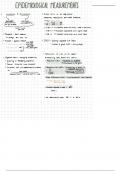
EPIDEMIOLOGICAL MEASUREMENTS
Infidence &
P
revalence > Odds ratio >
- for case-control !
S S measures association between exposure
cases
>
-
for case-control
onthaastation
new
=
↑
·
or
over time
·
if OR = 1 >
-
exposure does not affect odds of outcome
period
if ORL1 exposure associated with higher
>
- odds
·
Prevalence = Static measure if OR < 1- > exposure associated with lower odds
↳
always per 1000 etc.
·
Incidence =
dynamic measure
>
QALY =
Quality Adjusted
-
Life Years
new cases
-
Cumulative
·
=
incidence total cases lived
number of
years utility weight
= x
cases
-new
·incidencerate(m)S
total persone e
=
>
Measures of risk >
- for conort !
1 Dynamic cohort :
changing composition probability that event will occur
Absolute a
group in
growing decreasing population risk events
=
·
·
or
# individuals in that
·
Cannot calculate cum .
Incidence :
group
Incidence Relative risk (RR)
Probabilityofeveniis
· ·
rate via approximation method =
+
-
LD =
I
robability of event in
stawcases end)/2)
a
Persons
un exposed population
ons time C/(c + a)
Risk difference (RD) risk (untreated) (treated
· = -
risk
↳ also : absolute risk
reduction CARR)
=
·
Number needed to treat =
RD
(NNT)
· No association when : RR =
1 or RD = 0
, STUDY BESIGN
Case-control >
Cross-sectional Study
>
study
&
analytical >
etiology
-
Determines potential risk factors in Observes of people at one point in time
a
group
& Relation disease
individuals with condition between exposure -
↳ ↳
retrospective often survey
generally a
↳ ↳
information/Selection bias likely no follow-up time
u To what extend do HPV infections Up How tal are Dutch men and women at ?
agezo
increase the risk of cervical cancer ?
↳
Nested case-control from retrosp cohort
Ecologic Study
=
>
.
-Cohort study Observes variable
at least 7 at
group level
Measures disease within of individuals La Fe
group .
looking at association between
Smoking
over period of time and
lung cancer in different countries
u
·
Prospective cohort > -
longitudinal No information available about members !
4) to follow up on who received
people
treatment/were exposed to risk factors 1 Inception cohort =
First time users in experiment
·
Retrospective conort >
Study question
=
analytical or descriptive
↳ uses
past data -
quick cheap ,
↳ causal
↳
How
healinge
does
high blood pressure affect heart
descriptive/analytical
·
with medicaten e
~
Randomized Control Trial (RCT)
Examines effectiveness of intervention
↳
experimental or control
group
↳ double blinded is ideal >
Study domain =
theoretical population where the
up
for cause-and-effect relationships related
finding are to
↳
in what extend is the ·
new
drug A better Free of determinant , time , and place
!
than the Standard treatment for medica ·
fe .
pregnant woman
condition X ? were exposures
the
assigned by
investigator ?
~
- - choose cohort instead of case -
control if start
No
Experts
J
Observational from exposure
study
?
Hypothesis testing ·
conort index reference
group
: -
- -
- -
No
yes No
↓ ↓
beste ↓
non-randomized
design
↓
Analytic
als
v
Descripti
een exposed non-exposed
↓
based
Sampling on
-
Neither
ExposureoutcomeT
↳
Statistically significant when 1 not in C
- d ↓
rol cross-sectional
study
>
When wide
range C- > not precise
Infidence &
P
revalence > Odds ratio >
- for case-control !
S S measures association between exposure
cases
>
-
for case-control
onthaastation
new
=
↑
·
or
over time
·
if OR = 1 >
-
exposure does not affect odds of outcome
period
if ORL1 exposure associated with higher
>
- odds
·
Prevalence = Static measure if OR < 1- > exposure associated with lower odds
↳
always per 1000 etc.
·
Incidence =
dynamic measure
>
QALY =
Quality Adjusted
-
Life Years
new cases
-
Cumulative
·
=
incidence total cases lived
number of
years utility weight
= x
cases
-new
·incidencerate(m)S
total persone e
=
>
Measures of risk >
- for conort !
1 Dynamic cohort :
changing composition probability that event will occur
Absolute a
group in
growing decreasing population risk events
=
·
·
or
# individuals in that
·
Cannot calculate cum .
Incidence :
group
Incidence Relative risk (RR)
Probabilityofeveniis
· ·
rate via approximation method =
+
-
LD =
I
robability of event in
stawcases end)/2)
a
Persons
un exposed population
ons time C/(c + a)
Risk difference (RD) risk (untreated) (treated
· = -
risk
↳ also : absolute risk
reduction CARR)
=
·
Number needed to treat =
RD
(NNT)
· No association when : RR =
1 or RD = 0
, STUDY BESIGN
Case-control >
Cross-sectional Study
>
study
&
analytical >
etiology
-
Determines potential risk factors in Observes of people at one point in time
a
group
& Relation disease
individuals with condition between exposure -
↳ ↳
retrospective often survey
generally a
↳ ↳
information/Selection bias likely no follow-up time
u To what extend do HPV infections Up How tal are Dutch men and women at ?
agezo
increase the risk of cervical cancer ?
↳
Nested case-control from retrosp cohort
Ecologic Study
=
>
.
-Cohort study Observes variable
at least 7 at
group level
Measures disease within of individuals La Fe
group .
looking at association between
Smoking
over period of time and
lung cancer in different countries
u
·
Prospective cohort > -
longitudinal No information available about members !
4) to follow up on who received
people
treatment/were exposed to risk factors 1 Inception cohort =
First time users in experiment
·
Retrospective conort >
Study question
=
analytical or descriptive
↳ uses
past data -
quick cheap ,
↳ causal
↳
How
healinge
does
high blood pressure affect heart
descriptive/analytical
·
with medicaten e
~
Randomized Control Trial (RCT)
Examines effectiveness of intervention
↳
experimental or control
group
↳ double blinded is ideal >
Study domain =
theoretical population where the
up
for cause-and-effect relationships related
finding are to
↳
in what extend is the ·
new
drug A better Free of determinant , time , and place
!
than the Standard treatment for medica ·
fe .
pregnant woman
condition X ? were exposures
the
assigned by
investigator ?
~
- - choose cohort instead of case -
control if start
No
Experts
J
Observational from exposure
study
?
Hypothesis testing ·
conort index reference
group
: -
- -
- -
No
yes No
↓ ↓
beste ↓
non-randomized
design
↓
Analytic
als
v
Descripti
een exposed non-exposed
↓
based
Sampling on
-
Neither
ExposureoutcomeT
↳
Statistically significant when 1 not in C
- d ↓
rol cross-sectional
study
>
When wide
range C- > not precise