Unit 6 Electrical & Electronic Principles Assignment 3
For the next part of this unit, I will be describing the function & types of capacitors. I
will be showing what each capacitor looks like, as well as what the symbol is too.
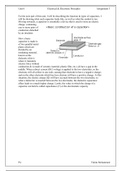
Moving onwards, a capacitor is essentially a device that is used to store an electric
charge, containing
one or more pairs of
conductors detached
by an insulator.
How a basic
capacitor is made is
of two parallel metal
plates which are
divided by an
insulating material,
known as the
dielectric (this is
where it transmits
electric force without
conduction & is made of ceramic material, plastic film, etc.), & have a gap in the
middle. When a direct current (DC) voltage is applied to the two electrodes, so the
electrons will all collect to one side, causing that electrode to have a negative charge;
and on the other electrode which has less electron will have a positive charge. At this
situation, the electric charge (Q) will have accrued between the two electrodes; so
when a dielectric is inserted between the two electrodes, the dielectric separation
affect leads to a much higher charge. Lastly, the value in which the charge of a
capacitor can hold is called capacitance (C) or the electrostatic capacity.
P4 Fahim Mohammed
, Unit 6 Electrical & Electronic Principles Assignment 3
Name of Symbol Picture Capacitance Typical Polarised Typical
Capacitor Range Range of Applications
Working
Voltage
Electrolytic 0.1 µF -1F Yes Power Supplies
Silver Mica Few pF – 50-1000v No Small, accurate,
3000pF high frequency,
but now
obsolete
Plastic No High frequency
& High
powered
Paper 300pF - 4µF Less than No High frequency
600v & High
powered
Ceramic 10pF - 1 µF 50v No High frequency
applications &
filtering
Variable 100pF – No Radio Tuning
500pF
Down below I have shown what a
polarized electrolytic capacitor
looks like & what a non-
polarized ceramic capacitor looks
like. But this shows nothing
without knowing the differences of
polarized & non-polarized.
Starting with polarized, this is a
type of capacitor that can only be
connected one way in a circuit.
Non-polarized capacitors are also a
type of capacitor that is connected anyway in a circuit, & examples of these capacitors are
ceramic, silver mica & just a few electrolytic capacitors are non-polarized.
Electrolytic
P4 Fahim Mohammed
For the next part of this unit, I will be describing the function & types of capacitors. I
will be showing what each capacitor looks like, as well as what the symbol is too.
Moving onwards, a capacitor is essentially a device that is used to store an electric
charge, containing
one or more pairs of
conductors detached
by an insulator.
How a basic
capacitor is made is
of two parallel metal
plates which are
divided by an
insulating material,
known as the
dielectric (this is
where it transmits
electric force without
conduction & is made of ceramic material, plastic film, etc.), & have a gap in the
middle. When a direct current (DC) voltage is applied to the two electrodes, so the
electrons will all collect to one side, causing that electrode to have a negative charge;
and on the other electrode which has less electron will have a positive charge. At this
situation, the electric charge (Q) will have accrued between the two electrodes; so
when a dielectric is inserted between the two electrodes, the dielectric separation
affect leads to a much higher charge. Lastly, the value in which the charge of a
capacitor can hold is called capacitance (C) or the electrostatic capacity.
P4 Fahim Mohammed
, Unit 6 Electrical & Electronic Principles Assignment 3
Name of Symbol Picture Capacitance Typical Polarised Typical
Capacitor Range Range of Applications
Working
Voltage
Electrolytic 0.1 µF -1F Yes Power Supplies
Silver Mica Few pF – 50-1000v No Small, accurate,
3000pF high frequency,
but now
obsolete
Plastic No High frequency
& High
powered
Paper 300pF - 4µF Less than No High frequency
600v & High
powered
Ceramic 10pF - 1 µF 50v No High frequency
applications &
filtering
Variable 100pF – No Radio Tuning
500pF
Down below I have shown what a
polarized electrolytic capacitor
looks like & what a non-
polarized ceramic capacitor looks
like. But this shows nothing
without knowing the differences of
polarized & non-polarized.
Starting with polarized, this is a
type of capacitor that can only be
connected one way in a circuit.
Non-polarized capacitors are also a
type of capacitor that is connected anyway in a circuit, & examples of these capacitors are
ceramic, silver mica & just a few electrolytic capacitors are non-polarized.
Electrolytic
P4 Fahim Mohammed