Database Management Systems (DBMS)
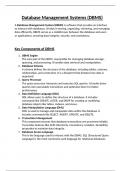
A Database Management System (DBMS) is software that provides an interface
to interact with databases. It helps in storing, organizing, retrieving, and managing
data efficiently. DBMS serves as a middle layer between the database and users
or applications, ensuring data integrity, security, and consistency.
Key Components of DBMS
1. DBMS Engine
The core part of the DBMS, responsible for managing database storage,
querying, and processing. It handles data retrieval and manipulation.
2. Database Schema
A schema defines the structure of the database, including tables, columns,
relationships, and constraints. It is a blueprint that dictates how data is
organized.
3. Query Processor
The query processor interprets and executes SQL queries. It breaks down
queries into executable instructions and optimizes them for better
performance.
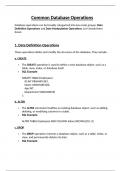
4. Data Definition Language (DDL)
DDL allows users to define the structure of a database. It includes
commands like CREATE, ALTER, and DROP for creating or modifying
database objects like tables, indexes, and views.
5. Data Manipulation Language (DML)
DML is used to manage and manipulate data within the database. It
includes commands like SELECT, INSERT, UPDATE, and DELETE.
6. Transaction Management
This component ensures that database transactions are processed reliably.
It provides features like ACID (Atomicity, Consistency, Isolation, Durability)
properties to maintain data integrity.
7. Database Access Language
This is the language used to interact with the DBMS. SQL (Structured Query
Language) is the most commonly used language for relational databases.
, 8. Security and Integrity Management
Ensures data privacy and enforces rules to maintain data accuracy. It
manages access control, encryption, and auditing features.
9. Storage Manager
This manages how the database is stored on disk and handles data
retrieval, storage allocation, and indexing.
Types of DBMS
There are several types of DBMS, each suited to different types of data and use
cases.
1. Hierarchical DBMS
o Data is organized in a tree-like structure.
o Each record has a parent-child relationship.
o Example: IBM IMS
2. Network DBMS
o Data is stored in a graph-like structure with multiple parent-child
relationships.
o Allows more complex relationships.
o Example: IDMS, Raima
3. Relational DBMS (RDBMS)
o Stores data in tables (rows and columns).
o Uses SQL to query and manipulate data.
o Example: MySQL, PostgreSQL
4. Object-Oriented DBMS (OODBMS)
o Stores data as objects, similar to how objects are represented in
object-oriented programming.
o Example: ObjectDB, db4o
5. NoSQL DBMS
o Non-relational database systems designed for flexibility, scalability,
and high availability.
o Suitable for unstructured or semi-structured data.
o Example: MongoDB, Cassandra
A Database Management System (DBMS) is software that provides an interface
to interact with databases. It helps in storing, organizing, retrieving, and managing
data efficiently. DBMS serves as a middle layer between the database and users
or applications, ensuring data integrity, security, and consistency.
Key Components of DBMS
1. DBMS Engine
The core part of the DBMS, responsible for managing database storage,
querying, and processing. It handles data retrieval and manipulation.
2. Database Schema
A schema defines the structure of the database, including tables, columns,
relationships, and constraints. It is a blueprint that dictates how data is
organized.
3. Query Processor
The query processor interprets and executes SQL queries. It breaks down
queries into executable instructions and optimizes them for better
performance.
4. Data Definition Language (DDL)
DDL allows users to define the structure of a database. It includes
commands like CREATE, ALTER, and DROP for creating or modifying
database objects like tables, indexes, and views.
5. Data Manipulation Language (DML)
DML is used to manage and manipulate data within the database. It
includes commands like SELECT, INSERT, UPDATE, and DELETE.
6. Transaction Management
This component ensures that database transactions are processed reliably.
It provides features like ACID (Atomicity, Consistency, Isolation, Durability)
properties to maintain data integrity.
7. Database Access Language
This is the language used to interact with the DBMS. SQL (Structured Query
Language) is the most commonly used language for relational databases.
, 8. Security and Integrity Management
Ensures data privacy and enforces rules to maintain data accuracy. It
manages access control, encryption, and auditing features.
9. Storage Manager
This manages how the database is stored on disk and handles data
retrieval, storage allocation, and indexing.
Types of DBMS
There are several types of DBMS, each suited to different types of data and use
cases.
1. Hierarchical DBMS
o Data is organized in a tree-like structure.
o Each record has a parent-child relationship.
o Example: IBM IMS
2. Network DBMS
o Data is stored in a graph-like structure with multiple parent-child
relationships.
o Allows more complex relationships.
o Example: IDMS, Raima
3. Relational DBMS (RDBMS)
o Stores data in tables (rows and columns).
o Uses SQL to query and manipulate data.
o Example: MySQL, PostgreSQL
4. Object-Oriented DBMS (OODBMS)
o Stores data as objects, similar to how objects are represented in
object-oriented programming.
o Example: ObjectDB, db4o
5. NoSQL DBMS
o Non-relational database systems designed for flexibility, scalability,
and high availability.
o Suitable for unstructured or semi-structured data.
o Example: MongoDB, Cassandra