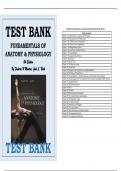
TEST BANK Test Bank for Fundamentals of Anatomy & Physiology, 8th Edition, Martini
Table of Contents
Chapter 1. An Introduction to Anatomy and Physiology
Chapter 2. The Chemical Level of Organization
Chapter 3. The Cellular Level of Organization
FUNDAMENTALS OF Chapter 4. The Tissue Level of Organization
Chapter 5. The Integumentary System
Chapter 6. Osseous Tissue and Bone Structure
ANATOMY & PHYSIOLOGY Chapter 7. The Axial Skeleton
Chapter 8. The Appendicular Skeleton
Chapter 9. Articulations
8th Edition Chapter 10. Muscle Tissue
Chapter 11. The Muscular System
By Frederic H Martini, Judi L. Nath Chapter 12. Neural Tissue
Chapter 13.The Spinal Cord, Spinal Nerves, and Spinal Reflexes
Chapter 14. The Brain and Cranial Nerves
Chapter 15. Neural Integration I: Sensory Pathways and the Somatic Nervous System
Chapter 16. Neural Integration II: The Autonomic Nervous System and Higher-Order Functions
Chapter 17. The Special Senses
Chapter 18. The Endocrine System
Chapter 19. Blood
Chapter 20. The Heart
Chapter 21. Blood Vessels and Circulation
Chapter 22. The Lymphoid System and Immunity
Chapter 23. The Respiratory System
Chapter 24. The Digestive System
Chapter 25. Metabolism and Energetics
Chapter 26. The Urinary System
Chapter 27. Fluid, Electrolyte, and Acid-Base Balance
Chapter 28. The Reproductive System
Chapter 29. Development and Inheritance
TEST BANK
,Chapter 1 An Introduction to Anatomy and Physiology 6) The study of the first two months of development is termed
A) histology.
Test Bank for Fundamentals of Anatomy & Physiology, 8th Edition
B) embryology.
C) cytology.
Multiple Choice Questions D) pathology.
1) The analysis of the internal structure of individual cells is called E) organology.
A) cytology.
Answer: B
B) histology.
Diff: 1
C) embryology. Skill: Level 1 Questions: Reviewing Facts and Terms
D) physiology.
E) anatomy. 7) The study of the function of specific organ systems is called
Answer: A A) systemic physiology.
Diff: 1 B) organ physiology.
Skill: Level 1 Questions: Reviewing Facts and Terms C) cell physiology.
D) pathological physiology.
2) The study of the general form and superficial markings of an organism is called anatomy. E) histology.
A) gross
Answer: A
B) surface
Diff: 1
C) systemic Skill: Level 1 Questions: Reviewing Facts and Terms
D) regional
E) surgical 8) Cardiovascular physiology is an example of
Answer: B A) histophysiology.
Diff: 1 B) organ physiology.
Skill: Level 1 Questions: Reviewing Facts and Terms C) systemic physiology.
D) pathological physiology.
3) The study of the superficial and internal features in a specific area of the body is called anatomy. E) physiological chemistry.
A) surface
Answer: C
B) regional
Diff: 1
C) surgical Skill: Level 1 Questions: Reviewing Facts and Terms
D) pathological
E) radiographic 9) Which of the following is arranged in correct order from the most COMPLEX to the SIMPLEST?
Answer: B A) cellular, tissue, molecular, system, organ, organism
Diff: 1 B) molecular, cellular, tissue, organ, system, organism
Skill: Level 1 Questions: Reviewing Facts and Terms C) tissue, cellular, molecular, organ, system, organism
D) organ, organism, molecular, cellular, tissue, system
4) Anatomical features that change during illness are studied in anatomy. E) organism, system, organ, tissue, cellular, molecular
A) gross
Answer: E
B) surface
Diff: 1
C) microscopic Skill: Level 1 Questions: Reviewing Facts and Terms
D) pathological
E) regional 10) Which organ system provides support, protection of soft tissue, mineral storage, and blood formation?
Answer: D A) integumentary
Diff: 1 B) muscular
Skill: Level 1 Questions: Reviewing Facts and Terms C) skeletal
D) nervous
5) The study of the liver is to gross anatomy as the study of the liver cell is to E) endocrine
A) physiology.
Answer: C
B) regional anatomy.
Diff: 1
C) cytology. Skill: Level 1 Questions: Reviewing Facts and Terms
D) systemic anatomy.
E) radiographic anatomy.
Answer: C
Diff: 1
Skill: Level 1 Questions: Reviewing Facts and Terms
Page 1 Page 2
Test Bank Fundamentals of Anatomy & Physiology, 8e, Martini Test Bank Fundamentals of Anatomy & Physiology, 8e, Martini
,11) Which organ system transports nutrients, metabolic wastes, gases, and defense cells? 16) Lungs are to the respiratory system as the liver is to the system.
A) cardiovascular A) lymphatic
B) digestive B) urinary
C) muscular C) digestive
D) respiratory D) cardiovascular
E) urinary E) both B and D
Answer: A Answer: C
Diff: 2 Diff: 1
Skill: Level 1 Questions: Reviewing Facts and Terms Skill: Level 1 Questions: Reviewing Facts and Terms
12) Which organ system includes the spleen and the tonsils? 17) Skin, hair, and nails are associated with the system.
A) digestive A) skeletal
B) endocrine B) muscular
C) nervous C) integumentary
D) cardiovascular D) endocrine
E) lymphatic E) both A and B
Answer: E Answer: C
Diff: 2 Diff: 1
Skill: Level 1 Questions: Reviewing Facts and Terms Skill: Level 1 Questions: Reviewing Facts and Terms
13) The kidneys and ureters are organs of the system. 18) The maintenance of a constant internal environment in an organism is termed
A) endocrine A) positive feedback.
B) digestive B) homeostasis.
C) respiratory C) negative feedback.
D) urinary D) effector control.
E) lymphatic E) integration.
Answer: D Answer: B
Diff: 1 Diff: 1
Skill: Level 1 Questions: Reviewing Facts and Terms Skill: Level 1 Questions: Reviewing Facts and Terms
14) The pituitary gland and thyroid gland are organs of the system. 19) When body temperature rises, a center in the brain initiates physiological changes to decrease the body
A) endocrine temperature. This is an example of
B) cardiovascular A) negative feedback.
C) respiratory B) positive feedback.
D) lymphatic C) nonhomeostatic regulation.
E) digestive D) diagnostic regulation.
Answer: A E) fever.
Diff: 1 Answer: A
Skill: Level 1 Questions: Reviewing Facts and Terms Diff: 1
Skill: Level 1 Questions: Reviewing Facts and Terms
15) Which organ system removes carbon dioxide from the bloodstream?
A) cardiovascular 20) In general, the nervous system does each of the following, except
B) lymphatic A) helps to maintain homeostasis.
C) respiratory B) responds rapidly to change.
D) digestive C) directs long-term responses to change.
E) endocrine D) directs very specific responses.
Answer: C E) both B and D
Diff: 1 Answer: C
Skill: Level 1 Questions: Reviewing Facts and Terms Diff: 1
Skill: Level 1 Questions: Reviewing Facts and Terms
Page 3 Page 4
Test Bank Fundamentals of Anatomy & Physiology, 8e, Martini Test Bank Fundamentals of Anatomy & Physiology, 8e, Martini
, 21) Which one of the following is not a characteristic of the endocrine system? 26) The chin is to the nose.
A) releases chemical messengers called hormones A) anterior
B) produces a more rapid response than the nervous system B) superior
C) produces effects that last for days or longer C) posterior
D) produces an effect that involves several organs or tissues at the same time D) inferior
E) important homeostatic system E) medial
Answer: B Answer: D
Diff: 1 Diff: 1
Skill: Level 1 Questions: Reviewing Facts and Terms Skill: Level 1 Questions: Reviewing Facts and Terms
22) A person facing forward with hands at the sides and palms facing forward is in the 27) Which of the following regions corresponds to the buttocks?
A) supine position. A) pelvic
B) prone position. B) cephalic
C) anatomical position. C) gluteal
D) frontal position. D) lumbar
E) sagittal position. E) thoracic
Answer: C Answer: C
Diff: 1 Diff: 1
Skill: Level 1 Questions: Reviewing Facts and Terms Skill: Level 1 Questions: Reviewing Facts and Terms
23) An anatomical term that means the same as ventral: 28) Which of the following terms refers to the foot?
A) posterior A) cervical
B) inferior B) brachial
C) abdominal C) antebrachial
D) anterior D) femoral
E) superior E) pedal
Answer: D Answer: E
Diff: 1 Diff: 1
Skill: Level 1 Questions: Reviewing Facts and Terms Skill: Level 1 Questions: Reviewing Facts and Terms
24) The heart is to the lungs. 29) Which plane divides the body into right and left parts?
A) lateral A) proximal
B) medial B) frontal
C) posterior C) orthogonal
D) proximal D) transverse
E) distal E) sagittal
Answer: B Answer: E
Diff: 1 Diff: 1
Skill: Level 1 Questions: Reviewing Facts and Terms Skill: Level 1 Questions: Reviewing Facts and Terms
25) The wrist is to the elbow. 30) The muscle known as the diaphragm separates the from the .
A) proximal A) pleural cavity; mediastinum
B) distal B) thoracic cavity; abdominopelvic cavity
C) lateral C) pericardial cavity; pleural cavity
D) medial D) abdominal cavity; pelvic cavity
E) horizontal E) pericardial sac; pericardial cavity
Answer: B Answer: B
Diff: 1 Diff: 1
Skill: Level 1 Questions: Reviewing Facts and Terms Skill: Level 1 Questions: Reviewing Facts and Terms
Page 5 Page 6
Test Bank Fundamentals of Anatomy & Physiology, 8e, Martini Test Bank Fundamentals of Anatomy & Physiology, 8e, Martini
Table of Contents
Chapter 1. An Introduction to Anatomy and Physiology
Chapter 2. The Chemical Level of Organization
Chapter 3. The Cellular Level of Organization
FUNDAMENTALS OF Chapter 4. The Tissue Level of Organization
Chapter 5. The Integumentary System
Chapter 6. Osseous Tissue and Bone Structure
ANATOMY & PHYSIOLOGY Chapter 7. The Axial Skeleton
Chapter 8. The Appendicular Skeleton
Chapter 9. Articulations
8th Edition Chapter 10. Muscle Tissue
Chapter 11. The Muscular System
By Frederic H Martini, Judi L. Nath Chapter 12. Neural Tissue
Chapter 13.The Spinal Cord, Spinal Nerves, and Spinal Reflexes
Chapter 14. The Brain and Cranial Nerves
Chapter 15. Neural Integration I: Sensory Pathways and the Somatic Nervous System
Chapter 16. Neural Integration II: The Autonomic Nervous System and Higher-Order Functions
Chapter 17. The Special Senses
Chapter 18. The Endocrine System
Chapter 19. Blood
Chapter 20. The Heart
Chapter 21. Blood Vessels and Circulation
Chapter 22. The Lymphoid System and Immunity
Chapter 23. The Respiratory System
Chapter 24. The Digestive System
Chapter 25. Metabolism and Energetics
Chapter 26. The Urinary System
Chapter 27. Fluid, Electrolyte, and Acid-Base Balance
Chapter 28. The Reproductive System
Chapter 29. Development and Inheritance
TEST BANK
,Chapter 1 An Introduction to Anatomy and Physiology 6) The study of the first two months of development is termed
A) histology.
Test Bank for Fundamentals of Anatomy & Physiology, 8th Edition
B) embryology.
C) cytology.
Multiple Choice Questions D) pathology.
1) The analysis of the internal structure of individual cells is called E) organology.
A) cytology.
Answer: B
B) histology.
Diff: 1
C) embryology. Skill: Level 1 Questions: Reviewing Facts and Terms
D) physiology.
E) anatomy. 7) The study of the function of specific organ systems is called
Answer: A A) systemic physiology.
Diff: 1 B) organ physiology.
Skill: Level 1 Questions: Reviewing Facts and Terms C) cell physiology.
D) pathological physiology.
2) The study of the general form and superficial markings of an organism is called anatomy. E) histology.
A) gross
Answer: A
B) surface
Diff: 1
C) systemic Skill: Level 1 Questions: Reviewing Facts and Terms
D) regional
E) surgical 8) Cardiovascular physiology is an example of
Answer: B A) histophysiology.
Diff: 1 B) organ physiology.
Skill: Level 1 Questions: Reviewing Facts and Terms C) systemic physiology.
D) pathological physiology.
3) The study of the superficial and internal features in a specific area of the body is called anatomy. E) physiological chemistry.
A) surface
Answer: C
B) regional
Diff: 1
C) surgical Skill: Level 1 Questions: Reviewing Facts and Terms
D) pathological
E) radiographic 9) Which of the following is arranged in correct order from the most COMPLEX to the SIMPLEST?
Answer: B A) cellular, tissue, molecular, system, organ, organism
Diff: 1 B) molecular, cellular, tissue, organ, system, organism
Skill: Level 1 Questions: Reviewing Facts and Terms C) tissue, cellular, molecular, organ, system, organism
D) organ, organism, molecular, cellular, tissue, system
4) Anatomical features that change during illness are studied in anatomy. E) organism, system, organ, tissue, cellular, molecular
A) gross
Answer: E
B) surface
Diff: 1
C) microscopic Skill: Level 1 Questions: Reviewing Facts and Terms
D) pathological
E) regional 10) Which organ system provides support, protection of soft tissue, mineral storage, and blood formation?
Answer: D A) integumentary
Diff: 1 B) muscular
Skill: Level 1 Questions: Reviewing Facts and Terms C) skeletal
D) nervous
5) The study of the liver is to gross anatomy as the study of the liver cell is to E) endocrine
A) physiology.
Answer: C
B) regional anatomy.
Diff: 1
C) cytology. Skill: Level 1 Questions: Reviewing Facts and Terms
D) systemic anatomy.
E) radiographic anatomy.
Answer: C
Diff: 1
Skill: Level 1 Questions: Reviewing Facts and Terms
Page 1 Page 2
Test Bank Fundamentals of Anatomy & Physiology, 8e, Martini Test Bank Fundamentals of Anatomy & Physiology, 8e, Martini
,11) Which organ system transports nutrients, metabolic wastes, gases, and defense cells? 16) Lungs are to the respiratory system as the liver is to the system.
A) cardiovascular A) lymphatic
B) digestive B) urinary
C) muscular C) digestive
D) respiratory D) cardiovascular
E) urinary E) both B and D
Answer: A Answer: C
Diff: 2 Diff: 1
Skill: Level 1 Questions: Reviewing Facts and Terms Skill: Level 1 Questions: Reviewing Facts and Terms
12) Which organ system includes the spleen and the tonsils? 17) Skin, hair, and nails are associated with the system.
A) digestive A) skeletal
B) endocrine B) muscular
C) nervous C) integumentary
D) cardiovascular D) endocrine
E) lymphatic E) both A and B
Answer: E Answer: C
Diff: 2 Diff: 1
Skill: Level 1 Questions: Reviewing Facts and Terms Skill: Level 1 Questions: Reviewing Facts and Terms
13) The kidneys and ureters are organs of the system. 18) The maintenance of a constant internal environment in an organism is termed
A) endocrine A) positive feedback.
B) digestive B) homeostasis.
C) respiratory C) negative feedback.
D) urinary D) effector control.
E) lymphatic E) integration.
Answer: D Answer: B
Diff: 1 Diff: 1
Skill: Level 1 Questions: Reviewing Facts and Terms Skill: Level 1 Questions: Reviewing Facts and Terms
14) The pituitary gland and thyroid gland are organs of the system. 19) When body temperature rises, a center in the brain initiates physiological changes to decrease the body
A) endocrine temperature. This is an example of
B) cardiovascular A) negative feedback.
C) respiratory B) positive feedback.
D) lymphatic C) nonhomeostatic regulation.
E) digestive D) diagnostic regulation.
Answer: A E) fever.
Diff: 1 Answer: A
Skill: Level 1 Questions: Reviewing Facts and Terms Diff: 1
Skill: Level 1 Questions: Reviewing Facts and Terms
15) Which organ system removes carbon dioxide from the bloodstream?
A) cardiovascular 20) In general, the nervous system does each of the following, except
B) lymphatic A) helps to maintain homeostasis.
C) respiratory B) responds rapidly to change.
D) digestive C) directs long-term responses to change.
E) endocrine D) directs very specific responses.
Answer: C E) both B and D
Diff: 1 Answer: C
Skill: Level 1 Questions: Reviewing Facts and Terms Diff: 1
Skill: Level 1 Questions: Reviewing Facts and Terms
Page 3 Page 4
Test Bank Fundamentals of Anatomy & Physiology, 8e, Martini Test Bank Fundamentals of Anatomy & Physiology, 8e, Martini
, 21) Which one of the following is not a characteristic of the endocrine system? 26) The chin is to the nose.
A) releases chemical messengers called hormones A) anterior
B) produces a more rapid response than the nervous system B) superior
C) produces effects that last for days or longer C) posterior
D) produces an effect that involves several organs or tissues at the same time D) inferior
E) important homeostatic system E) medial
Answer: B Answer: D
Diff: 1 Diff: 1
Skill: Level 1 Questions: Reviewing Facts and Terms Skill: Level 1 Questions: Reviewing Facts and Terms
22) A person facing forward with hands at the sides and palms facing forward is in the 27) Which of the following regions corresponds to the buttocks?
A) supine position. A) pelvic
B) prone position. B) cephalic
C) anatomical position. C) gluteal
D) frontal position. D) lumbar
E) sagittal position. E) thoracic
Answer: C Answer: C
Diff: 1 Diff: 1
Skill: Level 1 Questions: Reviewing Facts and Terms Skill: Level 1 Questions: Reviewing Facts and Terms
23) An anatomical term that means the same as ventral: 28) Which of the following terms refers to the foot?
A) posterior A) cervical
B) inferior B) brachial
C) abdominal C) antebrachial
D) anterior D) femoral
E) superior E) pedal
Answer: D Answer: E
Diff: 1 Diff: 1
Skill: Level 1 Questions: Reviewing Facts and Terms Skill: Level 1 Questions: Reviewing Facts and Terms
24) The heart is to the lungs. 29) Which plane divides the body into right and left parts?
A) lateral A) proximal
B) medial B) frontal
C) posterior C) orthogonal
D) proximal D) transverse
E) distal E) sagittal
Answer: B Answer: E
Diff: 1 Diff: 1
Skill: Level 1 Questions: Reviewing Facts and Terms Skill: Level 1 Questions: Reviewing Facts and Terms
25) The wrist is to the elbow. 30) The muscle known as the diaphragm separates the from the .
A) proximal A) pleural cavity; mediastinum
B) distal B) thoracic cavity; abdominopelvic cavity
C) lateral C) pericardial cavity; pleural cavity
D) medial D) abdominal cavity; pelvic cavity
E) horizontal E) pericardial sac; pericardial cavity
Answer: B Answer: B
Diff: 1 Diff: 1
Skill: Level 1 Questions: Reviewing Facts and Terms Skill: Level 1 Questions: Reviewing Facts and Terms
Page 5 Page 6
Test Bank Fundamentals of Anatomy & Physiology, 8e, Martini Test Bank Fundamentals of Anatomy & Physiology, 8e, Martini