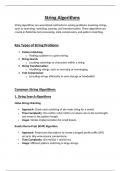
String Algorithms
String algorithms are specialized methods for solving problems involving strings,
such as searching, matching, parsing, and transformation. These algorithms are
crucial in fields like text processing, data compression, and pattern matching.
Key Types of String Problems
1. Pattern Matching:
o Finding a pattern in a given string.
2. String Search:
o Locating substrings or characters within a string.
3. String Transformation:
o Modifying strings, such as reversing or rearranging.
4. Text Compression:
o Encoding strings efficiently to save storage or bandwidth.
Common String Algorithms
1. String Search Algorithms
Naïve String Matching
Approach: Check each substring of the main string for a match.
Time Complexity: O(n⋅m)O(n \cdot m)O(n⋅m) where nnn is the text length
and mmm is the pattern length.
Usage: Simple implementation for small inputs.
Knuth-Morris-Pratt (KMP) Algorithm
Approach: Preprocess the pattern to create a longest prefix suffix (LPS)
array to skip unnecessary comparisons.
Time Complexity: O(n+m)O(n + m)O(n+m).
Usage: Efficient pattern matching in large strings.
, Rabin-Karp Algorithm
Approach: Use hashing to compare substring hashes with the pattern hash.
Time Complexity: Average O(n+m)O(n + m)O(n+m), worst-case O(n⋅m)O(n \
cdot m)O(n⋅m).
Usage: Useful for multiple pattern matching.
Boyer-Moore Algorithm
Approach: Skip sections of the text using bad character and good suffix
rules.
Time Complexity: Best-case O(n/m)O(n / m)O(n/m), worst-case
O(n⋅m)O(n \cdot m)O(n⋅m).
Usage: Fast for large alphabets or patterns.
2. Text Compression Algorithms
Huffman Encoding
Approach: Use a frequency-based tree for variable-length encoding.
Time Complexity: O(nlogn)O(n \log n)O(nlogn).
Usage: Lossless text compression.
Lempel-Ziv-Welch (LZW) Compression
Approach: Replace repeated substrings with references.
Time Complexity: O(n)O(n)O(n).
Usage: File compression.
3. Longest Common Substring and Subsequence
Longest Common Substring
Problem: Find the longest substring common to two strings.
Approach: Use dynamic programming or suffix arrays.
String algorithms are specialized methods for solving problems involving strings,
such as searching, matching, parsing, and transformation. These algorithms are
crucial in fields like text processing, data compression, and pattern matching.
Key Types of String Problems
1. Pattern Matching:
o Finding a pattern in a given string.
2. String Search:
o Locating substrings or characters within a string.
3. String Transformation:
o Modifying strings, such as reversing or rearranging.
4. Text Compression:
o Encoding strings efficiently to save storage or bandwidth.
Common String Algorithms
1. String Search Algorithms
Naïve String Matching
Approach: Check each substring of the main string for a match.
Time Complexity: O(n⋅m)O(n \cdot m)O(n⋅m) where nnn is the text length
and mmm is the pattern length.
Usage: Simple implementation for small inputs.
Knuth-Morris-Pratt (KMP) Algorithm
Approach: Preprocess the pattern to create a longest prefix suffix (LPS)
array to skip unnecessary comparisons.
Time Complexity: O(n+m)O(n + m)O(n+m).
Usage: Efficient pattern matching in large strings.
, Rabin-Karp Algorithm
Approach: Use hashing to compare substring hashes with the pattern hash.
Time Complexity: Average O(n+m)O(n + m)O(n+m), worst-case O(n⋅m)O(n \
cdot m)O(n⋅m).
Usage: Useful for multiple pattern matching.
Boyer-Moore Algorithm
Approach: Skip sections of the text using bad character and good suffix
rules.
Time Complexity: Best-case O(n/m)O(n / m)O(n/m), worst-case
O(n⋅m)O(n \cdot m)O(n⋅m).
Usage: Fast for large alphabets or patterns.
2. Text Compression Algorithms
Huffman Encoding
Approach: Use a frequency-based tree for variable-length encoding.
Time Complexity: O(nlogn)O(n \log n)O(nlogn).
Usage: Lossless text compression.
Lempel-Ziv-Welch (LZW) Compression
Approach: Replace repeated substrings with references.
Time Complexity: O(n)O(n)O(n).
Usage: File compression.
3. Longest Common Substring and Subsequence
Longest Common Substring
Problem: Find the longest substring common to two strings.
Approach: Use dynamic programming or suffix arrays.