
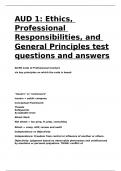
AUD 1: Ethics,
Professional
Responsibilities, and
General Principles test
questions and answers
AICPA Code of Professional Conduct
six key principles on which the code is based
"issuers" vs "nonissuers"
issuers = public company
Conceptual Framework
Threats
Safeguards
Acceptable level
Attest Work
Not attest = tax prep, fs prep, consulting
Attest = comp, AUP, review and audit
Independence vs Objectivity
Independence: Freedom from control or influence of another or others.
Objectivity: Judgment based on observable phenomena and uninfluenced
by emotions or personal prejudices. THINK: conflict of
, interest. Examples: Attest client, Attest client officers, Attest major
shareholders (10% or more ownership)
Indemnify
Compensate, reimburse
Arbitration VS Litigation
Arbitration: (example of an ADR) Matter is settled outside of court. Allow a
third party to come in to settle the disagreement
ARD
Alternative Dispute Resolution
MIPP VS MIB VS "Other Members"
Members in Public Practice = an individual who provides professional
services to clients, as a partner or employee of a public accounting firm or
as a sole practitioner.
Members in Business =
- staff accountant
- internal auditor
- assistant controller
Other:
Retired, etc.
Covered Members - Independence Issues
1) Financial Interest
2) Employee Relationships
3) Business Relationships
Examples:
- Five Percent Investments—Independence is impaired if any partner,
principal, shareholder, or professional employee of the accounting firm
(and any of their IFMs or CFMs) owns more than 5% or more of the client's
stock.
10% of stock
- DIRECT financial interest/ownership = influence over investment
decisions (regardless of % + materiality).
- MATERIAL indirect financial interest/ownership (regardless of
direct/indirect)
- BOTH INDIRECT (no influence) + IMMATERIAL is OK
Professional
Responsibilities, and
General Principles test
questions and answers
AICPA Code of Professional Conduct
six key principles on which the code is based
"issuers" vs "nonissuers"
issuers = public company
Conceptual Framework
Threats
Safeguards
Acceptable level
Attest Work
Not attest = tax prep, fs prep, consulting
Attest = comp, AUP, review and audit
Independence vs Objectivity
Independence: Freedom from control or influence of another or others.
Objectivity: Judgment based on observable phenomena and uninfluenced
by emotions or personal prejudices. THINK: conflict of
, interest. Examples: Attest client, Attest client officers, Attest major
shareholders (10% or more ownership)
Indemnify
Compensate, reimburse
Arbitration VS Litigation
Arbitration: (example of an ADR) Matter is settled outside of court. Allow a
third party to come in to settle the disagreement
ARD
Alternative Dispute Resolution
MIPP VS MIB VS "Other Members"
Members in Public Practice = an individual who provides professional
services to clients, as a partner or employee of a public accounting firm or
as a sole practitioner.
Members in Business =
- staff accountant
- internal auditor
- assistant controller
Other:
Retired, etc.
Covered Members - Independence Issues
1) Financial Interest
2) Employee Relationships
3) Business Relationships
Examples:
- Five Percent Investments—Independence is impaired if any partner,
principal, shareholder, or professional employee of the accounting firm
(and any of their IFMs or CFMs) owns more than 5% or more of the client's
stock.
10% of stock
- DIRECT financial interest/ownership = influence over investment
decisions (regardless of % + materiality).
- MATERIAL indirect financial interest/ownership (regardless of
direct/indirect)
- BOTH INDIRECT (no influence) + IMMATERIAL is OK


