

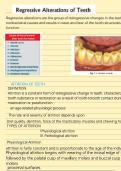
Regressive alterations are the group of retrogressive changes in the teet
nonbacterial causes and results in wear and tear of the tooth structures
function
ATTRITION OF TEETH
DEFINITION
A rition is a constant form of retrogressive change in teeth, characteriz
tooth substance or restoration as a result of tooth-totooth contact durin
mastication or parafunction
an age related physiologic process
The rate and severity of a rition depends upon
Diet quality, dentition, force of the masticatory muscles and chewing ha
TYPES OF ATTRITION
Physiological a rition
B. Pathological a rition
Physiological A rition
a rition is fairly constant and is propo ionate to the age of the indiv
Physiological a rition begins with wearing of the incisal edge of i
followed by the palatal cusp of maxillary molars and buccal cusp
molars
proximal su aces
, The tooth wear in this type of a rition does not maintain a consistent p
amount of tooth loss is not propo ionate to the age of the individual
CAUSES OF PATHOLOGICAL ATTRITION
Abnormal occlusion: May be developmental,
e.g. crowding of teeth or malposed teeth. In these cases, abnormal oc
positioning of teeth many lead to traumatic contact during chewing
to more tooth wear
Premature extraction of teeth
Extraction of some teeth from the dental arch will increase the occlu
the remaining teeth
Abnormal chewing habits: Parafunctional
chewing habits, e.g. bruxism (habitual grinding of teeth) and chroni
chewing of coarse and abrasive foods or other substance, e.g. toba
betel nut, etc. •
Structural defects in teeth: The structural defects, which make the t
vulnerable to a rition
Amelogenesis impe ecta
– Dentinogenesis impe ecta
Y :the hardness of enamel or dentin is much more inferior as compar
the normal teeth
CLINICAL FEATURES OF ATTRITION
1A rition can occur in both deciduous as well as in the perm
•
2A rition of tooth is clinically manifested by the formation o
smooth, shiny, well-polished facets on those su aces of teet
come in contact with the opposing teeth
3• Thus, a rition o en occurs on the tip of the cusps, incisa
the proximal contact areas, labial su ace of lower anteriors a
, When dentin becomes exposed it generally becomes discolored brown
. • A rition in the proximal su aces of teeth occurs due to ve ical move
within the socket during mastication.
• Proximal su ace a rition causes transformation of proximal “contact p
broad and flat “contact areas”. • This type of loss of tooth structure from
su aces may even lead to mesial migration of teeth in the dental arch.
o en exhibit more severe a ritions of teeth than women.
• Exposure of dentinal tubules in severe cases
of a rition may lead to tooth hypersensitivity.
• Pulp exposure and subsequent pain are rare
in case of a rition as the process is generally slow, and o en allows suf
formation of protective reparative dentin.
• A rition may also occur on the restorations
of teeth. A common example in this regard, is the development of shiny
amalgam filled su aces.
• A rition may even possibly lead to fracture of the cusps of teeth or re
TREATMENT
Corrections of developmental abnormalities causing traumatic occulusi
• Correction of parafunctional chewing habits
. • Protection of tooth by metal or metalceramic crowns where structur
amelogenesis or dentinogenesis impe ecta) exist.
• Construction of occlusal guard, if the habit of bruxism is persisting
DEFINITION
Abrasion is the pathological wearing of dental tissues or dental res
friction with foreign substances independent of occlusion
ETIOLOGY AND PATHOGENESIS
nonbacterial causes and results in wear and tear of the tooth structures
function
ATTRITION OF TEETH
DEFINITION
A rition is a constant form of retrogressive change in teeth, characteriz
tooth substance or restoration as a result of tooth-totooth contact durin
mastication or parafunction
an age related physiologic process
The rate and severity of a rition depends upon
Diet quality, dentition, force of the masticatory muscles and chewing ha
TYPES OF ATTRITION
Physiological a rition
B. Pathological a rition
Physiological A rition
a rition is fairly constant and is propo ionate to the age of the indiv
Physiological a rition begins with wearing of the incisal edge of i
followed by the palatal cusp of maxillary molars and buccal cusp
molars
proximal su aces
, The tooth wear in this type of a rition does not maintain a consistent p
amount of tooth loss is not propo ionate to the age of the individual
CAUSES OF PATHOLOGICAL ATTRITION
Abnormal occlusion: May be developmental,
e.g. crowding of teeth or malposed teeth. In these cases, abnormal oc
positioning of teeth many lead to traumatic contact during chewing
to more tooth wear
Premature extraction of teeth
Extraction of some teeth from the dental arch will increase the occlu
the remaining teeth
Abnormal chewing habits: Parafunctional
chewing habits, e.g. bruxism (habitual grinding of teeth) and chroni
chewing of coarse and abrasive foods or other substance, e.g. toba
betel nut, etc. •
Structural defects in teeth: The structural defects, which make the t
vulnerable to a rition
Amelogenesis impe ecta
– Dentinogenesis impe ecta
Y :the hardness of enamel or dentin is much more inferior as compar
the normal teeth
CLINICAL FEATURES OF ATTRITION
1A rition can occur in both deciduous as well as in the perm
•
2A rition of tooth is clinically manifested by the formation o
smooth, shiny, well-polished facets on those su aces of teet
come in contact with the opposing teeth
3• Thus, a rition o en occurs on the tip of the cusps, incisa
the proximal contact areas, labial su ace of lower anteriors a
, When dentin becomes exposed it generally becomes discolored brown
. • A rition in the proximal su aces of teeth occurs due to ve ical move
within the socket during mastication.
• Proximal su ace a rition causes transformation of proximal “contact p
broad and flat “contact areas”. • This type of loss of tooth structure from
su aces may even lead to mesial migration of teeth in the dental arch.
o en exhibit more severe a ritions of teeth than women.
• Exposure of dentinal tubules in severe cases
of a rition may lead to tooth hypersensitivity.
• Pulp exposure and subsequent pain are rare
in case of a rition as the process is generally slow, and o en allows suf
formation of protective reparative dentin.
• A rition may also occur on the restorations
of teeth. A common example in this regard, is the development of shiny
amalgam filled su aces.
• A rition may even possibly lead to fracture of the cusps of teeth or re
TREATMENT
Corrections of developmental abnormalities causing traumatic occulusi
• Correction of parafunctional chewing habits
. • Protection of tooth by metal or metalceramic crowns where structur
amelogenesis or dentinogenesis impe ecta) exist.
• Construction of occlusal guard, if the habit of bruxism is persisting
DEFINITION
Abrasion is the pathological wearing of dental tissues or dental res
friction with foreign substances independent of occlusion
ETIOLOGY AND PATHOGENESIS


