
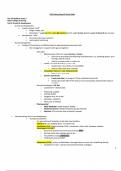
Child Caring Exam #3 Study Guide
• Growth and development o Growth: physical “stuff” ▪ Height, weight, size ▪ Remember: * weight 2x birth weight @6 months; 3x birth weight @12m; 4x birth weight @ 30month aka 1.5 years o Development: “skills” ▪ How mature the neuro-system is ▪ Learning and functioning • Nursing management o Knowing if interventions are effective based on age-appropriate assessment tools ▪ Pain management – based on both age and cognition • Pain scales o NIPS (neonatal infant pain scale) less than 2 months ▪ Gives scores according to the following: facial expression, cry, breathing pattern, arms and legs, state of arousal ▪ Used for neonates under 2 months old o FLACC- more than 2month (to 7 years old) ▪ Assesses face, lets, activity, cry, consolability ▪ Used for infant older than 2 months o Wong-Baker Faces (3-4 year old) preschooler ▪ Used for 3 to 4 year olds o Numeric scale (0-10) ▪ 8 years and older ( as young as 5 if they understand value of #) ▪ Can be used earlier ONLY if the child can count and actually understand the value of numbers • Non-pharmacological- USE first o Containment – blanket (nest) o Positioning- swaddle o Sucking- pacifier o Kangaroo care- skin to skin o Distraction, relaxation, o Music, pet, art therapy • Pharmaceutical o Mild/ Moderate= acetaminophen, NSAIDS o Moderate/ Severe= Opioids (morphine, diaudid, fentanyl) o Adjuvant- OTC and lower dose of opioids ( premee) o Age-appropriate plan of care development ▪ Nursing considerations • 0-2 years old mouth breathers; 2 and older nose breathers • Infants (0-1)– can recognize faces – use same nurse • Preschooler- (3-6)- Magical thinking= PAIN is punishment, others fault, disappear magically • School-age (6-12) WHY? o Ask a lot of questions and want to be involved; WHY? o Get their input when making a plan of care o They WANT to make contributions o Understand cause and effect • Adolescents-(12-18)- privacy, confidentiality encourage friends to come visit, establishing Identity o Exceptions for visits – post op; immunocompromised; contagious 1 o Priority ▪ Priority actions • Interventions based on patient signs/symptoms o RED FLAGS tell HCP ▪ Posterior fontanelle open (triangle shaped) after 2m RED FLAG o Patient care ▪ Anterior Fontanelle open (diamond shape) after 18m Red flag ▪ Weight gain at 6m should 2xbirth weight= if NOT red flag ▪ Weight gain at12m should 4x birth weight= if NOT red flag ▪ Should babble at 9m= if NOT red flag ▪ If Fontanelles are bulging sign of menigitis, ICP= Tell HCP ▪ If fontanelles sunken in= dehydration FVD= Tell HCP ▪ Peds Assessment – 1. interact w/parents 2. sit on parent lap 3. equipment out of sight; 4. invasive LAST (BP, oral temp ear exam) ▪ Ear assessment-anatomy of Eustachian tube - UNDER 3= pinna down and back; 3 and OLDER- Pinna up & back ▪ Age-appropriate nursing assessment • Infant-(0-1) recognize faces – use same NURSE • Toddler(1-3) Egocentric; least to most intrusive; (observe, auscultate, use parent lap) • Preschooler- (3-6)- magical thinking; Pain is punishment; o Coloring, finger painting • School-age-(6-12) WHY?, explain o puzzle • Adolescents (12-18)- (body image; ask patient) ; when asking separate from parents; invite friends to visit o Psychosocial development ▪ Identity vs role confusion ▪ They are trying to figure out who they are – parents need to “back off” o Nutritional assessment ▪ Concerned with body image and possible eating disorders ▪ Ask the patient specifically, what do you eat in a day? • Type of play being observed o Unoccupied: infant; not mobile and has random movements; no purpose o Solitary play – infant/toddler: play alone with their interest focused on their own activity o Onlooker play – infant/toddler: watch what other children are doing but do not make any attempt to enter the play o Parallel play – toddler (1-3): play independently but next to each other o Associative play – preschooler (3-6): children play together but with no group goal; kick ball around o Cooperative play – school-age (6-12): play is organized, play in a group with other children working to complete a specific goal; soccer basketball; SPORTS o Erikson’s Psychosocial Theories • Infants (birth – 1 year) Trust vs mistrust= = faith & optimism o Cooing and crying ; respond to non verbal cues o If not attained – not able to trust others o Toys- rattle; small toy go in mouth • Early Childhood/ Toddlers-(1-3) autonomy vs shame = learn self control; will power vs impulse; o a. EGOCENTRIC ; discuss how they will be effected o b. Teach parents: Allow toddler to explore; NO!, give choices; impressionable o c. Toys - vacuum • Preschool (3-6) initiative vs guilt= direction and purpose; Right vs wrong; start lying; imaginary friend o Imaginary friends, coloring, finger painting o Teach parents – give tasks they can actually accomplish o If not accomplished tasks=Guilt – second guess themselves 2 • School age ( 6-12) industry vs inferiority= Competence, contribute o Engage in tasks that they can fully accomplish, understand cause and effect; Want explanations WHY?; Puberty ; want to feel needed o Community service; sports; friends' matter, peer pressure, bullying o If not accomplished : feel inferior = negative self image o Toys: puzzle • Adolescence (12-18)-identity vs role confusion= devotion & fidelity ; role confusion o Confidentiality important; explain yes except if harm to self or others o Teach parents – let them go; still need rules; friends are important o If not accomplished – confused don’t know who they are o Piaget Cognitive Theories ▪ Sensorimotor (birth – 2years)= behavior imitation; trial and error; sensory processing ; TOUCHING toys put in mouth ▪ Preoperational (2-7)= EGOCENTRIC, concrete tangible thought process; simple associations • Women with big bellies are pregnant ▪ Concrete operations (7-11)= logical , coherent ; classify / sort; concrete systematic problem solve; less self centered ▪ Formal operations (11-15)- adaptive/ flexible; think abstractly / form hypothesis ; educated guess • Communication-based on developmental age: need to understand their cognitive levels o Infant (0-1): respond to non-verbal cues – cannot understand verbal ones yet ▪ Cooing and crying are their main forms of communication o Toddlers (1-3): egocentric, respond best when you discuss how THEY will be effected ▪ The experience of others has no interest to them o School-age (6-12): want explanations and reasons for everything ▪ NEED to know WHY ▪ Understand cause and effect o Adolescence: confidentiality is important; privacy; friends important ▪ Advise conversations are confidential unless self-harm or harm to others. • Education o What to include in teaching o Reflexes • Stepping o Hold infant and allow foot to touch surface o Infant will simulate walking o Normally present for 3-4 weeks (1 month) • Rooting and sucking o Touch/stroke infant’s cheek o Infant should turn head and open mouth towards stimulus o Usually disappears after 3-4 months • Palmar o Place finger in palm o Infant’s fingers close around finger o Lessens by 3-4 months • Tonic neck or fencing o When infant in supine position, turns head to one side o With infant facing one side, arm and leg on that side extend, opposite side will flex o Complete response disappears by 3-4 months • Moro or startle o “Scare” the baby – with a clap or noise, allow head/neck to start to fall back o Arms and legs spread out o Complete response may be seen until 8 weeks o Response is absent by 6 months • Plantar o Place finger at base of toes 3 o Toes curl downwards around finger o Lessens by 8 months • Crawling o Place newborn on stomach o Newborn makes crawling movements o Should disappear by 6 weeks repears when learning to walk • Babinski o Begin at heel and stroke upwards o All toes hyperextend and big toe with dorsiflex o Should disappear by 1 year old ▪ Skill development – appropriate skills, based on age • Infant o 1-2month head lag normal o 2 months: posterior fontanelle (triangle) closed; no longer mouth breathers use diaphragm o 3 months: can hold objects, won’t reach for them – turns head to follow sounds o 4 months: moro, tonic neck, rooting reflex gone – almost no head lag – plays with hands – laughs out loud, roll over o 6 months- birth weight 2x; teething, sit unsupported, babble , tripod position, no head lag o 7 months: sits while leaning forward on hands o 8 months: sits steadily, unsupported; PINCER grasp, teething o 9 months: pulls to standing position; mama, dada, sit unsupported, crawling o 10 months: object permanence o 11 months: “walks” with hands held o 12 months: birth weight 3x – birth length increased by 50% - says 3-5 words, start WALK, Babinski reflex gone; • Toddler o 15 months: tolerates separation from parents – creeps up stairs o 18 months: anterior Diamond fontanelle closed – runs clumsily – manages utensils, control spincter o 24 months:(2y) parallel play, vertical lines, egocentric, run well o 30 months:(2.5y) jumps with both feet – start potty training • Preschooler (allow to fully accomplish task) o 3 years: overnight bladder/bowel control – rides tricycle; walks up stairs with alternating feet; Parallel play, draws shapes o 4 years: jumps on one foot – uses scissors o 5 years: establishes handedness – throws and catches ball – walks backward; Associative play, balance on one foot o 7 years- perm teeth • School-age o Discussing theory w/ parents based on age o Toddler – autonomy vs shame and doubt – mobile, independence, curious, temper tantrum, egocentric, NO!; Give choices o Preschool- initiative vs guilt= allow toddler to fully accomplish tasks o Knowing if teaching is effective/ineffective ▪ Immunity and immunizations o Natural vs acquired (breastfeeding vs vaccine ( get sick) ▪ Natural immunity- acquired thru exposure of infection/ virus • Passive natural immunity- Breast milk has antibodies ▪ Acquired immunity – vaccine (intro of weakened form of organism) ▪ Purpose of immunizations o Location of vaccines ▪ Vastus lateralis- when not walking ▪ Deltoid- when they start walking 4 Unit 7: Cardiac & Respiratory ▪ Gluteal – celiac disease , muscle wasting ▪ Contraindications for vaccines - allergy, hx of abnormal reactions ▪ Normal side effects - redness swelling, pain fever ▪ Treat normal side effects - Tylenol, ice packs, ▪ Abnormal tell HCP – altered LOC, drowsy, dizzy,, hives, difficult breathing • Nursing management o Knowing when to contact the physician ▪ Viral infection – supportive care ▪ Based on critical or abnormal findings (respiratory) ▪ Cardiac “normalcy” ▪ Foramen ovale: shunts blood from right atrium to left atrium (LA-RA) ▪ Ductus arteriosus: connects Fetal pulmonary artery to the proximal descending aorta (PA-A) Fetal circulation- bypasses the lungs (lungs filled with amniotic fluid) placenta is oxygenated blood; fetal circulation is opposite of adult -Foramen ovule- between atrium; close day of birth -Ductus arteriosus- aka ductus Botalli aorta to pulmonary artery to descending aorta; = turn into ligaments ; may take 3 days to close; murmur -Ductus venosis- by passes liver= turn into ligaments; close day of birth -AVA- 2 arteries, 1 vein ; in umbilical cord o Priority ▪ Knowing when to intervene if a dangerous action is being performed ▪ Who to see first ▪ Caring for child displaying signs of distress (cardiac) o When is tachycardia considered abnormal? ▪ AT REST ▪ Children with emergencies (respiratory) o Recognizing normal/abnormal signs and/or symptoms in patients ▪ Expected signs/symptoms based on cardiac/respiratory disorders ▪ PDA (patent ductus arteriosus)- doesn’t close in first few weeks of life o Increased pulmonary blood flow o Left to right shunting o machinery-like murmur o S/S: asymtomatic or signs of HF respiratory issues, decreased cardiac output o Management- RX indomethacin (help close), surgery, cardiac cath ▪ Heart failure (Left lungs)/ (Right peripheral) o Early signs- tachypnea, poor feeding, diaphoresis during feeding o S/S- tachycardia @ rest, tachypnea, scalp sweating, fatigue, irritable, weight gain,resp distress o Nursing interventions- count RR for 1min, apical pulse 1 min, I&O weigh diapers, Weigh child 1lb in 1 day=(fluid), edema, auscultate lugs, easy suck nipples, allow rest meals; feed 45mins or less o Diet: Low sodium, high calorie o Meds: digoxin, Ace inhibitors, diuretics (lasix) ▪ Listen to APICAL PULSE 1 full min (increase contractility) ▪ Withold dig if HR less than (infant 100)( child 70) dig level 0.8-2 ▪ Dig toxicity S/S- anorexia, poor feed, N/V, bradycardia, dysthymia ▪ K level – 3.5-5/ NA 135-145 ▪ Na level- 135-145 o Lasix- Diuretics- check electrolytes= Potassium (dysthymias), Sodium (LOC) ▪ Teach food with K= apricot, Potatoe skin, cantaloupe, dried fruit o How to know treatment is working?= NORMAL WEIGHT for AGE ▪ Tetralogy of Fallot (PS,RVH,OA,VSD)…..PROV o 4 defects, causes decreased pulmonary blood flow ▪ Pulmonic stenosis, overriding aorta, right ventricular hypertrophy, ventricular septal defect 5 o Patient care o Prevention- quiet environment, don’t interrupt sleep, offer pacifier, small frequent meals, swaddle & hold during procedure o S/S: murmur, tet spell( cyanosis during crying , feeding), clubbing fingers, squatting o Tet spell S/S= cyanotic, high RR and resp depth, Hypoxemia o Priority intervention= #1 KNEE CHEST POSITION; oxygen, morphine, IV fluids, Document o Surgery – palliative shunt ▪ Tricuspid atresia- no tricuspid valve ( RA X RV) o Decreased pulmonary blood flow o Will also have ASD and VSD o S/S= infants cyanosis, tachycardia, dspnea; older child- chronic hypoxemia, clubbing o Treat- cardiac cath, surg ▪ RSV- Respiratory Syncytial Virus o Droplet precaution, direct contact w/ secretions o Risk factors-immunocompromised, o S/S- Rhinorrhea, eye, ear drainage, wheeze, fever, o Severe S/S- air hunger, tachypnea more than 70/min, listlessness, apnea episodes o Prevention- breast feeding, avoid smoke, handwashing o Treatment antiviral- Ribavirin ▪ Interventions to perform based on patient’s current health state ▪ Based on assessment findings, what should the nurse do? o Assessment findings following a procedure ▪ Delegating care to team members o Creating care plans ▪ RSV aka Bronchiolitis ▪ S/S= Begins with URI, rhinorrhea, low grade temperature, cough – intercostal retractions, wheezing, crackles, tachypnea, diminished breath sounds ▪ Supportive care ; suction , fluids, humidified oxygen ▪ Nursing management- contact precaution, ▪ Teaching= breastfeed, vaccinate ▪ Croup aka Laryngotracheobronchitis- inflammation of larynx, trachea, bronchi ▪ Causes- mycoplasma pnuemoniae (VIRUS) ▪ S/S: hoarseness, “barking/brassy” cough, inspiratory stridor, varying degrees of respiratory distress worse at night; fever ▪ Priority- Assess resp status ▪ Teaching- cool air vaporizer/ cool night air FREEZER; avoid cough syrup (dry,thicken secretion); prevent with vaccine. o Acute Epiglottitis- (over trachea prevent aspiration) ▪ Cause H. influeza bacteria ( HIB) ▪ Obstructive inflammatory process = EMERGENCY ▪ Abrupt onset; Red flag S/S hear stridor, drooling, tripod position, retractions, restless; ▪ NO VISUALIZING/ inspection THROAT; no awe, no tongue blade, NO oral temp ▪ Bedside intubation &trach in case of emergency ▪ Education- prevent epiglottis w/ vaccination o Laryngitis ▪ S/S= Hoarseness, loss of voice, throat pain ▪ Management: Voice rest and humidified air ▪ Teach - don’t use voice o Acute Larygngotrachealcobronchitis LTB= viral ▪ Low grade fever ▪ Management – humidified air, stay with parents o Medication management ▪ Assessment findings and patient status that determine if a medication should be administered • Education o Knowing if teaching is effective/ineffective
Document information
- Uploaded on
- January 23, 2025
- Number of pages
- 14
- Written in
- 2024/2025
- Type
- Exam (elaborations)
- Contains
- Questions & answers


