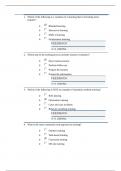
1. Which of the following is a variation of e-learning that is becoming more
popular?
o Blended learning
o Interactive learning
o Multi-e-learning
o Synchronous learning
FEEDBACK
(100.0%)
2. Which step in the training process includes mastery evaluation?
o Have trainee practice
o Perform follow-up
o Prepare the learners
o Present the information
FEEDBACK
(100.0%)
3. Which of the following is NOT an example of simulation method training?
o Role playing
o Orientation training
o Cases and case incidents
o Behavior modeling training
FEEDBACK
(100.0%)
4. What is the most commonly used approach to training?
o Outdoor training
o Web-based training
o Classroom training
o Off-site training
, FEEDBACK
(100.0%)
5. Although practical, on-the-job training has very little ________.
o Noticeable results
o Quality control
o Willing participants
o Success
FEEDBACK
(100.0%)
6. Discrimination training is based on the ________.
o Employment Discrimination laws
o Civil Rights Act of 1964
o Equal Opportunity Act
o Equal Employment Act
FEEDBACK
(100.0%)
7. Action learning appeals to the ________ learner.
o Extreme
o Kinesthetic
o Visual
o Auditory
FEEDBACK
(0.0%)
An approach known as action learning helps appeal to
the kinesthetic learner who needs hands-
on applications in order to best learn.
popular?
o Blended learning
o Interactive learning
o Multi-e-learning
o Synchronous learning
FEEDBACK
(100.0%)
2. Which step in the training process includes mastery evaluation?
o Have trainee practice
o Perform follow-up
o Prepare the learners
o Present the information
FEEDBACK
(100.0%)
3. Which of the following is NOT an example of simulation method training?
o Role playing
o Orientation training
o Cases and case incidents
o Behavior modeling training
FEEDBACK
(100.0%)
4. What is the most commonly used approach to training?
o Outdoor training
o Web-based training
o Classroom training
o Off-site training
, FEEDBACK
(100.0%)
5. Although practical, on-the-job training has very little ________.
o Noticeable results
o Quality control
o Willing participants
o Success
FEEDBACK
(100.0%)
6. Discrimination training is based on the ________.
o Employment Discrimination laws
o Civil Rights Act of 1964
o Equal Opportunity Act
o Equal Employment Act
FEEDBACK
(100.0%)
7. Action learning appeals to the ________ learner.
o Extreme
o Kinesthetic
o Visual
o Auditory
FEEDBACK
(0.0%)
An approach known as action learning helps appeal to
the kinesthetic learner who needs hands-
on applications in order to best learn.