

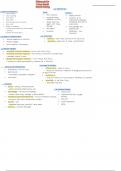
Inflammation
Tissue Repair
Wound Healing >
- patterns L
- sings of inflammation
acute chronic
• rubor (redness)
• tumor (swelling) • short duration • longer duration
• calor (heat) • nonspecificearly • recurrent acute
• dolor (pain) response to injury inlammatory response,
• function laesa (loss of function) • target infectious smoldering that fails to
• fever, chills agent, limit tissue evoke acute
• release of mediators damage • macrophages and
- histamine (antihistamines offset release) • neutrophils lymphocytes
- cytokines • exudates • fibroblasts - scar
- platelet activating factor formation
>
- causes of inflammation
>
-
intentions
• immune response to infection • primary - small, clean wound with no tissue lost
• trauma, surgery • secondary - great loss of tissue, contamination
• caustic agents - vancomycin
- vascular changes
• immediate transient response - occurs with minor injury
• immediate sustained response - more serious, continues for several days
- damages vessels in area
• delayed hemodynamic response - 4 to 24 hours after injury
- increase in capillary permeability, increase risk of infection
>
-
stages of healing
>
cellular acute inflammation • inflammation - onset at injury
• leukocytes to site of injury - blood clot formation, migration of phagocytes, production
• granulocytes of growth factors
- neutrophils, eosinophils, basophils • proliferative
• monocytes - build new tissue to fill wound space, fibroblasts to scarring
• remodling - 3 wks after injury
- decreased vasularity
- exudates
• serous - watery, minimal proteins
- plasma entering inflammatory site > impaired healing
-
• hemorrhagic - red blood cell leakage • malnutrition
- severe tissue injury, damage to blood vessels • impaired blood flow, oxygen
• membranous/pseudomembranous - mucous membrane surfaces delivery
- nectrotic cells within fibropurulent exudate • infection
• purulent - pus • wound seperation
- degraded leukocytes, proteins, tissue debris • aging
• fibrinous - contains fibrinogen
Tissue Repair
Wound Healing >
- patterns L
- sings of inflammation
acute chronic
• rubor (redness)
• tumor (swelling) • short duration • longer duration
• calor (heat) • nonspecificearly • recurrent acute
• dolor (pain) response to injury inlammatory response,
• function laesa (loss of function) • target infectious smoldering that fails to
• fever, chills agent, limit tissue evoke acute
• release of mediators damage • macrophages and
- histamine (antihistamines offset release) • neutrophils lymphocytes
- cytokines • exudates • fibroblasts - scar
- platelet activating factor formation
>
- causes of inflammation
>
-
intentions
• immune response to infection • primary - small, clean wound with no tissue lost
• trauma, surgery • secondary - great loss of tissue, contamination
• caustic agents - vancomycin
- vascular changes
• immediate transient response - occurs with minor injury
• immediate sustained response - more serious, continues for several days
- damages vessels in area
• delayed hemodynamic response - 4 to 24 hours after injury
- increase in capillary permeability, increase risk of infection
>
-
stages of healing
>
cellular acute inflammation • inflammation - onset at injury
• leukocytes to site of injury - blood clot formation, migration of phagocytes, production
• granulocytes of growth factors
- neutrophils, eosinophils, basophils • proliferative
• monocytes - build new tissue to fill wound space, fibroblasts to scarring
• remodling - 3 wks after injury
- decreased vasularity
- exudates
• serous - watery, minimal proteins
- plasma entering inflammatory site > impaired healing
-
• hemorrhagic - red blood cell leakage • malnutrition
- severe tissue injury, damage to blood vessels • impaired blood flow, oxygen
• membranous/pseudomembranous - mucous membrane surfaces delivery
- nectrotic cells within fibropurulent exudate • infection
• purulent - pus • wound seperation
- degraded leukocytes, proteins, tissue debris • aging
• fibrinous - contains fibrinogen


