ISSA CERTIFICATION TEST 2025 NEWEST COMPLETE 100 ACTUAL
QUESTIONS WITH CORRECT VERIFIED ANSWERS/ GRADED A+
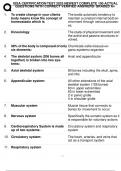
1. To create change in your clients The bodts automatic tendency to
body means know the concept of maintain a constant internal bodt en-
homeostasis which is vironment through various process-
es.
2. Kinesiology The study of physical movement and
the active and passive structures in-
volved.
3. 98% of the body is composed of only Chemicals>cells>tissues>or-
six elements: gans>systems>organism
4. The skeletal system (206 bones all Axial and appendicular
together) is broken into two sys-
tems:
5. Axial skeletal system 80 bones including the skull, spine,
and ribs
6. Appendicular system: All other extensions of the axial
skeletal system (126 bones)
60 in upper extremities
60 in lower extremities
2 in pelvic girdle
4 in shoulder girdle
7. Muscular system Muscle tissue that connects to
bones for movement to occur
8. Nervous system Specifically the somatic system as it
is responsible for voluntary actions
9. Cardiorespiratory System is made Circulatory system and respiratory
up of two systems: system
10. Circulatory system: The heart, arteries, and veins that
act as a transport system
11. Respiratory system
, ISSA CERTIFICATION TEST 2025
The lungs and air passageways
which supply oxygen to the body and
remove carbon dioxide
12. Digestive system Responsible for breaking down good
and eliminating waste
13. Endocrine system Releases hormones and respon-
sible for metabolic activities (e.g.,
growth hormone is most abundantly
produced by the pituitary gland)
14. Most important to know about the The most important to know is struc-
skeletal system and what it includes ture and function. The skeletal sys-
tem includes bones and joints that
make up the structure or framework
of our body.
15. The five main categories of bones: Flat bones, short bones, long
bones, sesamoid bones, and irregu-
lar bones
16. Flat bones: give characteristics and Curved surface and provide protec-
example tion.
Ex: ilium, ribs, sternum, clavicle,
scapula
17. Short bones: give characteristics Small, cubed shaped
and example Ex: carpals and tarsals
18. Long bones: give characteristics Long, cylindrical shaft and provide
and example structural support
Ex: tibia, fibula, femur, radius, ulna,
humerus
19. Sesamoid bones: characteristics Small bones in the tendon of a mus-
and example culotendinous joint
Ex: patella, flexor tendons of the time
and thumb
QUESTIONS WITH CORRECT VERIFIED ANSWERS/ GRADED A+
1. To create change in your clients The bodts automatic tendency to
body means know the concept of maintain a constant internal bodt en-
homeostasis which is vironment through various process-
es.
2. Kinesiology The study of physical movement and
the active and passive structures in-
volved.
3. 98% of the body is composed of only Chemicals>cells>tissues>or-
six elements: gans>systems>organism
4. The skeletal system (206 bones all Axial and appendicular
together) is broken into two sys-
tems:
5. Axial skeletal system 80 bones including the skull, spine,
and ribs
6. Appendicular system: All other extensions of the axial
skeletal system (126 bones)
60 in upper extremities
60 in lower extremities
2 in pelvic girdle
4 in shoulder girdle
7. Muscular system Muscle tissue that connects to
bones for movement to occur
8. Nervous system Specifically the somatic system as it
is responsible for voluntary actions
9. Cardiorespiratory System is made Circulatory system and respiratory
up of two systems: system
10. Circulatory system: The heart, arteries, and veins that
act as a transport system
11. Respiratory system
, ISSA CERTIFICATION TEST 2025
The lungs and air passageways
which supply oxygen to the body and
remove carbon dioxide
12. Digestive system Responsible for breaking down good
and eliminating waste
13. Endocrine system Releases hormones and respon-
sible for metabolic activities (e.g.,
growth hormone is most abundantly
produced by the pituitary gland)
14. Most important to know about the The most important to know is struc-
skeletal system and what it includes ture and function. The skeletal sys-
tem includes bones and joints that
make up the structure or framework
of our body.
15. The five main categories of bones: Flat bones, short bones, long
bones, sesamoid bones, and irregu-
lar bones
16. Flat bones: give characteristics and Curved surface and provide protec-
example tion.
Ex: ilium, ribs, sternum, clavicle,
scapula
17. Short bones: give characteristics Small, cubed shaped
and example Ex: carpals and tarsals
18. Long bones: give characteristics Long, cylindrical shaft and provide
and example structural support
Ex: tibia, fibula, femur, radius, ulna,
humerus
19. Sesamoid bones: characteristics Small bones in the tendon of a mus-
and example culotendinous joint
Ex: patella, flexor tendons of the time
and thumb