

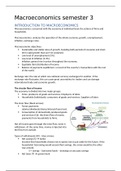
Macroeconomics semester 3
INTRODUCTION TO MACROECONOMICS
Microeconomics: concerned with the economy at individual level; the actions of firms and
households.
Macroeconomics: analyzes the operation of the whole economy; growth, unemployment,
inflation, exchange rates.
Macroeconomic objectives:
Sustainable and stable rates of growth. Avoiding both periods of recession and short-
term rapid growth that can’t be sustained.
Low level of unemployment (5%).
Low level of inflation (2-3%).
Inflation: general rise in prices throughout the economy.
Equitable (fair) distribution of income.
Balance of payments equilibrium: a record of the country’s transactions with the rest
of the world.
Exchange rate: the rate at which one national currency exchanges for another. If the
exchange rate fluctuates, this can cause great uncertainty for traders and can damage
international trade and economic growth.
The circular flow of income
The economy is divided into two major groups:
Firms: producers of goods and services. Employers of labor.
Households (individuals): consumers of goods and services. Suppliers of labor.
The inner flow (black arrows):
Factor payments:
salaries/dividends/shares/interest/loans/rent.
Consumption of domestically produced goods
and services (Cd): the direct flow of money
payments from households to firms.
Not all income goes through the inner flow; some is
withdrawn. At the same time, money is injected into
the flow from outside.
Types of withdrawals (W) – blue arrows:
Net savings (S) banks
Incomes that households choose not to spend, but to put aside for the future. if the
households’ borrowing would exceed their savings, the arrow would be the other
way around.
S = savings – borrowed funds – drawings on any past savings
Net taxes (T) government
, Taxes paid to central or local government. People can also receive benefits from the
government: transfer payments money is transferred from one group of people
(tax payers) to other (the recipients).
Import expenditure (M) abroad
Money that households spend on imported goods and services. Although the money
that consumers spend on such goods initially flows to domestic retailers, most of it
will eventually find its way abroad when the retailers/wholesalers themselves import
the product.
Types of injections (J) – green arrows:
Investment (I)
Money that firms obtain from various financial institutions – either past savings,
loans, or a new issue of shares.
Government expenditure (G)
When the government spends money on goods/services produced by firms.
Export expenditure (X)
When people abroad buy our exports of goods and services.
The national economy
Three ways of measuring GDP:
The product method: adding up the value of all goods and services produced in the
country, industry by industry.
The income method: adding up all incomes from households.
The expenditure method: adding up all expenditure on final output.
Consumer expenditure (C) + government expenditure (G) + investment
expenditure (I) + export (X)
Are national income statistics a suitable measure of living standards? Items that are
excluded:
Non-marketed items: ‘do-it-yourself’ and other home-based activities. E.g. painting
your room by yourself.
The underground economy: illegal and hence undeclared transactions. E.g.
drugs/guns.
Problems of using GDP statistics to measure welfare:
Production has human costs: if production increases as a result of people having to
work harder/longer, its benefit will be less. Pleasant working conditions are not
included in the GDP figures.
Production of some ‘bads’ may increase GDP: increased crime leads to more
expenditure on security; increased stress leads to more expenditure on healthcare;
and increased environmental damage leads to more expenditure on environmental
clean-up.
GDP ignores externalities: statistics do not record environmental side-effects.
Total GDP figures ignore the distribution of income: if some people gain and others
lose, we can’t say that there has been an ambiguous increase in welfare.
, THE MONEY SUPPLY
The functions of money:
Medium of exchange.
Means of storing wealth: saving money for the future.
Means of evaluation: money allows you to compare the value of
goods/services/assets.
Means of establishing value of future claims and payments. E.g. specifying prices in
contracts.
The ideal attributes of money:
Durability: it can last forever.
Divisibility
Transportability (also electronically)
Non-counterfeitability: copying money is almost impossible.
Main measures of money:
Narrow money: cash in circulation.
Broad money: both time and sight deposits, retail and wholesale deposits, and bank
and building society (savings institutions) deposits.
Fiat money: “worthless” money, e.g. bills ripped into pieces.
The Eurozone money supply:
M1: cash in circulation + money on the bank accounts. Not: money in safe or in
savings account.
M2: M1 + short-term time deposits + short-term saving deposits. (savings, deposits,
foreighn currencies).
M3: M2 + e.g. company bonds maturing in up to two years.
Roles of the central bank:
Issue notes: the central bank is responsible for printing notes and providing them to
the national banks.
Provider of liquidity to banks: they need to ensure that there is always an adequate
supply liquidity to meet the legitimate demands of depositors in banks.
Lender of last resort to commercial banks.
It oversees the activities of bank is other financial institutions:
Prudential control: the insistence that recognized banks maintain adequate liquidity.
It manages the government’s borrowing program.
Operates the monetary policy.
Controls inflation
Operates exchange rate policy and manages reserves.
Government bonds
= a debt security issued by a government to support government spending. E.g. a promise to
pay periodic (staatsobligatie/staatslening).
Governments raise money from taxes and the sale of government bonds.
INTRODUCTION TO MACROECONOMICS
Microeconomics: concerned with the economy at individual level; the actions of firms and
households.
Macroeconomics: analyzes the operation of the whole economy; growth, unemployment,
inflation, exchange rates.
Macroeconomic objectives:
Sustainable and stable rates of growth. Avoiding both periods of recession and short-
term rapid growth that can’t be sustained.
Low level of unemployment (5%).
Low level of inflation (2-3%).
Inflation: general rise in prices throughout the economy.
Equitable (fair) distribution of income.
Balance of payments equilibrium: a record of the country’s transactions with the rest
of the world.
Exchange rate: the rate at which one national currency exchanges for another. If the
exchange rate fluctuates, this can cause great uncertainty for traders and can damage
international trade and economic growth.
The circular flow of income
The economy is divided into two major groups:
Firms: producers of goods and services. Employers of labor.
Households (individuals): consumers of goods and services. Suppliers of labor.
The inner flow (black arrows):
Factor payments:
salaries/dividends/shares/interest/loans/rent.
Consumption of domestically produced goods
and services (Cd): the direct flow of money
payments from households to firms.
Not all income goes through the inner flow; some is
withdrawn. At the same time, money is injected into
the flow from outside.
Types of withdrawals (W) – blue arrows:
Net savings (S) banks
Incomes that households choose not to spend, but to put aside for the future. if the
households’ borrowing would exceed their savings, the arrow would be the other
way around.
S = savings – borrowed funds – drawings on any past savings
Net taxes (T) government
, Taxes paid to central or local government. People can also receive benefits from the
government: transfer payments money is transferred from one group of people
(tax payers) to other (the recipients).
Import expenditure (M) abroad
Money that households spend on imported goods and services. Although the money
that consumers spend on such goods initially flows to domestic retailers, most of it
will eventually find its way abroad when the retailers/wholesalers themselves import
the product.
Types of injections (J) – green arrows:
Investment (I)
Money that firms obtain from various financial institutions – either past savings,
loans, or a new issue of shares.
Government expenditure (G)
When the government spends money on goods/services produced by firms.
Export expenditure (X)
When people abroad buy our exports of goods and services.
The national economy
Three ways of measuring GDP:
The product method: adding up the value of all goods and services produced in the
country, industry by industry.
The income method: adding up all incomes from households.
The expenditure method: adding up all expenditure on final output.
Consumer expenditure (C) + government expenditure (G) + investment
expenditure (I) + export (X)
Are national income statistics a suitable measure of living standards? Items that are
excluded:
Non-marketed items: ‘do-it-yourself’ and other home-based activities. E.g. painting
your room by yourself.
The underground economy: illegal and hence undeclared transactions. E.g.
drugs/guns.
Problems of using GDP statistics to measure welfare:
Production has human costs: if production increases as a result of people having to
work harder/longer, its benefit will be less. Pleasant working conditions are not
included in the GDP figures.
Production of some ‘bads’ may increase GDP: increased crime leads to more
expenditure on security; increased stress leads to more expenditure on healthcare;
and increased environmental damage leads to more expenditure on environmental
clean-up.
GDP ignores externalities: statistics do not record environmental side-effects.
Total GDP figures ignore the distribution of income: if some people gain and others
lose, we can’t say that there has been an ambiguous increase in welfare.
, THE MONEY SUPPLY
The functions of money:
Medium of exchange.
Means of storing wealth: saving money for the future.
Means of evaluation: money allows you to compare the value of
goods/services/assets.
Means of establishing value of future claims and payments. E.g. specifying prices in
contracts.
The ideal attributes of money:
Durability: it can last forever.
Divisibility
Transportability (also electronically)
Non-counterfeitability: copying money is almost impossible.
Main measures of money:
Narrow money: cash in circulation.
Broad money: both time and sight deposits, retail and wholesale deposits, and bank
and building society (savings institutions) deposits.
Fiat money: “worthless” money, e.g. bills ripped into pieces.
The Eurozone money supply:
M1: cash in circulation + money on the bank accounts. Not: money in safe or in
savings account.
M2: M1 + short-term time deposits + short-term saving deposits. (savings, deposits,
foreighn currencies).
M3: M2 + e.g. company bonds maturing in up to two years.
Roles of the central bank:
Issue notes: the central bank is responsible for printing notes and providing them to
the national banks.
Provider of liquidity to banks: they need to ensure that there is always an adequate
supply liquidity to meet the legitimate demands of depositors in banks.
Lender of last resort to commercial banks.
It oversees the activities of bank is other financial institutions:
Prudential control: the insistence that recognized banks maintain adequate liquidity.
It manages the government’s borrowing program.
Operates the monetary policy.
Controls inflation
Operates exchange rate policy and manages reserves.
Government bonds
= a debt security issued by a government to support government spending. E.g. a promise to
pay periodic (staatsobligatie/staatslening).
Governments raise money from taxes and the sale of government bonds.


