

HCMG
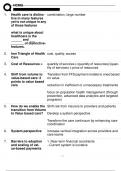
1. Health care is distinc- combination, large number
tive in many features
yet is not unique in any
of these features
what is unique about
healthcare is the
______ and ___
_______ of distinctive-
features.
2. Iron Triangle of Health cost, quality, access
Care
3. Cost of Resources = quantity of services x (quantity of resources)/(quan-
tity of services) x price of resources
4. Shift from volume to Transition from FFS payment models to ones based
value-based care: 3 on value
points to value based
care reduction in inefficient or unnecessary treatments
focus on population health management (through
prevention, advanced data analytics and targeted
programs)
5. How do we enable the Shift risk from insurers to providers and patients
transition from Volume
to Value based care? Develop a system perspective
Transform the care continuum by enhancing care
coordination
6. System perspective increase vertical integration across providers and
care teams
7. Barriers to adoption 1. Near term financial constraints
and scaling of val- --Current system is lucrative
ue-based payments
, HCMG
2. Short term focus
-inconsistent time horizons
3. Resistance to change
-risk and perceived risk (resistance to change)
8. Stakeholders in HC Regulators
Ecosystem
Manufacturers
Providers
Payers
Patients
9. The connection be- health and medical care
tween _____ and ____
______ is not nearly
as direct or immediate
as most discussions
would have us believe
10. _____ rather than Patients rather than physicians have major influ-
_____ have major ence on their health while physicians rather than
influence on their patients have major influence on the cost of medical
______ while physi- care
cians rather than pa-
tients have major in-
fluence on the ____ of
medical care
11. Insurance companies' Processing claims (justification for scale)
core business is:
Spreading risk (justification for scale)
Population health management
12. Providers' core busi-
ness is:
, HCMG
Care delivery
Population health management
13. Distinctive (but not Uncertainty
unique) features of
Healthcare Prominence of Insurance
Asymmetric Information
Large Role of Nonprofit Firms
Restrictions on Competition
"Natural" Features of Health Care Services
Government Subsidies and Public Provision
Externalities
Moral Issues
14. Uncertainty: Demand Uncertainty about quality - It is very difficult to verify
Side the quality of care.
Uncertainty about individual's illnesses: hard to an-
ticipate future health needs.
15. Uncertainty: Supply Uncertainty about the effectiveness of medical
Side treatment: hard to predict the outcome of a given
treatment
16. Prominence of Insur- Insured people do not pay the full cost of services
ance --weakens the effect of prices and also is associat-
ed with what we call the Moral Hazard problem
17. Prominence of Insur- Insurance coverage may alter the behavior of the
ance: Moral Hazard insured individual.
problem
, HCMG
Insurance coverage may alter the behavior of
health care providers.
18. Asymmetric Informa- (Hidden information)
tion: Adverse selection
problem Patients have private info -- info is known by the
patient but not insurer/provider
(i.e. lifestyle, family history, propensity to use med-
ical services)
19. Asymmetric Informa- Providers have private info -- info not known to
tion: Induced Demand patient
or Quantity Shirking
-patient's medical condition
-quality of medical service
20. Large Role of Nonprof- Many hospitals, nursing homes, and insurers orga-
it Firms nize as private non profit firms (501c3)
21. Single objective for profit maximization
firms:
22. Restrictions on Com- (1) Many well informed buyers and sellers, no one
petition: Free Compet- large enough to influence price.
itive Markets (2) Buyers and sellers act independently (no collu-
sion)
.(3) Free entry
23. Restrictions on Com- (1) Serious information problems, slow dissemina-
petition: Healthcare tion of technologies, large regional variation, and
Markets info asymmetries.
(2) Mergers, alliances, networks, HMOs, etc...
(3) Entry is limited by licensing, Certificate of need
(CON) legislation
24.
1. Health care is distinc- combination, large number
tive in many features
yet is not unique in any
of these features
what is unique about
healthcare is the
______ and ___
_______ of distinctive-
features.
2. Iron Triangle of Health cost, quality, access
Care
3. Cost of Resources = quantity of services x (quantity of resources)/(quan-
tity of services) x price of resources
4. Shift from volume to Transition from FFS payment models to ones based
value-based care: 3 on value
points to value based
care reduction in inefficient or unnecessary treatments
focus on population health management (through
prevention, advanced data analytics and targeted
programs)
5. How do we enable the Shift risk from insurers to providers and patients
transition from Volume
to Value based care? Develop a system perspective
Transform the care continuum by enhancing care
coordination
6. System perspective increase vertical integration across providers and
care teams
7. Barriers to adoption 1. Near term financial constraints
and scaling of val- --Current system is lucrative
ue-based payments
, HCMG
2. Short term focus
-inconsistent time horizons
3. Resistance to change
-risk and perceived risk (resistance to change)
8. Stakeholders in HC Regulators
Ecosystem
Manufacturers
Providers
Payers
Patients
9. The connection be- health and medical care
tween _____ and ____
______ is not nearly
as direct or immediate
as most discussions
would have us believe
10. _____ rather than Patients rather than physicians have major influ-
_____ have major ence on their health while physicians rather than
influence on their patients have major influence on the cost of medical
______ while physi- care
cians rather than pa-
tients have major in-
fluence on the ____ of
medical care
11. Insurance companies' Processing claims (justification for scale)
core business is:
Spreading risk (justification for scale)
Population health management
12. Providers' core busi-
ness is:
, HCMG
Care delivery
Population health management
13. Distinctive (but not Uncertainty
unique) features of
Healthcare Prominence of Insurance
Asymmetric Information
Large Role of Nonprofit Firms
Restrictions on Competition
"Natural" Features of Health Care Services
Government Subsidies and Public Provision
Externalities
Moral Issues
14. Uncertainty: Demand Uncertainty about quality - It is very difficult to verify
Side the quality of care.
Uncertainty about individual's illnesses: hard to an-
ticipate future health needs.
15. Uncertainty: Supply Uncertainty about the effectiveness of medical
Side treatment: hard to predict the outcome of a given
treatment
16. Prominence of Insur- Insured people do not pay the full cost of services
ance --weakens the effect of prices and also is associat-
ed with what we call the Moral Hazard problem
17. Prominence of Insur- Insurance coverage may alter the behavior of the
ance: Moral Hazard insured individual.
problem
, HCMG
Insurance coverage may alter the behavior of
health care providers.
18. Asymmetric Informa- (Hidden information)
tion: Adverse selection
problem Patients have private info -- info is known by the
patient but not insurer/provider
(i.e. lifestyle, family history, propensity to use med-
ical services)
19. Asymmetric Informa- Providers have private info -- info not known to
tion: Induced Demand patient
or Quantity Shirking
-patient's medical condition
-quality of medical service
20. Large Role of Nonprof- Many hospitals, nursing homes, and insurers orga-
it Firms nize as private non profit firms (501c3)
21. Single objective for profit maximization
firms:
22. Restrictions on Com- (1) Many well informed buyers and sellers, no one
petition: Free Compet- large enough to influence price.
itive Markets (2) Buyers and sellers act independently (no collu-
sion)
.(3) Free entry
23. Restrictions on Com- (1) Serious information problems, slow dissemina-
petition: Healthcare tion of technologies, large regional variation, and
Markets info asymmetries.
(2) Mergers, alliances, networks, HMOs, etc...
(3) Entry is limited by licensing, Certificate of need
(CON) legislation
24.


