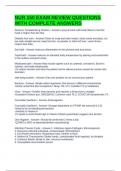
NUR 150 EXAM REVIEW QUESTIONS
WITH COMPLETE ANSWERS
Reverse Trendelenburg Position - Answer-Lying on back with body tilted so that the
head is higher than the feet
Diabetic foot care - Answer-Clean w/ soap and warm water, clean socks everyday, cut
toe nails straight across, keep feet dry, no powder or lotion b/t toes , wear shoes ,
inspect feet daily
Sitz bath - Answer-reduces inflammation in the perineal and anal areas
Tepid bath - Answer-reduces an elevated body temperature by placing cool washcloths
in the axillary and groin areas
Medicated bath - Answer-May include agents such as oatmeal, cornstarch, Burow's
solution, and soda bicarbonate
•To reduce tension and relax the patient and to relieve pruritus caused by certain skin
disorders
side-lying position - Answer-Oral care position for an unconscious patient
Bacteria - Answer--Single-celled organisms that thrives in different environments
-Mostly unharmful-(few exceptions= Strep, TB, UTI, Cellulitis>TX w/ antibiotics
Virus - Answer--Smaller than bacteria and requires a living host to multiply
-Example=Chicken pox, AIDES(HIV), Common cold, FLU, COVID-19>Symptomatic TX
Coumadin (warfarin) - Answer-Anticoagulant
Coumadin (warfarin) - Answer--Dosage dependent on PT/INR lab values(2.0-3.0)
-Need to be on bleeding precautions
-Antidote is Vitamin K
-Pt needs to avoid foods high in Vitamin K(Dark green/leafy veggies) and alcohol
Oral Hygiene - Answer--Should be performed 2 times a day
-Q2HRS is NPO or dependent(when repositioning)
Infection Process Cycle - Answer-1. Infectious Agent-Pathogen, Microorganism
2. Reservoir-Infected individual, contaminated H2O/soil/food
3. Exit Route-Secretions, Respiratory tract, Mother to fetus
4. Method of Transmission-Shake hands, contaminated food ingested, air droplets
5. Entrance-Mouth, Break in skin, mucous membranes
6. Susceptible Host-Another person
WITH COMPLETE ANSWERS
Reverse Trendelenburg Position - Answer-Lying on back with body tilted so that the
head is higher than the feet
Diabetic foot care - Answer-Clean w/ soap and warm water, clean socks everyday, cut
toe nails straight across, keep feet dry, no powder or lotion b/t toes , wear shoes ,
inspect feet daily
Sitz bath - Answer-reduces inflammation in the perineal and anal areas
Tepid bath - Answer-reduces an elevated body temperature by placing cool washcloths
in the axillary and groin areas
Medicated bath - Answer-May include agents such as oatmeal, cornstarch, Burow's
solution, and soda bicarbonate
•To reduce tension and relax the patient and to relieve pruritus caused by certain skin
disorders
side-lying position - Answer-Oral care position for an unconscious patient
Bacteria - Answer--Single-celled organisms that thrives in different environments
-Mostly unharmful-(few exceptions= Strep, TB, UTI, Cellulitis>TX w/ antibiotics
Virus - Answer--Smaller than bacteria and requires a living host to multiply
-Example=Chicken pox, AIDES(HIV), Common cold, FLU, COVID-19>Symptomatic TX
Coumadin (warfarin) - Answer-Anticoagulant
Coumadin (warfarin) - Answer--Dosage dependent on PT/INR lab values(2.0-3.0)
-Need to be on bleeding precautions
-Antidote is Vitamin K
-Pt needs to avoid foods high in Vitamin K(Dark green/leafy veggies) and alcohol
Oral Hygiene - Answer--Should be performed 2 times a day
-Q2HRS is NPO or dependent(when repositioning)
Infection Process Cycle - Answer-1. Infectious Agent-Pathogen, Microorganism
2. Reservoir-Infected individual, contaminated H2O/soil/food
3. Exit Route-Secretions, Respiratory tract, Mother to fetus
4. Method of Transmission-Shake hands, contaminated food ingested, air droplets
5. Entrance-Mouth, Break in skin, mucous membranes
6. Susceptible Host-Another person