

Summary Notes
Separation and Visualization of Nucleic
Acids
1. Quantification of Nucleic Acids
Quantification of nucleic acids, such as DNA and
RNA, determines their concentration and purity in
a sample. This process is crucial for downstream
applications like PCR, sequencing, and cloning.
Common techniques include spectrophotometry
using a NanoDrop (measuring absorbance at 260
nm for nucleic acids and 280 nm for proteins) and
fluorometry, which uses fluorescent dyes specific
to nucleic acids for more sensitive detection.
Example:
Using a NanoDrop, a researcher measures the
absorbance of an RNA sample. The absorbance ratio at
260/280 nm is 1.8, indicating good purity, and the RNA
concentration is 50 ng/μL. This RNA can now be used
for cDNA synthesis in a reverse transcription PCR
experiment.
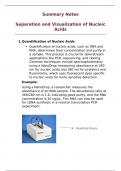
NanoDrop Device
, 1.1 Gel Electrophoresis
Separation of molecules based on relative
migration through a gel across an electric field.
Two main types:
1. Agarose gel electrophoresis
- Typically used for separation nucleic acid molecules
ranging from 100 bp to 100 kbp) – static electric field
- Two variants:
~ Pulse field gel electrophoresis (PFGE) & Field inversion
gel electrophoresis (FIGE): used for separating larger
molecules
e.g. from 50 to 1000 kb
2. Polyacrylamide gel electrophoresis
(PAGE) < 100bp
- resolution to the base pair.
~ While spectrophotometry (e.g., NanoDrop) and
fluorometry measure concentration and purity, gel
electrophoresis complements these methods by
assessing the integrity and size of nucleic acids.
How They Are Linked:
~ Integrity Assessment: Gel electrophoresis helps verify if
the DNA or RNA is intact or degraded, which is crucial for
accurate quantification. For example, smeared RNA on a
gel indicates degradation, even if spectrophotometric
measurements suggest high concentration.
~ Verification of Results: After quantifying nucleic acids,
running a gel ensures the sample is free of contaminants
Separation and Visualization of Nucleic
Acids
1. Quantification of Nucleic Acids
Quantification of nucleic acids, such as DNA and
RNA, determines their concentration and purity in
a sample. This process is crucial for downstream
applications like PCR, sequencing, and cloning.
Common techniques include spectrophotometry
using a NanoDrop (measuring absorbance at 260
nm for nucleic acids and 280 nm for proteins) and
fluorometry, which uses fluorescent dyes specific
to nucleic acids for more sensitive detection.
Example:
Using a NanoDrop, a researcher measures the
absorbance of an RNA sample. The absorbance ratio at
260/280 nm is 1.8, indicating good purity, and the RNA
concentration is 50 ng/μL. This RNA can now be used
for cDNA synthesis in a reverse transcription PCR
experiment.
NanoDrop Device
, 1.1 Gel Electrophoresis
Separation of molecules based on relative
migration through a gel across an electric field.
Two main types:
1. Agarose gel electrophoresis
- Typically used for separation nucleic acid molecules
ranging from 100 bp to 100 kbp) – static electric field
- Two variants:
~ Pulse field gel electrophoresis (PFGE) & Field inversion
gel electrophoresis (FIGE): used for separating larger
molecules
e.g. from 50 to 1000 kb
2. Polyacrylamide gel electrophoresis
(PAGE) < 100bp
- resolution to the base pair.
~ While spectrophotometry (e.g., NanoDrop) and
fluorometry measure concentration and purity, gel
electrophoresis complements these methods by
assessing the integrity and size of nucleic acids.
How They Are Linked:
~ Integrity Assessment: Gel electrophoresis helps verify if
the DNA or RNA is intact or degraded, which is crucial for
accurate quantification. For example, smeared RNA on a
gel indicates degradation, even if spectrophotometric
measurements suggest high concentration.
~ Verification of Results: After quantifying nucleic acids,
running a gel ensures the sample is free of contaminants


