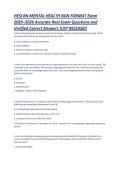
HESI-PN Mental Health Prep Questions & Knowledge Review | 100% VERIFIED CORRECT GUARANTEED GRADE A+
HESI-PN Mental Health Prep Questions & Knowledge Review | 100% VERIFIED CORRECT GUARANTEED GRADE A+ Which data indicate to the nurse that a client is experiencing effective coping following the loss of a spouse? Select all that apply. 1.Looks at old snapshots of family 2.Constantly neglects personal grooming 3.Visits the spouse's grave once a month 4.Visits the senior citizens' center once a month 5.Prefers to spend time alone and avoids contact with others Looking at old snapshots of family Visits the Spouse's grave once a month Visits the senior citizens' center once a month Coping mechanisms are behaviors that are used to decrease stress and anxiety. Visiting a spouse's grave, visiting the senior citizens' center, and looking at snapshots of the family are effective coping mechanisms. Neglecting grooming and preferring to spend time alone and avoiding contact with others are behaviors that identify ineffective coping of the grieving process. Which client is most likely at risk to become a victim of elder abuse? 1.A 75-year-old man with moderate hypertension 2.A 68-year-old man with newly diagnosed cataracts 3.A 90-year-old woman with advanced Alzheimer's disease 4.A 70-year-old woman with early diagnosed Lyme disease A 90-year-old woman with advanced Alzheimer's disease Elder abuse is widespread and occurs among all subgroups of the population. It includes physical and psychological abuse, the misuse of property, and the violation of rights. The person at highest risk of abuse is an elder with dementia that occurs with Alzheimer's disease. The nurse is assigned to care for a client experiencing disturbed thought processes. The nurse is told that the client believes that their food is being poisoned. Which communication technique should the nurse plan to use to encourage the client to eat? 1.Open-ended questions and silence 2.Focusing on self-disclosure regarding food preferences 3.Stating the reasons that the client may not want to eat 4.Offering opinions about the necessity of adequate nutrition Open-ended questions and silence Open-ended questions and silence are strategies used to encourage clients to discuss their problem. Options 3 and 4 do not encourage the client to express feelings. The nurse should not offer opinions and should not state the reasons, but should encourage the client to identify the reasons for their behavior. Option 2 is not a client-centered intervention. We have an expert-written solution to this problem! The nurse is assigned to care for a client admitted to the hospital after sustaining an injury from a house fire. The client attempted to save a neighbor involved in the fire, but despite the client's efforts, the neighbor died. Which action should the nurse take to enable the client to work through the meaning of the crisis? 1.Identifying the client's ability to function 2.Identifying the client's potential for self-harm 3.Inquiring about the client's feelings that may affect coping 4.Inquiring about the client's perception of the cause of the neighbor's death Inquiring about the client's feelings that may affect coping The client must first deal with feelings and negative responses before the client is able to work through the meaning of the crisis. Option 3 pertains directly to the client's feelings. Options 1, 2, and 4 do not directly address the client's feelings. We have an expert-written solution to this problem! The nurse is assisting with the data collection on a client admitted to the psychiatric unit. After review of the obtained data, the nurse should identify which as a priority concern? 1.The client's report of not eating or sleeping 2.The presence of bruises on the client's body 3.The client's report of self-destructive thoughts 4.The family member is disapproving of the treatment. The client's report of self-destructive thoughts The client's thoughts are extremely important when verbalized. Self-destructive thoughts are the highest priority. Options 1, 2, and 4 will all affect the treatment of the client but are not of greatest importance at this time. Laboratory work is prescribed for a client who has been experiencing delusions. When the laboratory technician approaches the client to obtain a specimen of the client's blood, the client begins to shout, "You're all vampires. Let me out of here!" The nurse present at the time should respond with which question or statement? 1."The technician is not going to hurt you but is going to help." 2."Are you fearful and think that others may want to hurt you?" 3."What makes you think that the technician wants to hurt you?" 4."The technician will leave and come back later for your blood." "Are you fearful and think that others may want to hurt you?" Option 2 is the only option that recognizes the client's need. This response helps the client focus on the emotion underlying the delusion but does not argue with it. If the nurse attempts to change the client's mind, the delusion may, in fact, be even more strongly held. Options 1, 3, and 4 do not focus on the client's feelings. An intoxicated client is brought to the emergency department by local police. The client is told that the primary health care provider (PHCP) will be in to see the client in about 30 minutes. The client becomes very loud and offensive and wants to be seen by the PHCP immediately. The nurse assisting to care for the client should take which appropriate nursing intervention? 1.Watch the behavior escalate before intervening. 2.Attempt to talk with the client to de-escalate the behavior. 3.Offer to take the client to an examination room until he or she can be treated. 4.Inform the client that he or she will be asked to leave if the behavior continues. Offer to take the client to an examination room until he or she can be treated. Safety of the client, other clients, and staff is of prime concern. Option 3 is in effect an isolation technique that allows for separation from others and provides for a less stimulating environment where the client can maintain dignity. When dealing with an impaired individual, trying to talk may be out of the question. Waiting to intervene could cause the client to become even more agitated and a threat to others. Option 4 would only further aggravate an already agitated individual. A client is admitted to a psychiatric unit for treatment of a psychotic disorder. The client is at the locked exit door and is shouting, "Let me out! There's nothing wrong with me! I don't belong here!" The nurse identifies this behavior as which defense mechanism? 1.Denial 2.Projection CONTINUED..
Written for
- Institution
- HESI-PN Mental Health Prep
- Course
- HESI-PN Mental Health Prep
Document information
- Uploaded on
- January 13, 2025
- Number of pages
- 11
- Written in
- 2024/2025
- Type
- Exam (elaborations)
- Contains
- Questions & answers
Subjects
-
hesi pn mental health prep
-
which data indicate to the nurse that a client is
-
which client is most likely at risk to become a vi
-
the nurse is assigned to care for a client experie