

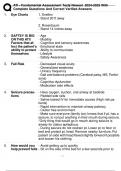
ATI - Fundamental Assessment Testÿ Newest 2024-2025 With
Complete Questions And Correct Verified Answers
1. Eye Charts 1. Snellen
- Stand 20 ft away
2. Rosenbaum
- Stand 14 inches away
2. SAFTEY IS BIG - Age
ON THIS ATI! - Mobility
Factors that af- - Cognitive and sensory awareness
fect the patient's - Emotional state
ability to protect - Ability to communicate
themselves - Lifestyle
- Safety Awareness
3. Fall Risk - Decreased visual acuity
- Generalized weakness
- Urinary frequency
- Gait and balance problems (Cerebral palsy, MS, Parkin-
sons)
- Cognitive dysfunction
- Medication side effects
4. Seizure precau- - Have oxygen, suction, oral airway at bedside
tions - Padded side rails
- Saline locked IV for immediate access (High risk pa-
tients)
- Rapid intervention to maintain airway patency.
- Clutter free environment
- Make sure everyone (family too) knows that if pt. has a
seizure, to not put anything in their mouth during seizure.
*Only thing that would go in mouth during seizure is
airway for status epilepticus.
- During seizure do not restrain pt. Lower pt. to floor or
bed and protect pt. head. Remove nearby furniture. Put
patient on side with head flexed slightly forward if possible
and loosen his clothing.
5. How would you - Avoid getting up to quickly
help prevent falls - Sit on the side of the bed for a few seconds prior to
, ATI - Fundamentals Assessment Test
for a patient with standing
orthostatic hy- - Stand at the side of the bed a few seconds prior to
potension? walking
6. Seclusion and - When everything else fails (orientation to environment,
Restraints family member, sitter, diversional activities, electronic de-
vices) is when you use restraints.
- Provider must prescribe after seeing the patient face to
face
7. Provider pre- - Reason for restraints
scription for re- - Type of restraints
straints must in- - Location of restraints
clude what? - How long to use restraints
- Type of behavior that warrants restraints
- *Prescription only last 4 hours for an adult. Providers
may renew these prescriptions with a maximum of 24
consecutive hours.*
8. Restraints in an - When there is an immediate risk to the patient or others,
emergency situa- nurses may place restraints on patient.
tion
- The nurse must then obtain a prescription from the
provider ASAP, usually within 1 hour.
9. Nursing Respon- - Explain the need for restraints to pt. and family. They are
sibilities for pa- for safety and are temporary.
tients in re-
straints - Ask pt. or guardian to sign consent form.
- Assess skin integrity and provide skin care according to
hospital protocol, usually Q2.
- Offer fluid and food.
- Provide means for hygiene and elimination.
- Monitor Vitals
, ATI - Fundamentals Assessment Test
- Offer range of motion exercises of extremities.
- Pad bony prominences to prevent skin breakdown.
- Use quick release knot to tie the restraints to the bed
frame where they will not tighten when raising or lowering
the bed.
- Fit 2 fingers b/w restraints and patient.
- Remove or replace restraints frequently to ensure good
circulation to the area and allow for full range of motion to
the limbs.
- Never leave pt. alone without restraints.
10. Fire Response - R - *Rescue* and protect patients close to fire by moving
RACE them to a safer location. Let patients who can walk, walk.
A - *Alarm* Activate alarm
C - *Contain* the fire by closing doors and windows and
turning off any sources of oxygen and electrical devices.
Vent. pts. who are on life support with a BVM.
E - *Extinguish* fire
11. How to use P - *Pull* the pin
fire extinguisher
- PASS A - *Aim* at base of fire
S - *Squeeze* handle
S - *Sweep* extinguisher from side to side.
12. State licensing Ensure that health care providers and agencies comply
boards with state regulations.
13. The Joint Com- Sets quality standards for accreditation of health care
mission facilities.
, ATI - Fundamentals Assessment TEST
14. Medicare For patients older than 65 or those with permanent dis-
abilities.
15. Medicaid For patients who have low income.
16. Preventative Educates and equips patients to reduce and control risk
health care factors for disease.
Examples
- Programs that promote immunizations
- Stress management
- Occupational health programs
- Seat belt use
17. Primary Health Emphasizes health promotion and includes prenatal and
care well-baby care, family planning, nutrition counseling, dis-
ease control.
Sustained partnership between patient and provider.
Directed toward promoting health and preventing devel-
opment of disease process or injury
Examples
- Office/clinic visits
- Community health centers
- Scheduled school or work-centered screenings (vision,
hearing, obesity)
- Immunizations
- Smoking cessation
- Diet
18. Secondary The diagnosis and treatment of acute illness and injury.
Healthcare
Focus on screening for early detection of disease with
prompt treatment of any found.
Examples
- Care in hospital settings (inpatient & ER)
Complete Questions And Correct Verified Answers
1. Eye Charts 1. Snellen
- Stand 20 ft away
2. Rosenbaum
- Stand 14 inches away
2. SAFTEY IS BIG - Age
ON THIS ATI! - Mobility
Factors that af- - Cognitive and sensory awareness
fect the patient's - Emotional state
ability to protect - Ability to communicate
themselves - Lifestyle
- Safety Awareness
3. Fall Risk - Decreased visual acuity
- Generalized weakness
- Urinary frequency
- Gait and balance problems (Cerebral palsy, MS, Parkin-
sons)
- Cognitive dysfunction
- Medication side effects
4. Seizure precau- - Have oxygen, suction, oral airway at bedside
tions - Padded side rails
- Saline locked IV for immediate access (High risk pa-
tients)
- Rapid intervention to maintain airway patency.
- Clutter free environment
- Make sure everyone (family too) knows that if pt. has a
seizure, to not put anything in their mouth during seizure.
*Only thing that would go in mouth during seizure is
airway for status epilepticus.
- During seizure do not restrain pt. Lower pt. to floor or
bed and protect pt. head. Remove nearby furniture. Put
patient on side with head flexed slightly forward if possible
and loosen his clothing.
5. How would you - Avoid getting up to quickly
help prevent falls - Sit on the side of the bed for a few seconds prior to
, ATI - Fundamentals Assessment Test
for a patient with standing
orthostatic hy- - Stand at the side of the bed a few seconds prior to
potension? walking
6. Seclusion and - When everything else fails (orientation to environment,
Restraints family member, sitter, diversional activities, electronic de-
vices) is when you use restraints.
- Provider must prescribe after seeing the patient face to
face
7. Provider pre- - Reason for restraints
scription for re- - Type of restraints
straints must in- - Location of restraints
clude what? - How long to use restraints
- Type of behavior that warrants restraints
- *Prescription only last 4 hours for an adult. Providers
may renew these prescriptions with a maximum of 24
consecutive hours.*
8. Restraints in an - When there is an immediate risk to the patient or others,
emergency situa- nurses may place restraints on patient.
tion
- The nurse must then obtain a prescription from the
provider ASAP, usually within 1 hour.
9. Nursing Respon- - Explain the need for restraints to pt. and family. They are
sibilities for pa- for safety and are temporary.
tients in re-
straints - Ask pt. or guardian to sign consent form.
- Assess skin integrity and provide skin care according to
hospital protocol, usually Q2.
- Offer fluid and food.
- Provide means for hygiene and elimination.
- Monitor Vitals
, ATI - Fundamentals Assessment Test
- Offer range of motion exercises of extremities.
- Pad bony prominences to prevent skin breakdown.
- Use quick release knot to tie the restraints to the bed
frame where they will not tighten when raising or lowering
the bed.
- Fit 2 fingers b/w restraints and patient.
- Remove or replace restraints frequently to ensure good
circulation to the area and allow for full range of motion to
the limbs.
- Never leave pt. alone without restraints.
10. Fire Response - R - *Rescue* and protect patients close to fire by moving
RACE them to a safer location. Let patients who can walk, walk.
A - *Alarm* Activate alarm
C - *Contain* the fire by closing doors and windows and
turning off any sources of oxygen and electrical devices.
Vent. pts. who are on life support with a BVM.
E - *Extinguish* fire
11. How to use P - *Pull* the pin
fire extinguisher
- PASS A - *Aim* at base of fire
S - *Squeeze* handle
S - *Sweep* extinguisher from side to side.
12. State licensing Ensure that health care providers and agencies comply
boards with state regulations.
13. The Joint Com- Sets quality standards for accreditation of health care
mission facilities.
, ATI - Fundamentals Assessment TEST
14. Medicare For patients older than 65 or those with permanent dis-
abilities.
15. Medicaid For patients who have low income.
16. Preventative Educates and equips patients to reduce and control risk
health care factors for disease.
Examples
- Programs that promote immunizations
- Stress management
- Occupational health programs
- Seat belt use
17. Primary Health Emphasizes health promotion and includes prenatal and
care well-baby care, family planning, nutrition counseling, dis-
ease control.
Sustained partnership between patient and provider.
Directed toward promoting health and preventing devel-
opment of disease process or injury
Examples
- Office/clinic visits
- Community health centers
- Scheduled school or work-centered screenings (vision,
hearing, obesity)
- Immunizations
- Smoking cessation
- Diet
18. Secondary The diagnosis and treatment of acute illness and injury.
Healthcare
Focus on screening for early detection of disease with
prompt treatment of any found.
Examples
- Care in hospital settings (inpatient & ER)


