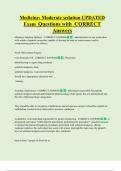
Medicine: Moderate sedation UPDATED
Exam Questions with CORRECT
Answers
Moderate Sedation Defined: - CORRECT ANSWER - administration of any medication
with sedative/hypnotic properties capable of altering the state of consciousness and/or
compromising protective reflexes
AMA Office-based Surgery
Core Principle #10 - CORRECT ANSWER - Physicians
administering or supervising moderate
sedation/analgesia, deep
sedation/analgesia, or general anesthesia
should have appropriate education and
training.
Training of personnel - CORRECT ANSWER - Individuals responsible for patients
sedation/analgesia should understand the pharmacology of the agents that are administered and
the role of pharmacologic antagonists...
They should be able to recognize complications and at least one caregiver should be capable of
establishing a patent airway and positive pressure ventilation
Availability of an individual responsible for patient monitoring - CORRECT ANSWER -A
designated individual, *other than the practitioner performing the procedure*, should be present
to monitor the patient throughout procedures performed with sedation/analgesia...during
moderate sedation, this individual may assist with minor, interruptible tasks once the patient's
level of sedation/analgesia and vital signs have stabilized
need at least 3 people in room for sx
, Monitoring Guidelines - CORRECT ANSWER - Level of consciousness
Pulmonary ventilation
Oxygenation
emodynamics
Use of supplemental oxygen - CORRECT ANSWER - Equipment to administer
supplemental oxygen should be present when sedation/analgesia is administered
Anesthetic induction agents used for sedation/analgesia (propofol, methohexital, ketamine): -
CORRECT ANSWER - The literature suggests that when administered by non-
anesthesiologists, propofol and ketamine can provide satisfactory moderate sedation; however,
consultants agree that AVOIDING these medications decreases the likelihood of adverse
outcomes during moderate sedation.
Key Elements of JCAHO's Agenda for Moderate Sedation: - CORRECT ANSWER -
Moderate sedation has been identified as a high risk, high volume, problem prone care process.
A "single and consistent policy" for the use of moderate sedation across all sites of care.
Based on minimum standards established by anesthesiology.
Goals Of Moderate Sedation - CORRECT ANSWER - Patient responds to tactile
stimulation
Maintains a patent airway
Maintains protective reflexes
Maintains cardiovascular homeostasis
Exam Questions with CORRECT
Answers
Moderate Sedation Defined: - CORRECT ANSWER - administration of any medication
with sedative/hypnotic properties capable of altering the state of consciousness and/or
compromising protective reflexes
AMA Office-based Surgery
Core Principle #10 - CORRECT ANSWER - Physicians
administering or supervising moderate
sedation/analgesia, deep
sedation/analgesia, or general anesthesia
should have appropriate education and
training.
Training of personnel - CORRECT ANSWER - Individuals responsible for patients
sedation/analgesia should understand the pharmacology of the agents that are administered and
the role of pharmacologic antagonists...
They should be able to recognize complications and at least one caregiver should be capable of
establishing a patent airway and positive pressure ventilation
Availability of an individual responsible for patient monitoring - CORRECT ANSWER -A
designated individual, *other than the practitioner performing the procedure*, should be present
to monitor the patient throughout procedures performed with sedation/analgesia...during
moderate sedation, this individual may assist with minor, interruptible tasks once the patient's
level of sedation/analgesia and vital signs have stabilized
need at least 3 people in room for sx
, Monitoring Guidelines - CORRECT ANSWER - Level of consciousness
Pulmonary ventilation
Oxygenation
emodynamics
Use of supplemental oxygen - CORRECT ANSWER - Equipment to administer
supplemental oxygen should be present when sedation/analgesia is administered
Anesthetic induction agents used for sedation/analgesia (propofol, methohexital, ketamine): -
CORRECT ANSWER - The literature suggests that when administered by non-
anesthesiologists, propofol and ketamine can provide satisfactory moderate sedation; however,
consultants agree that AVOIDING these medications decreases the likelihood of adverse
outcomes during moderate sedation.
Key Elements of JCAHO's Agenda for Moderate Sedation: - CORRECT ANSWER -
Moderate sedation has been identified as a high risk, high volume, problem prone care process.
A "single and consistent policy" for the use of moderate sedation across all sites of care.
Based on minimum standards established by anesthesiology.
Goals Of Moderate Sedation - CORRECT ANSWER - Patient responds to tactile
stimulation
Maintains a patent airway
Maintains protective reflexes
Maintains cardiovascular homeostasis