
Illinois Class B Non-CDL Exam Test with Verified Answers
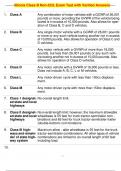
1. Class A Any combination of motor vehicles with a GCWR of 26,001
pounds or more, providing the GVWR of the vehicle being
towed is in excess of 10,000 pounds. Also allows for oper-
ation of Class B, C and D vehicles.
2. Class B Any single motor vehicle with a GCWR of 26,001 pounds
or more or any such vehicle towing another not in excess
of 10,000 pounds. Also allows for operation of Class C and
D vehicles.
3. Class C Any motor vehicle with a GVWR of more than 16,000
pounds, but less than 26,001 pounds or any such vehi-
cle towing another not in excess of 10,000 pounds. Also
allows for operation of Class D vehicles.
4. Class D Any motor vehicle with a GVWR of 16,000 pounds or less.
Does not include A. B, C, L or M vehicles.
5. Class L Any motor-driven cycle with less than 150cc displace-
ment.
6. Class M Any motor-driven cycle with more than 150cc displace-
ment.
7. Class I designat- No overall length limit.
ed state and local
highways
8. Class II designat- No overall length limit; however, the maximum allowable
ed state and local wheelbase is 55 feet for truck tractor-semitrailer com -
highways binations and 65 feet for truck tractor-semitrailer-trailer
(double-bottom) com binations.
9. Class III high- Maximum allow - able wheelbase is 55 feet for the truck
ways and remain- tractor-semitrailer combinations. All other types of vehicle
der of state high- combinations are limited to an overall length of 60 feet
way system including load.
10.
1/8
, Illinois Class B Non-CDL Exam Test with Verified Answers
Non-designated Maximum overall length is 55 feet, including loads for truck
local streets and tractor-semitrailer combinations, and 60 feet for all other
highways types of vehicle combinations.
11. Combination of May have an overall length of 65 feet plus a front overhang
vehicles special- of 3 feet and a rear overhang of 4 feet on Class I and II
ly designed to highways. On all other highways and streets, the maximum
transport motor overall length is 60 feet including load
vehicles
12. Width The maximum width for most vehicles is 8 feet, except on
designated Class I and II state high ways and designated
local roads where a width of 8 feet, 6 inches is allowed
13. Farm Width Ex- Loads of farm products or implements of husbandry being
emption transported during the period from one-half hour after
sunrise to one-half hour before sunset in times of good
visibility. These vehicles are not exempt when there is
not enough light, during bad weather conditions, or when
persons or vehicles on the roadway cannot be clearly seen
from 1,000 feet away.
14. Bus Width Ex- Buses operating within the limits of cities and villages
emption located in counties with populations of 500,000 or more.
Maximum widths may be up to 9 feet; however, no vehicle
wider than 8 feet, 8 inches may be operated on interstate
highways in those counties.
15. Length No vehicle with or without a load, other than a semitrailer,
shall exceed a length of 42 feet.
16. Length Excep- Exceptions are vehicles hauling pipes, poles, machinery
tion or other structural objects that cannot be quickly taken
apart. However, the length of these objects may not ex-
ceed 80 feet, except for public utility emergency repairs
or for those holding special permits. These vehicles are
not allowed to operate when it is dark or on Saturdays,
Sundays and legal holidays.
17. Height
2/8
1. Class A Any combination of motor vehicles with a GCWR of 26,001
pounds or more, providing the GVWR of the vehicle being
towed is in excess of 10,000 pounds. Also allows for oper-
ation of Class B, C and D vehicles.
2. Class B Any single motor vehicle with a GCWR of 26,001 pounds
or more or any such vehicle towing another not in excess
of 10,000 pounds. Also allows for operation of Class C and
D vehicles.
3. Class C Any motor vehicle with a GVWR of more than 16,000
pounds, but less than 26,001 pounds or any such vehi-
cle towing another not in excess of 10,000 pounds. Also
allows for operation of Class D vehicles.
4. Class D Any motor vehicle with a GVWR of 16,000 pounds or less.
Does not include A. B, C, L or M vehicles.
5. Class L Any motor-driven cycle with less than 150cc displace-
ment.
6. Class M Any motor-driven cycle with more than 150cc displace-
ment.
7. Class I designat- No overall length limit.
ed state and local
highways
8. Class II designat- No overall length limit; however, the maximum allowable
ed state and local wheelbase is 55 feet for truck tractor-semitrailer com -
highways binations and 65 feet for truck tractor-semitrailer-trailer
(double-bottom) com binations.
9. Class III high- Maximum allow - able wheelbase is 55 feet for the truck
ways and remain- tractor-semitrailer combinations. All other types of vehicle
der of state high- combinations are limited to an overall length of 60 feet
way system including load.
10.
1/8
, Illinois Class B Non-CDL Exam Test with Verified Answers
Non-designated Maximum overall length is 55 feet, including loads for truck
local streets and tractor-semitrailer combinations, and 60 feet for all other
highways types of vehicle combinations.
11. Combination of May have an overall length of 65 feet plus a front overhang
vehicles special- of 3 feet and a rear overhang of 4 feet on Class I and II
ly designed to highways. On all other highways and streets, the maximum
transport motor overall length is 60 feet including load
vehicles
12. Width The maximum width for most vehicles is 8 feet, except on
designated Class I and II state high ways and designated
local roads where a width of 8 feet, 6 inches is allowed
13. Farm Width Ex- Loads of farm products or implements of husbandry being
emption transported during the period from one-half hour after
sunrise to one-half hour before sunset in times of good
visibility. These vehicles are not exempt when there is
not enough light, during bad weather conditions, or when
persons or vehicles on the roadway cannot be clearly seen
from 1,000 feet away.
14. Bus Width Ex- Buses operating within the limits of cities and villages
emption located in counties with populations of 500,000 or more.
Maximum widths may be up to 9 feet; however, no vehicle
wider than 8 feet, 8 inches may be operated on interstate
highways in those counties.
15. Length No vehicle with or without a load, other than a semitrailer,
shall exceed a length of 42 feet.
16. Length Excep- Exceptions are vehicles hauling pipes, poles, machinery
tion or other structural objects that cannot be quickly taken
apart. However, the length of these objects may not ex-
ceed 80 feet, except for public utility emergency repairs
or for those holding special permits. These vehicles are
not allowed to operate when it is dark or on Saturdays,
Sundays and legal holidays.
17. Height
2/8


