Tilly Salmon
Macroeconomics
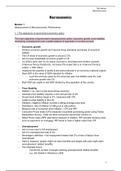
Macroeconomics
Module 1
Measurement of Macroeconomic Performance
1.1 The objectives of government economic policy
The main objectives of government macroeconomic policy: economic growth, price stability,
minimising unemployment and a stable balance of payments on current account
- Economic growth
- Achieve economic growth and improve living standards and levels of economic
welfare
- The LR trend of economic growth is around 2.5%
- Aim to have sustainable economic growth in LR
- In LEDCs govt aim to increase economic development before growth,
(improve living standards, increase life expectancy & improve literacy
rates) → HDI index
- measures the quantity of goods & services produced in an economy (national output)
- Real GDP is the value of GDP adjusted for inflation
- e.g.if the economy grew by 4% since last year, but inflation was 2%, real
economic growth was 2%
- Real GDP per capita is real GDP divided by the population of the country
- Price Stability
- Inflation = av. rise in price level across economy
- Absolute price stability requires a zero annual rate of infl.
- Government inflation target is 2%, measured with CPI.
- Leads to price stability in the LR.
- Deflation; negative inflation involves a falling average price level
- Disinflation; rate of inflation is falling but is still positive
- Measure rate of consumer price inflation = CPI and RPI
- Consumer Prices Index (CPI) measures household purchasing power using Family
Expenditure Survey - finds out what consumers spend their income on
- Retail Prices Index (RPI) alternative measure of inflation, RPI includes housing costs,
such as payments on mortgage, RPI tends to have a higher value than CPI
- Unemployment
- Aim to have near to full employment.
- Aim for unemployment rate of 3%
- Beveridge’s definition = full employment means that 3% or less of labour force
unemployed
- Hard to measure, people might not claim benefits and people with jobs might claim
unemployment related benefits.
- The Claimant Count
- Counts the number of people claiming unemployment related benefits
- e.g. Job Seeker’s Allowance (JSA)
1
Macroeconomics
Macroeconomics
Module 1
Measurement of Macroeconomic Performance
1.1 The objectives of government economic policy
The main objectives of government macroeconomic policy: economic growth, price stability,
minimising unemployment and a stable balance of payments on current account
- Economic growth
- Achieve economic growth and improve living standards and levels of economic
welfare
- The LR trend of economic growth is around 2.5%
- Aim to have sustainable economic growth in LR
- In LEDCs govt aim to increase economic development before growth,
(improve living standards, increase life expectancy & improve literacy
rates) → HDI index
- measures the quantity of goods & services produced in an economy (national output)
- Real GDP is the value of GDP adjusted for inflation
- e.g.if the economy grew by 4% since last year, but inflation was 2%, real
economic growth was 2%
- Real GDP per capita is real GDP divided by the population of the country
- Price Stability
- Inflation = av. rise in price level across economy
- Absolute price stability requires a zero annual rate of infl.
- Government inflation target is 2%, measured with CPI.
- Leads to price stability in the LR.
- Deflation; negative inflation involves a falling average price level
- Disinflation; rate of inflation is falling but is still positive
- Measure rate of consumer price inflation = CPI and RPI
- Consumer Prices Index (CPI) measures household purchasing power using Family
Expenditure Survey - finds out what consumers spend their income on
- Retail Prices Index (RPI) alternative measure of inflation, RPI includes housing costs,
such as payments on mortgage, RPI tends to have a higher value than CPI
- Unemployment
- Aim to have near to full employment.
- Aim for unemployment rate of 3%
- Beveridge’s definition = full employment means that 3% or less of labour force
unemployed
- Hard to measure, people might not claim benefits and people with jobs might claim
unemployment related benefits.
- The Claimant Count
- Counts the number of people claiming unemployment related benefits
- e.g. Job Seeker’s Allowance (JSA)
1