

Revenue management
Lecture 1
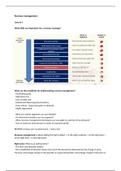
What skills are imperative for a revenue manager?
What are the conditions for implementing revenue management?
- Perishable goods
- High fixed cost
- Low variable cost
- Limited and fixed capacity/inventory
- Time critical – large fluctuation in demand
- Highly segmented
- What are market segments can you identify?
- On what characteristics can you segment?
- What revenue management techniques can you apply in a period of low demand?
- How to make the best decision in order to maximize profit?
REVPOR (revenue per occupied room < used a lot)
Revenue management is about selling the right product > to the right customer > at the right price >
at the right time > in the right place
Right price: What is an optimal price?
- The price and demand relation
- Price elasticities of demand: shows how much the demand is influenced by the change in price
Formula: percentage change in the quantity of a good demanded / percentage change in the price of
, that good (product or service)
- Multiple prices lead to an increase of revenue
Dynamic pricing: a pricing strategy in which companies set flexible prices for products or services
based on current market demands
Cost-based pricing: a pricing method wherein the price of a product is determined by adding a profit
element (percentage) in addition to the cost of making the product
Value-based pricing: a pricing strategy which set prices primarily, but not exclusively, according to
the perceived or estimated value of a product or service to the customer rather than according to the
cost of the product or historical pricing (example: painting is much more expensive than the costs of
making it was, since the value for the customer is higher)
Right customer:
- Relation between revenue management and segmentation: Segmenting your market, offering
different prices, increases revenue
- Customers can be segmented by many different target groups biggest groups (business, leisure,
groups)
- Willingness to pay
- Customer centric approach: Any marketing or operational effort focused on the needs, wants and
desires of an organization customers
When you are setting conditions, you have to put yourself in the shoes of the customer
- Price fencing: protect your prices in a way that low paying customers who are not meant to choose
this price, cannot choose for this option
Right product:
- Segmentation should lead to differentiation (price & product)
- Implementing pricing conditions
- Building a pricing structure, new products and conditions
Right time:
- Supply and demand
- Displacement analysis: different guests, different customer worth, different willingness to pay and
customer value. You ask yourself, which customer will you accept when there is one room left? and
could you have made more revenue by accepting different guests? And what is the most optimal
business mix?
- Analyzing and forecasting
Right place:
- you need demand first (sales) and you need to control your reservations in a reservation system
(management info). You also need to analyse and forecast
- Then you need to set a price, decide on availability and for each price you need to set price
conditions (price fencing, duration, purchasing rules)
Price fencing: rules or restrictions that allow customers to segment themselves into appropriate rate
categories based on their needs, behavior or willingness to pay. (Especially used in hotel industry and
airlines) < is essential to prevent customers buying the cheaper products
Lecture 1
What skills are imperative for a revenue manager?
What are the conditions for implementing revenue management?
- Perishable goods
- High fixed cost
- Low variable cost
- Limited and fixed capacity/inventory
- Time critical – large fluctuation in demand
- Highly segmented
- What are market segments can you identify?
- On what characteristics can you segment?
- What revenue management techniques can you apply in a period of low demand?
- How to make the best decision in order to maximize profit?
REVPOR (revenue per occupied room < used a lot)
Revenue management is about selling the right product > to the right customer > at the right price >
at the right time > in the right place
Right price: What is an optimal price?
- The price and demand relation
- Price elasticities of demand: shows how much the demand is influenced by the change in price
Formula: percentage change in the quantity of a good demanded / percentage change in the price of
, that good (product or service)
- Multiple prices lead to an increase of revenue
Dynamic pricing: a pricing strategy in which companies set flexible prices for products or services
based on current market demands
Cost-based pricing: a pricing method wherein the price of a product is determined by adding a profit
element (percentage) in addition to the cost of making the product
Value-based pricing: a pricing strategy which set prices primarily, but not exclusively, according to
the perceived or estimated value of a product or service to the customer rather than according to the
cost of the product or historical pricing (example: painting is much more expensive than the costs of
making it was, since the value for the customer is higher)
Right customer:
- Relation between revenue management and segmentation: Segmenting your market, offering
different prices, increases revenue
- Customers can be segmented by many different target groups biggest groups (business, leisure,
groups)
- Willingness to pay
- Customer centric approach: Any marketing or operational effort focused on the needs, wants and
desires of an organization customers
When you are setting conditions, you have to put yourself in the shoes of the customer
- Price fencing: protect your prices in a way that low paying customers who are not meant to choose
this price, cannot choose for this option
Right product:
- Segmentation should lead to differentiation (price & product)
- Implementing pricing conditions
- Building a pricing structure, new products and conditions
Right time:
- Supply and demand
- Displacement analysis: different guests, different customer worth, different willingness to pay and
customer value. You ask yourself, which customer will you accept when there is one room left? and
could you have made more revenue by accepting different guests? And what is the most optimal
business mix?
- Analyzing and forecasting
Right place:
- you need demand first (sales) and you need to control your reservations in a reservation system
(management info). You also need to analyse and forecast
- Then you need to set a price, decide on availability and for each price you need to set price
conditions (price fencing, duration, purchasing rules)
Price fencing: rules or restrictions that allow customers to segment themselves into appropriate rate
categories based on their needs, behavior or willingness to pay. (Especially used in hotel industry and
airlines) < is essential to prevent customers buying the cheaper products


