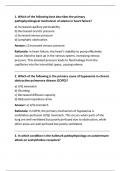
1. Which of the following best describes the primary
pathophysiological mechanism of edema in heart failure?
a) Increased capillary permeability
b) Decreased oncotic pressure
c) Increased venous pressure
d) Lymphatic obstruction
Answer: c) Increased venous pressure
Rationale: In heart failure, the heart's inability to pump effectively
causes blood to back up in the venous system, increasing venous
pressure. This elevated pressure leads to fluid leakage from the
capillaries into the interstitial space, causing edema.
2. Which of the following is the primary cause of hypoxemia in chronic
obstructive pulmonary disease (COPD)?
a) V/Q mismatch
b) Shunting
c) Decreased diffusion capacity
d) Reduced respiratory drive
Answer: a) V/Q mismatch
Rationale: In COPD, the primary mechanism of hypoxemia is
ventilation-perfusion (V/Q) mismatch. This occurs when parts of the
lung are well ventilated but poorly perfused due to obstruction, while
other areas are well perfused but poorly ventilated.
3. In which condition is the hallmark pathophysiology an autoimmune
attack on acetylcholine receptors?
,a) Myasthenia gravis
b) Guillain-Barré syndrome
c) Multiple sclerosis
d) Parkinson's disease
Answer: a) Myasthenia gravis
Rationale: Myasthenia gravis is characterized by an autoimmune
response where antibodies target and block acetylcholine receptors at
the neuromuscular junction, leading to muscle weakness and fatigue.
4. Which of the following best explains the pathophysiology of Type 2
diabetes mellitus?
a) Autoimmune destruction of beta cells in the pancreas
b) Insulin resistance and pancreatic beta cell dysfunction
c) Lack of dietary intake of glucose
d) Inability of the liver to metabolize glucose
Answer: b) Insulin resistance and pancreatic beta cell dysfunction
Rationale: Type 2 diabetes mellitus is primarily caused by insulin
resistance, where the body's cells do not respond properly to insulin.
Over time, pancreatic beta cells also fail to secrete enough insulin,
contributing to hyperglycemia.
5. In acute respiratory distress syndrome (ARDS), which of the
following is a primary cause of the hypoxemia?
a) Pulmonary fibrosis
b) Increased pulmonary capillary permeability
c) Decreased alveolar surface area
d) V/Q mismatch due to airway collapse
, Answer: b) Increased pulmonary capillary permeability
Rationale: ARDS is characterized by inflammation and increased
permeability of the pulmonary capillaries. This allows protein-rich fluid
to leak into the alveoli, impairing gas exchange and leading to
hypoxemia.
6. Which of the following best describes the pathophysiology of gout?
a) Formation of autoantibodies against uric acid
b) Deposition of urate crystals in joints
c) Decreased production of uric acid
d) Autoimmune destruction of synovial membranes
Answer: b) Deposition of urate crystals in joints
Rationale: Gout is caused by the deposition of monosodium urate
crystals in joints, leading to inflammation, pain, and swelling. This
occurs when there is an excess of uric acid in the blood, often due to
impaired renal excretion.
7. Which pathophysiological change is primarily responsible for the
increased production of erythropoietin in chronic kidney disease?
a) Hypoxia from impaired renal oxygenation
b) Hyperkalemia
c) Low glomerular filtration rate (GFR)
d) Increased angiotensin II levels
Answer: a) Hypoxia from impaired renal oxygenation
Rationale: In chronic kidney disease, decreased renal perfusion and
oxygenation lead to hypoxia, stimulating the release of erythropoietin
pathophysiological mechanism of edema in heart failure?
a) Increased capillary permeability
b) Decreased oncotic pressure
c) Increased venous pressure
d) Lymphatic obstruction
Answer: c) Increased venous pressure
Rationale: In heart failure, the heart's inability to pump effectively
causes blood to back up in the venous system, increasing venous
pressure. This elevated pressure leads to fluid leakage from the
capillaries into the interstitial space, causing edema.
2. Which of the following is the primary cause of hypoxemia in chronic
obstructive pulmonary disease (COPD)?
a) V/Q mismatch
b) Shunting
c) Decreased diffusion capacity
d) Reduced respiratory drive
Answer: a) V/Q mismatch
Rationale: In COPD, the primary mechanism of hypoxemia is
ventilation-perfusion (V/Q) mismatch. This occurs when parts of the
lung are well ventilated but poorly perfused due to obstruction, while
other areas are well perfused but poorly ventilated.
3. In which condition is the hallmark pathophysiology an autoimmune
attack on acetylcholine receptors?
,a) Myasthenia gravis
b) Guillain-Barré syndrome
c) Multiple sclerosis
d) Parkinson's disease
Answer: a) Myasthenia gravis
Rationale: Myasthenia gravis is characterized by an autoimmune
response where antibodies target and block acetylcholine receptors at
the neuromuscular junction, leading to muscle weakness and fatigue.
4. Which of the following best explains the pathophysiology of Type 2
diabetes mellitus?
a) Autoimmune destruction of beta cells in the pancreas
b) Insulin resistance and pancreatic beta cell dysfunction
c) Lack of dietary intake of glucose
d) Inability of the liver to metabolize glucose
Answer: b) Insulin resistance and pancreatic beta cell dysfunction
Rationale: Type 2 diabetes mellitus is primarily caused by insulin
resistance, where the body's cells do not respond properly to insulin.
Over time, pancreatic beta cells also fail to secrete enough insulin,
contributing to hyperglycemia.
5. In acute respiratory distress syndrome (ARDS), which of the
following is a primary cause of the hypoxemia?
a) Pulmonary fibrosis
b) Increased pulmonary capillary permeability
c) Decreased alveolar surface area
d) V/Q mismatch due to airway collapse
, Answer: b) Increased pulmonary capillary permeability
Rationale: ARDS is characterized by inflammation and increased
permeability of the pulmonary capillaries. This allows protein-rich fluid
to leak into the alveoli, impairing gas exchange and leading to
hypoxemia.
6. Which of the following best describes the pathophysiology of gout?
a) Formation of autoantibodies against uric acid
b) Deposition of urate crystals in joints
c) Decreased production of uric acid
d) Autoimmune destruction of synovial membranes
Answer: b) Deposition of urate crystals in joints
Rationale: Gout is caused by the deposition of monosodium urate
crystals in joints, leading to inflammation, pain, and swelling. This
occurs when there is an excess of uric acid in the blood, often due to
impaired renal excretion.
7. Which pathophysiological change is primarily responsible for the
increased production of erythropoietin in chronic kidney disease?
a) Hypoxia from impaired renal oxygenation
b) Hyperkalemia
c) Low glomerular filtration rate (GFR)
d) Increased angiotensin II levels
Answer: a) Hypoxia from impaired renal oxygenation
Rationale: In chronic kidney disease, decreased renal perfusion and
oxygenation lead to hypoxia, stimulating the release of erythropoietin