1
Contravariant and Covariant Vectors
𝑛
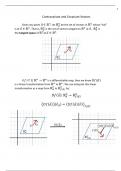
Given any point 𝑎⃗ ∈ ℝ𝑛 , let ℝ𝑎⃗⃗ be the set of vectors in ℝ𝑛 whose “tail”
𝑛 𝑛
is at 𝑎⃗ ∈ ℝ𝑛 . That is, ℝ𝑎⃗⃗ is the set of vectors tangent to ℝ𝑛 at 𝑎⃗. ℝ𝑎⃗⃗ is
the tangent space of ℝ𝑛 at 𝑎⃗ ∈ ℝ𝑛 .
𝑣⃗𝑎⃗⃗
𝑎⃗
ℝ𝑛𝑎⃗⃗
If 𝑓: 𝑈 ⊆ ℝ𝑛 → ℝ𝑛 is a differentiable map, then we know 𝐷𝑓 (𝑎⃗)
is a linear transformation from ℝ𝑛 to ℝ𝑛 . We can interpret this linear
𝑛 𝑛
transformation as a map from ℝ𝑎⃗⃗ to ℝ𝑓(𝑎⃗⃗) by:
𝐷𝑓 (𝑎⃗): ℝ𝑛𝑎⃗⃗ → ℝ𝑓𝑛(𝑎⃗⃗)
(𝐷𝑓(𝑎⃗))(𝑣⃗𝑎⃗⃗ ) = (𝐷𝑓 (𝑎⃗)(𝑣⃗))𝑓(𝑎⃗⃗) .
𝑣⃗𝑎⃗⃗ 𝐷𝑓(𝑎⃗)
𝑎⃗ ((𝐷𝑓(𝑎⃗))(𝑣⃗))𝑓(𝑎⃗⃗)
ℝ𝑛𝑎⃗⃗ 𝑓(𝑎⃗)
𝑛
ℝ𝑓(𝑎
⃗⃗)
, 2
In particular, if 𝑓: 𝑈 ⊆ ℝ𝑛 → ℝ𝑛 is a change of coordinates, i.e.
dim ((𝐷𝑓(𝑎⃗))(ℝ𝑛𝑎⃗⃗ )) = 𝑛, then 𝐷𝑓(𝑎⃗) is an isomorphism (one-to-one and onto).
𝑛 𝑛
Thus, 𝐷𝑓 (𝑎⃗ ) maps a basis for ℝ𝑎⃗⃗ to a basis for ℝ𝑓(𝑎⃗⃗) for each 𝑎⃗ ∈ 𝑈 ⊆ ℝ𝑛 .
⃗⃗ =< 𝑥1 , 𝑥2 > in rectangular coordinates
If we start with a position vector 𝑅
in ℝ2 , then the tangent space at < 𝑥1 , 𝑥2 >, ℝ2<𝑥1 ,𝑥2 > , is spanned by:
𝜕𝑅⃗⃗ 𝜕𝑅⃗⃗
= < 1, 0 > = < 0, 1 >
𝜕𝑥1 𝜕𝑥2
< 0,1 >
< 1,0 >
< 𝑥1 , 𝑥2 >
ℝ2<𝑥1 ,𝑥2>
In other words, {< 1, 0 > , < 0, 1 >} are a basis for the tangent space
of ℝ2<𝑥1 ,𝑥2 > at any point < 𝑥1 , 𝑥2 >.
Contravariant and Covariant Vectors
𝑛
Given any point 𝑎⃗ ∈ ℝ𝑛 , let ℝ𝑎⃗⃗ be the set of vectors in ℝ𝑛 whose “tail”
𝑛 𝑛
is at 𝑎⃗ ∈ ℝ𝑛 . That is, ℝ𝑎⃗⃗ is the set of vectors tangent to ℝ𝑛 at 𝑎⃗. ℝ𝑎⃗⃗ is
the tangent space of ℝ𝑛 at 𝑎⃗ ∈ ℝ𝑛 .
𝑣⃗𝑎⃗⃗
𝑎⃗
ℝ𝑛𝑎⃗⃗
If 𝑓: 𝑈 ⊆ ℝ𝑛 → ℝ𝑛 is a differentiable map, then we know 𝐷𝑓 (𝑎⃗)
is a linear transformation from ℝ𝑛 to ℝ𝑛 . We can interpret this linear
𝑛 𝑛
transformation as a map from ℝ𝑎⃗⃗ to ℝ𝑓(𝑎⃗⃗) by:
𝐷𝑓 (𝑎⃗): ℝ𝑛𝑎⃗⃗ → ℝ𝑓𝑛(𝑎⃗⃗)
(𝐷𝑓(𝑎⃗))(𝑣⃗𝑎⃗⃗ ) = (𝐷𝑓 (𝑎⃗)(𝑣⃗))𝑓(𝑎⃗⃗) .
𝑣⃗𝑎⃗⃗ 𝐷𝑓(𝑎⃗)
𝑎⃗ ((𝐷𝑓(𝑎⃗))(𝑣⃗))𝑓(𝑎⃗⃗)
ℝ𝑛𝑎⃗⃗ 𝑓(𝑎⃗)
𝑛
ℝ𝑓(𝑎
⃗⃗)
, 2
In particular, if 𝑓: 𝑈 ⊆ ℝ𝑛 → ℝ𝑛 is a change of coordinates, i.e.
dim ((𝐷𝑓(𝑎⃗))(ℝ𝑛𝑎⃗⃗ )) = 𝑛, then 𝐷𝑓(𝑎⃗) is an isomorphism (one-to-one and onto).
𝑛 𝑛
Thus, 𝐷𝑓 (𝑎⃗ ) maps a basis for ℝ𝑎⃗⃗ to a basis for ℝ𝑓(𝑎⃗⃗) for each 𝑎⃗ ∈ 𝑈 ⊆ ℝ𝑛 .
⃗⃗ =< 𝑥1 , 𝑥2 > in rectangular coordinates
If we start with a position vector 𝑅
in ℝ2 , then the tangent space at < 𝑥1 , 𝑥2 >, ℝ2<𝑥1 ,𝑥2 > , is spanned by:
𝜕𝑅⃗⃗ 𝜕𝑅⃗⃗
= < 1, 0 > = < 0, 1 >
𝜕𝑥1 𝜕𝑥2
< 0,1 >
< 1,0 >
< 𝑥1 , 𝑥2 >
ℝ2<𝑥1 ,𝑥2>
In other words, {< 1, 0 > , < 0, 1 >} are a basis for the tangent space
of ℝ2<𝑥1 ,𝑥2 > at any point < 𝑥1 , 𝑥2 >.