1
The Differential of a Map
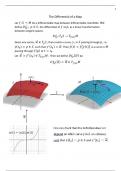
Let 𝑓: 𝑆 → 𝑀 be a differentiable map between differentiable manifolds. We
define 𝐷𝑓𝑝 ; 𝑝 ∈ 𝑆, the differential of 𝑓 at 𝑝, as a linear transformation
between tangent spaces.
𝐷𝑓𝑝 : 𝑇𝑝 𝑆 → 𝑇𝑓(𝑝) 𝑀
Given any vector, 𝑤
⃗⃗ ∈ 𝑇𝑝 𝑆, there exists a curve, 𝛾, in 𝑆 passing through 𝑝, i.e.
𝛾 (𝑡0 ) = 𝑝 ∈ 𝑆, such that 𝛾 ′ (𝑡0 ) = 𝑤
⃗⃗ . Then 𝛾̅ (𝑡) = 𝑓(𝛾 (𝑡)) is a curve in 𝑀
passing through 𝑓 (𝑝) at 𝑡 = 𝑡0 .
⃗̅
Let 𝑤⃗ = 𝛾̅ ′ (𝑡0 ) ∈ 𝑇𝑓(𝑝) 𝑀. Then we define 𝐷𝑓𝑝 (𝑤
⃗⃗ ) by:
𝐷𝑓𝑝 (𝑤 ⃗̅⃗ ∈ 𝑇𝑓(𝑝) 𝑀
⃗⃗ ) = 𝑤
𝛾(𝑡)
, 2
How do we calculate 𝐷𝑓𝑝 ?
If we let 𝑥: 𝑈 ⊆ 𝑆 → ℝ𝑚 be a local coordinate chart on 𝑈 ⊆ 𝑆 and
𝑦: 𝑉 ⊆ 𝑀 → ℝ𝑛 be a local coordinate chart on 𝑉 ⊆ 𝑀, then:
𝑦 ∘ 𝑓 ∘ 𝑥 −1 : 𝑥(𝑈 ∩ 𝑓 −1 (𝑉)) ⊆ ℝ𝑚 → 𝑦(𝑉) ⊆ ℝ𝑛
𝑀
𝑆
So 𝑦 ∘ 𝑓 ∘ 𝑥 −1 maps an open set in ℝ𝑚 into an open set in ℝ𝑛 by
𝑦 ∘ 𝑓 ∘ 𝑥 −1 (𝑥 1 , … , 𝑥 𝑚 ) = (𝑦1 , … , 𝑦 𝑛 ) = (𝑦1 (𝑥 1 , … , 𝑥 𝑚 ), … , 𝑦 𝑛 (𝑥 1 , … , 𝑥 𝑚 )).
The Differential of a Map
Let 𝑓: 𝑆 → 𝑀 be a differentiable map between differentiable manifolds. We
define 𝐷𝑓𝑝 ; 𝑝 ∈ 𝑆, the differential of 𝑓 at 𝑝, as a linear transformation
between tangent spaces.
𝐷𝑓𝑝 : 𝑇𝑝 𝑆 → 𝑇𝑓(𝑝) 𝑀
Given any vector, 𝑤
⃗⃗ ∈ 𝑇𝑝 𝑆, there exists a curve, 𝛾, in 𝑆 passing through 𝑝, i.e.
𝛾 (𝑡0 ) = 𝑝 ∈ 𝑆, such that 𝛾 ′ (𝑡0 ) = 𝑤
⃗⃗ . Then 𝛾̅ (𝑡) = 𝑓(𝛾 (𝑡)) is a curve in 𝑀
passing through 𝑓 (𝑝) at 𝑡 = 𝑡0 .
⃗̅
Let 𝑤⃗ = 𝛾̅ ′ (𝑡0 ) ∈ 𝑇𝑓(𝑝) 𝑀. Then we define 𝐷𝑓𝑝 (𝑤
⃗⃗ ) by:
𝐷𝑓𝑝 (𝑤 ⃗̅⃗ ∈ 𝑇𝑓(𝑝) 𝑀
⃗⃗ ) = 𝑤
𝛾(𝑡)
, 2
How do we calculate 𝐷𝑓𝑝 ?
If we let 𝑥: 𝑈 ⊆ 𝑆 → ℝ𝑚 be a local coordinate chart on 𝑈 ⊆ 𝑆 and
𝑦: 𝑉 ⊆ 𝑀 → ℝ𝑛 be a local coordinate chart on 𝑉 ⊆ 𝑀, then:
𝑦 ∘ 𝑓 ∘ 𝑥 −1 : 𝑥(𝑈 ∩ 𝑓 −1 (𝑉)) ⊆ ℝ𝑚 → 𝑦(𝑉) ⊆ ℝ𝑛
𝑀
𝑆
So 𝑦 ∘ 𝑓 ∘ 𝑥 −1 maps an open set in ℝ𝑚 into an open set in ℝ𝑛 by
𝑦 ∘ 𝑓 ∘ 𝑥 −1 (𝑥 1 , … , 𝑥 𝑚 ) = (𝑦1 , … , 𝑦 𝑛 ) = (𝑦1 (𝑥 1 , … , 𝑥 𝑚 ), … , 𝑦 𝑛 (𝑥 1 , … , 𝑥 𝑚 )).