1
Riemannian Metrics
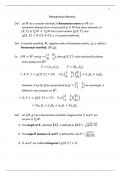
Def. Let 𝑀 be a smooth manifold. A Riemannian metric on 𝑀 is a
symmetric bilinear form at each point 𝑝 ∈ 𝑀 that takes elements of
(𝑋, 𝑌) ∈ 𝑇𝑝 𝑀 × 𝑇𝑝 𝑀 into a real number 𝑔(𝑋, 𝑌) and
𝑔(𝑋, 𝑋) > 0 if 𝑋 ≠ 0 (i.e. it’s positive definite).
Def. A smooth manifold, 𝑀, together with a Riemannian metric, 𝑔, is called a
Riemannian manifold, (𝑀, 𝑔).
1 0
Ex. If 𝑀 = ℝ2 and 𝑔 = ( ), then 𝑔(𝑋, 𝑌) is the standard Euclidean
0 1
inner product on ℝ2 .
𝑋 = (𝛼1 , 𝛼2 ); 𝑌 = (𝛽1 , 𝛽2 )
𝛼2 ) (1 0 𝛽1
< 𝑋, 𝑌 > = 𝑔(𝑋, 𝑌) = (𝛼1 ) ( ) = 𝛼1 𝛽1 + 𝛼2 𝛽2 .
0 1 𝛽2
2 1
However, if we let 𝑔̅ be represented by 𝑔̅ = ( ) we would get a
1 3
different inner product on ℝ2 :
𝛼2 ) (2 1 𝛽1
< 𝑋, 𝑌 > = 𝑔̅ (𝑋, 𝑌) = (𝛼1 )( )
1 3 𝛽2
= 2𝛼1 𝛽1 + 𝛼1 𝛽2 + 𝛼2 𝛽1 + 3𝛼2 𝛽2 .
Def. Let (𝑀, 𝑔) be a Riemannian manifold. Suppose that 𝑋 and 𝑌 are
vectors in 𝑇𝑝 𝑀.
1. The length of 𝑿, denoted ‖𝑋‖, is defined as ‖𝑋‖ = √𝑔(𝑋, 𝑋)
𝑔(𝑋,𝑌)
2. The angle 𝜽 between 𝑿 and 𝒀 is defined by cos 𝜃 = ‖
𝑋‖ ‖𝑌‖
3. 𝑋 and 𝑌 are called orthogonal if 𝑔(𝑋, 𝑌) = 0.
, 2
Two Riemannian manifolds are considered the same if they have the same metric.
Def. Let 𝑀 and 𝑁 be two Riemannian manifolds. A diffeomorphism 𝑓: 𝑀 → 𝑁
is called an isometry if for all 𝑝 ∈ 𝑀 the following holds:
< 𝑋, 𝑌 >𝑝 = < 𝑑𝑓𝑝 (𝑋), 𝑑𝑓𝑝 (𝑌) >𝑓(𝑝) for 𝑋, 𝑌 ∈ 𝑇𝑝 𝑀.
Two Riemannian manifolds are called isometric if there exists an isometry
between them.
Given a parametrization of a manifold ⃗Φ
⃗⃗ , there is a Riemannian metric
associated with ⃗Φ
⃗⃗ . We call this the metric induced by ⃗𝚽
⃗⃗ .
Ex. Let ⃗Φ
⃗⃗ (𝑢, 𝑣) = (𝑢, 𝑣, 𝑢2 + 𝑣 2 ) be a parametrization of a surface 𝑆.
Find the metric induce by ⃗Φ
⃗⃗ .
At (𝑢, 𝑣 ) = (1, 2), Let 𝑋 ∈ 𝑇(1,2,5) 𝑆 be given by < 2, −3 >, i.e.,
𝑋 = 2Φ ⃗⃗⃗ 𝑢 (1, 2) − 3Φ
⃗⃗⃗ 𝑣 (1, 2). Find ‖𝑋‖?
⃗Φ
⃗⃗ 𝑢 =< 1, 0, 2𝑢 > , ⃗Φ
⃗⃗ 𝑣 =< 0, 1, 2𝑣 >
As we saw earlier, we can get the metric induced by ⃗Φ
⃗⃗ on 𝑆 by:
𝑔11 = ⃗Φ⃗⃗ 𝑢 ⋅ ⃗Φ ⃗⃗ 𝑢 = 1 + 4𝑢2
𝑔12 = 𝑔21 = Φ⃗⃗⃗ 𝑢 ⋅ Φ ⃗⃗⃗ 𝑣 = 4𝑢𝑣
𝑔22 = ⃗Φ ⃗⃗ 𝑣 ⋅ ⃗Φ⃗⃗ 𝑣 = 1 + 4𝑣 2
So the metric induced by ⃗Φ
⃗⃗ is given by:
2
𝑔 = (1 + 4𝑢 4𝑢𝑣 )
4𝑢𝑣 1 + 4𝑣 2
⃗⃗⃗ 𝑢 , ⃗Φ
with respect to the basis {Φ ⃗⃗ 𝑣 } = {< 1, 0, 2𝑢 >, < 0, 1, 2𝑣 >}.
Riemannian Metrics
Def. Let 𝑀 be a smooth manifold. A Riemannian metric on 𝑀 is a
symmetric bilinear form at each point 𝑝 ∈ 𝑀 that takes elements of
(𝑋, 𝑌) ∈ 𝑇𝑝 𝑀 × 𝑇𝑝 𝑀 into a real number 𝑔(𝑋, 𝑌) and
𝑔(𝑋, 𝑋) > 0 if 𝑋 ≠ 0 (i.e. it’s positive definite).
Def. A smooth manifold, 𝑀, together with a Riemannian metric, 𝑔, is called a
Riemannian manifold, (𝑀, 𝑔).
1 0
Ex. If 𝑀 = ℝ2 and 𝑔 = ( ), then 𝑔(𝑋, 𝑌) is the standard Euclidean
0 1
inner product on ℝ2 .
𝑋 = (𝛼1 , 𝛼2 ); 𝑌 = (𝛽1 , 𝛽2 )
𝛼2 ) (1 0 𝛽1
< 𝑋, 𝑌 > = 𝑔(𝑋, 𝑌) = (𝛼1 ) ( ) = 𝛼1 𝛽1 + 𝛼2 𝛽2 .
0 1 𝛽2
2 1
However, if we let 𝑔̅ be represented by 𝑔̅ = ( ) we would get a
1 3
different inner product on ℝ2 :
𝛼2 ) (2 1 𝛽1
< 𝑋, 𝑌 > = 𝑔̅ (𝑋, 𝑌) = (𝛼1 )( )
1 3 𝛽2
= 2𝛼1 𝛽1 + 𝛼1 𝛽2 + 𝛼2 𝛽1 + 3𝛼2 𝛽2 .
Def. Let (𝑀, 𝑔) be a Riemannian manifold. Suppose that 𝑋 and 𝑌 are
vectors in 𝑇𝑝 𝑀.
1. The length of 𝑿, denoted ‖𝑋‖, is defined as ‖𝑋‖ = √𝑔(𝑋, 𝑋)
𝑔(𝑋,𝑌)
2. The angle 𝜽 between 𝑿 and 𝒀 is defined by cos 𝜃 = ‖
𝑋‖ ‖𝑌‖
3. 𝑋 and 𝑌 are called orthogonal if 𝑔(𝑋, 𝑌) = 0.
, 2
Two Riemannian manifolds are considered the same if they have the same metric.
Def. Let 𝑀 and 𝑁 be two Riemannian manifolds. A diffeomorphism 𝑓: 𝑀 → 𝑁
is called an isometry if for all 𝑝 ∈ 𝑀 the following holds:
< 𝑋, 𝑌 >𝑝 = < 𝑑𝑓𝑝 (𝑋), 𝑑𝑓𝑝 (𝑌) >𝑓(𝑝) for 𝑋, 𝑌 ∈ 𝑇𝑝 𝑀.
Two Riemannian manifolds are called isometric if there exists an isometry
between them.
Given a parametrization of a manifold ⃗Φ
⃗⃗ , there is a Riemannian metric
associated with ⃗Φ
⃗⃗ . We call this the metric induced by ⃗𝚽
⃗⃗ .
Ex. Let ⃗Φ
⃗⃗ (𝑢, 𝑣) = (𝑢, 𝑣, 𝑢2 + 𝑣 2 ) be a parametrization of a surface 𝑆.
Find the metric induce by ⃗Φ
⃗⃗ .
At (𝑢, 𝑣 ) = (1, 2), Let 𝑋 ∈ 𝑇(1,2,5) 𝑆 be given by < 2, −3 >, i.e.,
𝑋 = 2Φ ⃗⃗⃗ 𝑢 (1, 2) − 3Φ
⃗⃗⃗ 𝑣 (1, 2). Find ‖𝑋‖?
⃗Φ
⃗⃗ 𝑢 =< 1, 0, 2𝑢 > , ⃗Φ
⃗⃗ 𝑣 =< 0, 1, 2𝑣 >
As we saw earlier, we can get the metric induced by ⃗Φ
⃗⃗ on 𝑆 by:
𝑔11 = ⃗Φ⃗⃗ 𝑢 ⋅ ⃗Φ ⃗⃗ 𝑢 = 1 + 4𝑢2
𝑔12 = 𝑔21 = Φ⃗⃗⃗ 𝑢 ⋅ Φ ⃗⃗⃗ 𝑣 = 4𝑢𝑣
𝑔22 = ⃗Φ ⃗⃗ 𝑣 ⋅ ⃗Φ⃗⃗ 𝑣 = 1 + 4𝑣 2
So the metric induced by ⃗Φ
⃗⃗ is given by:
2
𝑔 = (1 + 4𝑢 4𝑢𝑣 )
4𝑢𝑣 1 + 4𝑣 2
⃗⃗⃗ 𝑢 , ⃗Φ
with respect to the basis {Φ ⃗⃗ 𝑣 } = {< 1, 0, 2𝑢 >, < 0, 1, 2𝑣 >}.