1
Lebesgue Outer Measure
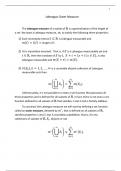
The Lebesgue measure of a subset of ℝ is a generalization of the length of
a set. We want a Lebesgue measure, 𝑚, to satisfy the following three properties:
1) Each nonempty interval 𝐼 ⊆ ℝ is Lebesgue measurable and
𝑚(𝐼) = 𝑙 (𝐼) = length of 𝐼.
2) 𝑚 is translation invariant. That is, If 𝐸 is a Lebesgue measureable set and
𝑡 ∈ ℝ, then the translate of 𝐸 by 𝑡, 𝐸 + 𝑡 = {𝑥 + 𝑡| 𝑥 ∈ 𝐸}, is also
Lebesgue measurable and 𝑚(𝐸 + 𝑡) = 𝑚(𝐸).
3) If {𝐸𝑘 }, 𝑘 = 1, 2, … , ∞ is a countable disjoint collection of Lebesgue
measurable sets then
∞ ∞
𝑚 (⋃ 𝐸𝑘 ) = ∑ 𝑚(𝐸𝑘 ).
𝑘=1 𝑘=1
Unfortunately, it’s not possible to create a set function that possesses all
three properties and is defined for all subsets of ℝ. In fact, there is not even a set
function defined for all subsets of ℝ that satisfies 1 and 2 and is finitely additive.
To construct the Lebesgue measure we will start by defining a set function
called an outer measure, denoted by 𝑚∗ , that is defined on all subsets of ℝ,
satisfies properties 1 and 2, but is countably subadditive, that is, for any
collections of subsets of ℝ, 𝐸𝑖 , disjoint or not
∞ ∞
𝑚∗ (⋃ 𝐸𝑖 ) ≤ ∑ 𝑚∗ (𝐸𝑖 ).
𝑖=1 𝑘=1
, 2
We will then determine what it means for a set to be Lebesgue measurable
and show that the collection of Lebesgue measurable sets forms a 𝜎-algebra
(i.e. it contains ℝ and is closed with respect to complements and countable
unions) containing the open and closed sets. We will then restrict 𝑚∗ to this
collection of sets and denote it by 𝑚 and prove 𝑚 is countably additive. 𝑚 will
be the Lebesgue measure.
We start by defining the length of an interval (closed, open, or half
closed/open) 𝐼, 𝑙 (𝐼 ), to be |𝑏 − 𝑎|, where 𝑎, 𝑏 are the endpoints, if both 𝑎 and
𝑏 are finite and ∞ if either 𝑎 or 𝑏 is not finite.
If 𝐴 is a set of real numbers, consider {𝐼𝑘 }, 𝑘 = 1, 2, … , ∞, where 𝐼𝑘 is an
open, bounded interval and 𝐴 ⊆ ⋃∞
𝑘=1 𝐼𝑘 . We define the outer measure of 𝐸,
𝑚∗ (𝐸) to be:
∞ ∞
𝑚∗ (𝐸 ) = inf {∑ 𝑙(𝐼𝑘 )⃒𝐸 ⊆ ⋃ 𝐼𝑘 }
𝑘=1 𝑘=1
( ) ( ) ( )
𝐸
Notice:
a) 𝑚∗ (𝜙) = 0.
b) If 𝐸 ⊆ 𝐹, then 𝑚∗ (𝐸 ) ≤ 𝑚∗ (𝐹) because any cover of 𝐹 is also a
cover of 𝐸.
Lebesgue Outer Measure
The Lebesgue measure of a subset of ℝ is a generalization of the length of
a set. We want a Lebesgue measure, 𝑚, to satisfy the following three properties:
1) Each nonempty interval 𝐼 ⊆ ℝ is Lebesgue measurable and
𝑚(𝐼) = 𝑙 (𝐼) = length of 𝐼.
2) 𝑚 is translation invariant. That is, If 𝐸 is a Lebesgue measureable set and
𝑡 ∈ ℝ, then the translate of 𝐸 by 𝑡, 𝐸 + 𝑡 = {𝑥 + 𝑡| 𝑥 ∈ 𝐸}, is also
Lebesgue measurable and 𝑚(𝐸 + 𝑡) = 𝑚(𝐸).
3) If {𝐸𝑘 }, 𝑘 = 1, 2, … , ∞ is a countable disjoint collection of Lebesgue
measurable sets then
∞ ∞
𝑚 (⋃ 𝐸𝑘 ) = ∑ 𝑚(𝐸𝑘 ).
𝑘=1 𝑘=1
Unfortunately, it’s not possible to create a set function that possesses all
three properties and is defined for all subsets of ℝ. In fact, there is not even a set
function defined for all subsets of ℝ that satisfies 1 and 2 and is finitely additive.
To construct the Lebesgue measure we will start by defining a set function
called an outer measure, denoted by 𝑚∗ , that is defined on all subsets of ℝ,
satisfies properties 1 and 2, but is countably subadditive, that is, for any
collections of subsets of ℝ, 𝐸𝑖 , disjoint or not
∞ ∞
𝑚∗ (⋃ 𝐸𝑖 ) ≤ ∑ 𝑚∗ (𝐸𝑖 ).
𝑖=1 𝑘=1
, 2
We will then determine what it means for a set to be Lebesgue measurable
and show that the collection of Lebesgue measurable sets forms a 𝜎-algebra
(i.e. it contains ℝ and is closed with respect to complements and countable
unions) containing the open and closed sets. We will then restrict 𝑚∗ to this
collection of sets and denote it by 𝑚 and prove 𝑚 is countably additive. 𝑚 will
be the Lebesgue measure.
We start by defining the length of an interval (closed, open, or half
closed/open) 𝐼, 𝑙 (𝐼 ), to be |𝑏 − 𝑎|, where 𝑎, 𝑏 are the endpoints, if both 𝑎 and
𝑏 are finite and ∞ if either 𝑎 or 𝑏 is not finite.
If 𝐴 is a set of real numbers, consider {𝐼𝑘 }, 𝑘 = 1, 2, … , ∞, where 𝐼𝑘 is an
open, bounded interval and 𝐴 ⊆ ⋃∞
𝑘=1 𝐼𝑘 . We define the outer measure of 𝐸,
𝑚∗ (𝐸) to be:
∞ ∞
𝑚∗ (𝐸 ) = inf {∑ 𝑙(𝐼𝑘 )⃒𝐸 ⊆ ⋃ 𝐼𝑘 }
𝑘=1 𝑘=1
( ) ( ) ( )
𝐸
Notice:
a) 𝑚∗ (𝜙) = 0.
b) If 𝐸 ⊆ 𝐹, then 𝑚∗ (𝐸 ) ≤ 𝑚∗ (𝐹) because any cover of 𝐹 is also a
cover of 𝐸.