1
The Cantor Set and the Cantor Function
So far we know if 𝐸 is countable then 𝑚(𝐸 ) = 0
This leads us to the question if a set has measure 0, is it countable?
The Cantor Set
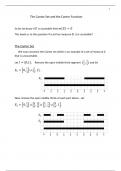
We now construct the Cantor set which is an example of a set of measure 0
that is uncountable.
1 2
Let 𝐼 = [0,1]. Remove the open middle third segment ( , ) and let
3 3
1 2
𝐸1 = [0, ] ∪ [ , 1].
3 3
𝐸1
Now remove the open middle thirds of each part above. Let
1 2 1 2 7 8
𝐸2 = [0, ] ∪ [ , ] ∪ [ , ] ∪ [ , 1].
9 9 3 3 9 9
𝐸2
𝐸1
, 2
Continue this way always removing open middle thirds of each segment to get
𝐸1 ⊇ 𝐸2 ⊇ 𝐸3 ⊇ ⋯ . The Cantor set is defined to be:
∞
𝐶 = ⋂ 𝐸𝑖
𝑖=1
where 𝐸𝑛 is the union of 2𝑛 intervals, each of length 3−𝑛 .
Notice that any 𝑥 ∈ [0,1] can be written in base 3 as:
𝑎𝑘
𝑥 = ∑∞
𝑘=1 ; where 𝑎𝑘 = 0, 1, or 2.
3𝑘
1 2
Thus if 𝐸1 = [0, ] ∪ [ , 1], then we have removed all numbers whose base 3
3 3
1 𝑎𝑘
representation looks like: 𝑥 = + ∑∞
𝑘=2 𝑘 , where at least one 𝑎𝑘 ≠ 0.
3 3
1 2 1 2 7 8
If 𝐸2 = [0, ] ∪ [ , ] ∪ [ , ] ∪ [ , 1], then we have removed all numbers
9 9 3 3 9 9
1 𝑎2
whose base 3 representation has a 2 as its term.
3 32
Notice that this means if 𝑥 ∈ 𝐶 then its base 3 representation is:
𝑎𝑘
𝑥 = ∑∞
𝑘=1 ; where 𝑎𝑘 = 0 or 2.
3𝑘
Prop. The Cantor set is a closed, uncountable set of measure 0.
Each 𝐸𝑘 is closed so 𝐶 is the intersection of a countable collection of closed sets
and is hence closed.
The Cantor Set and the Cantor Function
So far we know if 𝐸 is countable then 𝑚(𝐸 ) = 0
This leads us to the question if a set has measure 0, is it countable?
The Cantor Set
We now construct the Cantor set which is an example of a set of measure 0
that is uncountable.
1 2
Let 𝐼 = [0,1]. Remove the open middle third segment ( , ) and let
3 3
1 2
𝐸1 = [0, ] ∪ [ , 1].
3 3
𝐸1
Now remove the open middle thirds of each part above. Let
1 2 1 2 7 8
𝐸2 = [0, ] ∪ [ , ] ∪ [ , ] ∪ [ , 1].
9 9 3 3 9 9
𝐸2
𝐸1
, 2
Continue this way always removing open middle thirds of each segment to get
𝐸1 ⊇ 𝐸2 ⊇ 𝐸3 ⊇ ⋯ . The Cantor set is defined to be:
∞
𝐶 = ⋂ 𝐸𝑖
𝑖=1
where 𝐸𝑛 is the union of 2𝑛 intervals, each of length 3−𝑛 .
Notice that any 𝑥 ∈ [0,1] can be written in base 3 as:
𝑎𝑘
𝑥 = ∑∞
𝑘=1 ; where 𝑎𝑘 = 0, 1, or 2.
3𝑘
1 2
Thus if 𝐸1 = [0, ] ∪ [ , 1], then we have removed all numbers whose base 3
3 3
1 𝑎𝑘
representation looks like: 𝑥 = + ∑∞
𝑘=2 𝑘 , where at least one 𝑎𝑘 ≠ 0.
3 3
1 2 1 2 7 8
If 𝐸2 = [0, ] ∪ [ , ] ∪ [ , ] ∪ [ , 1], then we have removed all numbers
9 9 3 3 9 9
1 𝑎2
whose base 3 representation has a 2 as its term.
3 32
Notice that this means if 𝑥 ∈ 𝐶 then its base 3 representation is:
𝑎𝑘
𝑥 = ∑∞
𝑘=1 ; where 𝑎𝑘 = 0 or 2.
3𝑘
Prop. The Cantor set is a closed, uncountable set of measure 0.
Each 𝐸𝑘 is closed so 𝐶 is the intersection of a countable collection of closed sets
and is hence closed.