1
Totally Bounded Sets
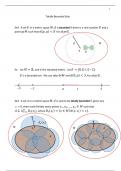
Def. A set 𝐸 in a metric space 𝑀, 𝑑 is bounded if there is a real number 𝐾 and a
point 𝑞𝜖𝑀 such that 𝑑(𝑝, 𝑞) < 𝐾 for all 𝑝𝜖𝐸.
𝐾 𝑀
𝑞
𝐸
Ex. Let 𝑀 = ℝ, and 𝑑 the standard metric. Let 𝐸 = [0,1) ∪ {−2}.
𝐸 is a bounded set. We can take 0𝜖𝑀 and 𝑑 (0, 𝑝) < 3, for all 𝑝𝜖𝐸.
( )
−3 −2 0 1 3
Def. A set 𝐴 in a metric space 𝑀, 𝑑 is said to be totally bounded if, given any
𝜖 > 0, there exist finitely many points 𝑥1 , 𝑥2 , … , 𝑥𝑛 ∈ 𝑀 such that
𝐴 ⊆ ⋃𝑛𝑖=1 𝐵𝜖 (𝑥𝑖 ), where 𝐵𝜖 (𝑥𝑖 ) = {𝑥 ∈ 𝑀| 𝑑(𝑥, 𝑥𝑖 ) < 𝜖}.
𝜖 𝐵𝜖 (𝑥𝑖 )
𝜖
𝑀 𝑥𝑖 𝑀 𝐴
𝑥𝑖
𝐴
, 2
Ex. (−2,3] ∪ {7} ∪ [8,9] is a totally bounded set in ℝ (In fact, in ℝ being
totally bounded is equivalent to being bounded. However, this is not true for a
general metric space).
Ex. (−1,6] ∪ (9, ∞) is not a totally bounded set in ℝ.
Notice that if 𝐴 is totally bounded, then 𝐴 is bounded (but not the other way
around). Let’s see why.
Given any 𝜖 > 0, there exist finitely many points 𝑥1 , 𝑥2 , … , 𝑥𝑛 such that
𝐴 ⊆ ⋃𝑛𝑖=1 𝐵𝜖 (𝑥𝑖 ).
If 𝑥 is any point in 𝐴 then 𝑥 ∈ 𝐵𝜖 (𝑥𝑖 ), for some 𝑖.
Now we show that 𝑑(𝑥, 𝑥1 ) ≤ max 𝑑 (𝑥1 , 𝑥𝑘 ) + 𝜖 .
1≤𝑘≤𝑛
𝜖
𝑥
𝑥𝑖
𝑥1
By the triangle inequality:
𝑑(𝑥, 𝑥1 ) ≤ 𝑑(𝑥, 𝑥𝑘 ) + 𝑑(𝑥𝑘 , 𝑥1 ) ≤ 𝑑 (𝑥, 𝑥𝑘 ) + max 𝑑 (𝑥1 , 𝑥𝑘 ).
1≤𝑘≤𝑛
Totally Bounded Sets
Def. A set 𝐸 in a metric space 𝑀, 𝑑 is bounded if there is a real number 𝐾 and a
point 𝑞𝜖𝑀 such that 𝑑(𝑝, 𝑞) < 𝐾 for all 𝑝𝜖𝐸.
𝐾 𝑀
𝑞
𝐸
Ex. Let 𝑀 = ℝ, and 𝑑 the standard metric. Let 𝐸 = [0,1) ∪ {−2}.
𝐸 is a bounded set. We can take 0𝜖𝑀 and 𝑑 (0, 𝑝) < 3, for all 𝑝𝜖𝐸.
( )
−3 −2 0 1 3
Def. A set 𝐴 in a metric space 𝑀, 𝑑 is said to be totally bounded if, given any
𝜖 > 0, there exist finitely many points 𝑥1 , 𝑥2 , … , 𝑥𝑛 ∈ 𝑀 such that
𝐴 ⊆ ⋃𝑛𝑖=1 𝐵𝜖 (𝑥𝑖 ), where 𝐵𝜖 (𝑥𝑖 ) = {𝑥 ∈ 𝑀| 𝑑(𝑥, 𝑥𝑖 ) < 𝜖}.
𝜖 𝐵𝜖 (𝑥𝑖 )
𝜖
𝑀 𝑥𝑖 𝑀 𝐴
𝑥𝑖
𝐴
, 2
Ex. (−2,3] ∪ {7} ∪ [8,9] is a totally bounded set in ℝ (In fact, in ℝ being
totally bounded is equivalent to being bounded. However, this is not true for a
general metric space).
Ex. (−1,6] ∪ (9, ∞) is not a totally bounded set in ℝ.
Notice that if 𝐴 is totally bounded, then 𝐴 is bounded (but not the other way
around). Let’s see why.
Given any 𝜖 > 0, there exist finitely many points 𝑥1 , 𝑥2 , … , 𝑥𝑛 such that
𝐴 ⊆ ⋃𝑛𝑖=1 𝐵𝜖 (𝑥𝑖 ).
If 𝑥 is any point in 𝐴 then 𝑥 ∈ 𝐵𝜖 (𝑥𝑖 ), for some 𝑖.
Now we show that 𝑑(𝑥, 𝑥1 ) ≤ max 𝑑 (𝑥1 , 𝑥𝑘 ) + 𝜖 .
1≤𝑘≤𝑛
𝜖
𝑥
𝑥𝑖
𝑥1
By the triangle inequality:
𝑑(𝑥, 𝑥1 ) ≤ 𝑑(𝑥, 𝑥𝑘 ) + 𝑑(𝑥𝑘 , 𝑥1 ) ≤ 𝑑 (𝑥, 𝑥𝑘 ) + max 𝑑 (𝑥1 , 𝑥𝑘 ).
1≤𝑘≤𝑛