1
Uniform Convergence
Def. Suppose {𝑓𝑛 (𝑥)} is a sequence of functions 𝑓𝑛 : 𝐼 ⊆ ℝ → ℝ, where 𝐼 is an
interval (bounded or unbounded, open, closed, or neither) in ℝ. We say {𝒇𝒏 (𝒙)}
converges pointwise to 𝒇(𝒙), and write lim 𝑓𝑛 (𝑥) = 𝑓(𝑥), if for each 𝑥 ∈ 𝐼, the
𝑛→∞
sequence of real numbers {𝑓𝑛 (𝑥)} converges to 𝑓(𝑥).
That is, for all 𝜖 > 0 there exists an 𝑁𝑥 ∈ ℤ+ (i.e. 𝑁𝑥 can depend on 𝑥), such that if
𝑛 ≥ 𝑁𝑥 then |𝑓𝑛 (𝑥) − 𝑓 (𝑥)| < 𝜖.
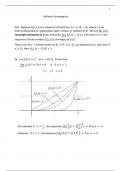
Ex. Let 𝑓𝑛 (𝑥) = 𝑥 𝑛 , on 𝐼 = [0,1]. Prove that:
lim 𝑓𝑛 (𝑥) = 𝑓(𝑥) = 0 𝑖𝑓 0 ≤ 𝑥 < 1
𝑛→∞
=1 𝑖𝑓 𝑥 = 1.
1
𝑓3 (𝑥) = 𝑥 3
𝑓2 (𝑥) = 𝑥 2
𝑓10 (𝑥) = 𝑥 10
𝑓1 (𝑥) = 𝑥
1
1 1 1 𝑛
For example, if 𝑥 = , the sequence {𝑓𝑛 ( )} = {( ) } → 0 as 𝑛 → ∞.
2 2 2
However, if 𝑥 = 1 , the sequence {𝑓𝑛 (1)} = {(1)𝑛 } → 1 as 𝑛 → ∞.
, 2
We must show given any 𝜖 > 0 there exists an 𝑁𝑥 ∈ ℤ+, such that if 𝑛 ≥ 𝑁𝑥
then |𝑥 𝑛 − 𝑓(𝑥 )| < 𝜖 .
If 𝑥 = 1, then |1𝑛 − 1| = 0 < 𝜖 for any 𝑛, so we can choose 𝑁𝑥 = 1.
If 𝑥 = 0, then |0𝑛 − 0| = 0 < 𝜖 for any 𝑛, so we again can choose 𝑁𝑥 = 1.
If 0 < 𝑥 < 1, then: |𝑥 𝑛 − 0| < 𝜖
|𝑥|𝑛 < 𝜖
(𝑛)𝑙𝑛|𝑥 | < 𝑙𝑛𝜖
𝑙𝑛𝜖
𝑛> (since ln|x| < 0 because 0 < 𝑥 < 1)
ln|𝑥|
𝑙𝑛𝜖
So choose 𝑁𝑥 > max (𝑙𝑛|𝑥| , 0); If 𝑛 ≥ 𝑁𝑥 then:
𝑙𝑛𝜖 𝑙𝑛𝜖
|𝑥 𝑛 − 0| = |𝑥|𝑛 < |𝑥| ln|𝑥| = (𝑒 ln|𝑥| )ln|𝑥| = 𝑒 𝑙𝑛𝜖 = 𝜖.
Notice that each 𝑓𝑛 (𝑥) in this example is a continuous function, but the
sequence of functions converges pointwise to a discontinuous function.
Uniform Convergence
Def. Suppose {𝑓𝑛 (𝑥)} is a sequence of functions 𝑓𝑛 : 𝐼 ⊆ ℝ → ℝ, where 𝐼 is an
interval (bounded or unbounded, open, closed, or neither) in ℝ. We say {𝒇𝒏 (𝒙)}
converges pointwise to 𝒇(𝒙), and write lim 𝑓𝑛 (𝑥) = 𝑓(𝑥), if for each 𝑥 ∈ 𝐼, the
𝑛→∞
sequence of real numbers {𝑓𝑛 (𝑥)} converges to 𝑓(𝑥).
That is, for all 𝜖 > 0 there exists an 𝑁𝑥 ∈ ℤ+ (i.e. 𝑁𝑥 can depend on 𝑥), such that if
𝑛 ≥ 𝑁𝑥 then |𝑓𝑛 (𝑥) − 𝑓 (𝑥)| < 𝜖.
Ex. Let 𝑓𝑛 (𝑥) = 𝑥 𝑛 , on 𝐼 = [0,1]. Prove that:
lim 𝑓𝑛 (𝑥) = 𝑓(𝑥) = 0 𝑖𝑓 0 ≤ 𝑥 < 1
𝑛→∞
=1 𝑖𝑓 𝑥 = 1.
1
𝑓3 (𝑥) = 𝑥 3
𝑓2 (𝑥) = 𝑥 2
𝑓10 (𝑥) = 𝑥 10
𝑓1 (𝑥) = 𝑥
1
1 1 1 𝑛
For example, if 𝑥 = , the sequence {𝑓𝑛 ( )} = {( ) } → 0 as 𝑛 → ∞.
2 2 2
However, if 𝑥 = 1 , the sequence {𝑓𝑛 (1)} = {(1)𝑛 } → 1 as 𝑛 → ∞.
, 2
We must show given any 𝜖 > 0 there exists an 𝑁𝑥 ∈ ℤ+, such that if 𝑛 ≥ 𝑁𝑥
then |𝑥 𝑛 − 𝑓(𝑥 )| < 𝜖 .
If 𝑥 = 1, then |1𝑛 − 1| = 0 < 𝜖 for any 𝑛, so we can choose 𝑁𝑥 = 1.
If 𝑥 = 0, then |0𝑛 − 0| = 0 < 𝜖 for any 𝑛, so we again can choose 𝑁𝑥 = 1.
If 0 < 𝑥 < 1, then: |𝑥 𝑛 − 0| < 𝜖
|𝑥|𝑛 < 𝜖
(𝑛)𝑙𝑛|𝑥 | < 𝑙𝑛𝜖
𝑙𝑛𝜖
𝑛> (since ln|x| < 0 because 0 < 𝑥 < 1)
ln|𝑥|
𝑙𝑛𝜖
So choose 𝑁𝑥 > max (𝑙𝑛|𝑥| , 0); If 𝑛 ≥ 𝑁𝑥 then:
𝑙𝑛𝜖 𝑙𝑛𝜖
|𝑥 𝑛 − 0| = |𝑥|𝑛 < |𝑥| ln|𝑥| = (𝑒 ln|𝑥| )ln|𝑥| = 𝑒 𝑙𝑛𝜖 = 𝜖.
Notice that each 𝑓𝑛 (𝑥) in this example is a continuous function, but the
sequence of functions converges pointwise to a discontinuous function.