Biology 141 Study Guide – Unit I
Instructions: Write out answers to each question immediately after the class meeting in which we
cover each topic.
Chapter 1 & BioSkills
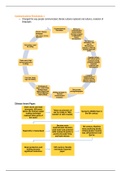
1. How do an observation, a hypothesis, and a prediction differ? What makes a hypothesis
useful for scientific investigations that try to explain the natural world? Give examples of
hypotheses that are and are not scientifically useful. State the null hypothesis that
corresponds to each of your examples.
Observation- what you can see & directly measure
Hypothesis- proposed explanation for limited observations
Useful b/c they introduce original ideas to test, they specify specific relationships you
will expect to see between variables, and they allow you to identify controls and variables to
test
Ex. Good: Squirrels’ diets consist exclusively of acorns.
Null: Squirrels’ diets consist of a variety of different foods.
Bad: Squirrels find acorns to be tasty.
Null: Squirrels do not like the taste of acorns.
Prediction- guesses about future outcomes based on hypothesis
2. What are the key steps in hypothesis testing? What are the essential characteristics of a
scientific experiment? Design an experiment to test the hypothesis that squirrels prefer nuts
over chicken wings. Specify which conditions should be held constant across all experiments
and describe one or more controls you would include.
Key steps:
Create a precise/specific hypothesis & make predictions
Design observational or experimental study to test predictions
Essential characteristics:
Control (noun)- checks for factors, other than one being tested, that might influence
outcome
Constant- keep experimental conditions same
Replicates (more data points)- makes data & conclusions more reliable
Ex. Hypothesis: squirrels prefer nuts over chicken wings
Null: squirrels prefer chicken wings over nuts
Control: squirrels given choice of eating just wings (100 squirrels); squirrels given
choice of eating just nuts (100 squirrels)
Constant: same squirrels, same time of nuts, same type of chicken wings, same type
of squirrels
Replicates: use the same group of 300 squirrels
Experimental group: squirrels given choice of eating either wings or nuts (100
squirrels)
1
,3. What is the difference between a hypothesis and a scientific theory?
Hypothesis is a more specific, proposed explanation, whereas scientific theory is a well-
tested, more broad/general explanation for various scientific phenomena.
4. What is the hypothesis of Spontaneous Generation and how does Cell Theory challenge that
hypothesis? Explain the Pasteur experiment, including the purpose of the swan-necked
flasks. Why did Pasteur boil the broth in both types of flasks? For each type of flasks, what is
the outcome predicted by Spontaneous Generation? By Cell Theory?
Spontaneous generation- living organisms arise spontaneously from nonliving matter
Cell theory challenges b/c one component of theory is that all cells must come from
preexisting cells
Pasteur experiment- involved the use of a swan-necked flask & bacteria growth; no
bacteria growth in swan-necked flask opposed to bacterial growth in regular flask
disproved spontaneous generation theory
Purpose of swan-necked flask is to trap bacteria in air, preventing them from getting
into nutrient broth
Purpose for boiling was to kill all preexisting bacteria
Predictions:
Spontaneous Generation: there would be bacterial growth in BOTH types of
flasks
Cell Theory: there would be bacterial growth in the regular flask and NO
bacterial growth in the swan-necked flask
5. What observed patterns support the theory of evolution by natural selection? Be sure to
define the terms evolution and population in your answer. What are the two conditions
required for natural selection to occur?
Overtime, the traits belonging to individuals in a population (a group of organisms that live
together/exist together in the same environment) change as the overall population evolves
(the gradual development/change in traits of populations of organisms over time). Traits
that are more advantageous to the organisms’ overall finesses are more abundant in the
population because those with disadvantageous traits are unable to reproduce as well.
2 conditions for natural selection:
Differential reproduction- organisms are able to produce offspring with variable
traits
Heritable variation- traits much be heritable, meaning that they can be passed on
from one generation to the next
6. How does artificial selection differ from natural selection? How would you artificially select
for a particular characteristic?
In artificial selection, humans purposefully select and breed individuals with certain traits
that they find desirable. Whereas in natural selection, traits are selected naturally &
randomly; in other words, randomly distributed traits that are more advantageous to
certain individuals in certain environments give them a better chance of survival, therefore
a better chance of reproducing and passing on their traits.
2
, I would choose an individual with the desired characteristic and I would breed this
individual with another one of its species possessing the same desired characteristic as well,
in order to increase the chances of their offspring inheriting the desired trait.
7. Explain how genotype determines phenotype. Your answer should include a description and
an illustration of the flow of genetic information in a cell.
Flow of Genetic Information: DNA (genotype) -> mRNA -> proteins -> traits (phenotype)
An organism’s DNA, their genotype, codes for specific messenger RNAs, that code for
specific proteins, that manifest as/determine specific traits possessed by the organism (its
phenotype).
8. What are the similarities and differences between organisms in the three domains of life?
What do the nodes and branches of a phylogenetic tree indicate? Use genetic information to
generate a phylogenetic tree, and interpret information given in a phylogenetic tree.
A similarity is that most organisms possess ribosomal RNA.
A similarity between the domains Bacteria and Archaea is that both contain prokaryotes.
A difference is that all the organisms have different ribosomal RNA sequences.
A difference between Eukaryotes and the other two domains, is that Eukaryotes possess
nuclei and other membrane-bound organelle while the organisms in the other domains do
not.
Nodes as which the tree diverges, or forks represent where common ancestors split into new
species
Branches in the tree indicate individual species and/or populations over time
Understanding phylogenetic trees:
The more similar the sequence of ribosomal RNA in organisms, the more closely related
they are.
Distance on the tree does NOT accurately display relationships. Use the nodes to
determine how closely related two species are. For instance, although two species may
be adjacent on a tree, if they do not share a common ancestor than this is an indication
that they are not closely related.
Nodes can be rotated, which means that all species from the same common ancestor are
equally related to another specific species from another ancestor.
9. How can the independent and dependent variables in an experiment be distinguished? Given
data from an experiment, plot data on a graph. Be sure to label the graph and both axes.
Independent variables are those that are purposefully manipulated.
The X axis on a graph
Dependent variables are those that measure the effect of the manipulation of the
independent variable. In other words, they change as a result of changing the independent
variable.
The Y axis on a graph
10. Analyze and interpret data presented in tables, graphs, or sentences. Convert data from words
to figures and figures to words.
Look for patterns and trends between data points. Evidence of Causation? Positive
(increasing) or Negative (decreasing)?
3
Instructions: Write out answers to each question immediately after the class meeting in which we
cover each topic.
Chapter 1 & BioSkills
1. How do an observation, a hypothesis, and a prediction differ? What makes a hypothesis
useful for scientific investigations that try to explain the natural world? Give examples of
hypotheses that are and are not scientifically useful. State the null hypothesis that
corresponds to each of your examples.
Observation- what you can see & directly measure
Hypothesis- proposed explanation for limited observations
Useful b/c they introduce original ideas to test, they specify specific relationships you
will expect to see between variables, and they allow you to identify controls and variables to
test
Ex. Good: Squirrels’ diets consist exclusively of acorns.
Null: Squirrels’ diets consist of a variety of different foods.
Bad: Squirrels find acorns to be tasty.
Null: Squirrels do not like the taste of acorns.
Prediction- guesses about future outcomes based on hypothesis
2. What are the key steps in hypothesis testing? What are the essential characteristics of a
scientific experiment? Design an experiment to test the hypothesis that squirrels prefer nuts
over chicken wings. Specify which conditions should be held constant across all experiments
and describe one or more controls you would include.
Key steps:
Create a precise/specific hypothesis & make predictions
Design observational or experimental study to test predictions
Essential characteristics:
Control (noun)- checks for factors, other than one being tested, that might influence
outcome
Constant- keep experimental conditions same
Replicates (more data points)- makes data & conclusions more reliable
Ex. Hypothesis: squirrels prefer nuts over chicken wings
Null: squirrels prefer chicken wings over nuts
Control: squirrels given choice of eating just wings (100 squirrels); squirrels given
choice of eating just nuts (100 squirrels)
Constant: same squirrels, same time of nuts, same type of chicken wings, same type
of squirrels
Replicates: use the same group of 300 squirrels
Experimental group: squirrels given choice of eating either wings or nuts (100
squirrels)
1
,3. What is the difference between a hypothesis and a scientific theory?
Hypothesis is a more specific, proposed explanation, whereas scientific theory is a well-
tested, more broad/general explanation for various scientific phenomena.
4. What is the hypothesis of Spontaneous Generation and how does Cell Theory challenge that
hypothesis? Explain the Pasteur experiment, including the purpose of the swan-necked
flasks. Why did Pasteur boil the broth in both types of flasks? For each type of flasks, what is
the outcome predicted by Spontaneous Generation? By Cell Theory?
Spontaneous generation- living organisms arise spontaneously from nonliving matter
Cell theory challenges b/c one component of theory is that all cells must come from
preexisting cells
Pasteur experiment- involved the use of a swan-necked flask & bacteria growth; no
bacteria growth in swan-necked flask opposed to bacterial growth in regular flask
disproved spontaneous generation theory
Purpose of swan-necked flask is to trap bacteria in air, preventing them from getting
into nutrient broth
Purpose for boiling was to kill all preexisting bacteria
Predictions:
Spontaneous Generation: there would be bacterial growth in BOTH types of
flasks
Cell Theory: there would be bacterial growth in the regular flask and NO
bacterial growth in the swan-necked flask
5. What observed patterns support the theory of evolution by natural selection? Be sure to
define the terms evolution and population in your answer. What are the two conditions
required for natural selection to occur?
Overtime, the traits belonging to individuals in a population (a group of organisms that live
together/exist together in the same environment) change as the overall population evolves
(the gradual development/change in traits of populations of organisms over time). Traits
that are more advantageous to the organisms’ overall finesses are more abundant in the
population because those with disadvantageous traits are unable to reproduce as well.
2 conditions for natural selection:
Differential reproduction- organisms are able to produce offspring with variable
traits
Heritable variation- traits much be heritable, meaning that they can be passed on
from one generation to the next
6. How does artificial selection differ from natural selection? How would you artificially select
for a particular characteristic?
In artificial selection, humans purposefully select and breed individuals with certain traits
that they find desirable. Whereas in natural selection, traits are selected naturally &
randomly; in other words, randomly distributed traits that are more advantageous to
certain individuals in certain environments give them a better chance of survival, therefore
a better chance of reproducing and passing on their traits.
2
, I would choose an individual with the desired characteristic and I would breed this
individual with another one of its species possessing the same desired characteristic as well,
in order to increase the chances of their offspring inheriting the desired trait.
7. Explain how genotype determines phenotype. Your answer should include a description and
an illustration of the flow of genetic information in a cell.
Flow of Genetic Information: DNA (genotype) -> mRNA -> proteins -> traits (phenotype)
An organism’s DNA, their genotype, codes for specific messenger RNAs, that code for
specific proteins, that manifest as/determine specific traits possessed by the organism (its
phenotype).
8. What are the similarities and differences between organisms in the three domains of life?
What do the nodes and branches of a phylogenetic tree indicate? Use genetic information to
generate a phylogenetic tree, and interpret information given in a phylogenetic tree.
A similarity is that most organisms possess ribosomal RNA.
A similarity between the domains Bacteria and Archaea is that both contain prokaryotes.
A difference is that all the organisms have different ribosomal RNA sequences.
A difference between Eukaryotes and the other two domains, is that Eukaryotes possess
nuclei and other membrane-bound organelle while the organisms in the other domains do
not.
Nodes as which the tree diverges, or forks represent where common ancestors split into new
species
Branches in the tree indicate individual species and/or populations over time
Understanding phylogenetic trees:
The more similar the sequence of ribosomal RNA in organisms, the more closely related
they are.
Distance on the tree does NOT accurately display relationships. Use the nodes to
determine how closely related two species are. For instance, although two species may
be adjacent on a tree, if they do not share a common ancestor than this is an indication
that they are not closely related.
Nodes can be rotated, which means that all species from the same common ancestor are
equally related to another specific species from another ancestor.
9. How can the independent and dependent variables in an experiment be distinguished? Given
data from an experiment, plot data on a graph. Be sure to label the graph and both axes.
Independent variables are those that are purposefully manipulated.
The X axis on a graph
Dependent variables are those that measure the effect of the manipulation of the
independent variable. In other words, they change as a result of changing the independent
variable.
The Y axis on a graph
10. Analyze and interpret data presented in tables, graphs, or sentences. Convert data from words
to figures and figures to words.
Look for patterns and trends between data points. Evidence of Causation? Positive
(increasing) or Negative (decreasing)?
3