
DD Review: Focused
Study for Success
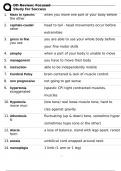
1. Mass to specific when you move one part of your body before
the other
2. cephalo-caudel head to tail - head movements occur before
other
extremities
3. gross to fine you are able to use your whole body before
you use
your fine motor skills
4. atrophy when a part of your body is unable to move
5. management you have to move their body
6. instruction able to be independently mobile
7. Cerebral Palsy brain centered & lack of muscle control
8. non progressive not going to get worse
9. hypertonia (spastic CP) tight contracted muscles,
exaggerated
muscles
10. Hypotonia (low tone) real loose muscle tone, hard to
move mus-
cles against gravity
11. Athentosis fluctuating (up & down) tone, sometime hyper
&
sometimes hypo (one or the other)
12. Atacia a lose of balance. stand with legs apart, rarest
form
13. anoxia umbilical cord wrapped around neck
14. monoplegia 1 limb (1 arm or 1 leg)
1/
3
Study for Success
1. Mass to specific when you move one part of your body before
the other
2. cephalo-caudel head to tail - head movements occur before
other
extremities
3. gross to fine you are able to use your whole body before
you use
your fine motor skills
4. atrophy when a part of your body is unable to move
5. management you have to move their body
6. instruction able to be independently mobile
7. Cerebral Palsy brain centered & lack of muscle control
8. non progressive not going to get worse
9. hypertonia (spastic CP) tight contracted muscles,
exaggerated
muscles
10. Hypotonia (low tone) real loose muscle tone, hard to
move mus-
cles against gravity
11. Athentosis fluctuating (up & down) tone, sometime hyper
&
sometimes hypo (one or the other)
12. Atacia a lose of balance. stand with legs apart, rarest
form
13. anoxia umbilical cord wrapped around neck
14. monoplegia 1 limb (1 arm or 1 leg)
1/
3


